The Ancient Indians Called It Rta — And It Predates Every Religion
In the previous blog, we described the universe’s origin — the cosmic sacrifice of the Purusha, the moment when consciousness chose to become a cosmos. But a cosmos is not merely a collection of things. It is an ordered collection. A universe that runs.
Something had to make it run. Something had to ensure that the sun, having risen on the first morning of existence, would rise again on the second. That the rains would follow the heat. That a seed pressed into dark earth would push upward toward light rather than downward into darkness. That cause would reliably follow effect. That the universe, in short, would not dissolve back into chaos the moment it came into being.
The ancient Indians had a name for this something. They called it Rta.
Rta is not a concept you learn and then move on from. It is the ground you have been standing on your entire life — you simply did not know its name.
This blog is about that name — Rta in the Vedas. About what it means, what it governs, and why understanding it will permanently change what you see when you stand inside a Hindu temple and watch a priest perform a ritual that has been performed, in essentially the same form, every single morning for over a thousand years.
I. The Morning That Never Fails
There is a river in South India called the Cauvery.
It rises in the Brahmagiri hills of the Western Ghats — in the state now called Karnataka — and travels southeast for 802 kilometres before emptying into the Bay of Bengal. Along its banks, particularly in the broad, flat delta region of Tamil Nadu, there are more ancient Hindu temples per square kilometre than almost anywhere else on earth. Temples that have stood for a thousand years, some for two thousand. Temples that were old when the Norman Conquest of England was still in the future.
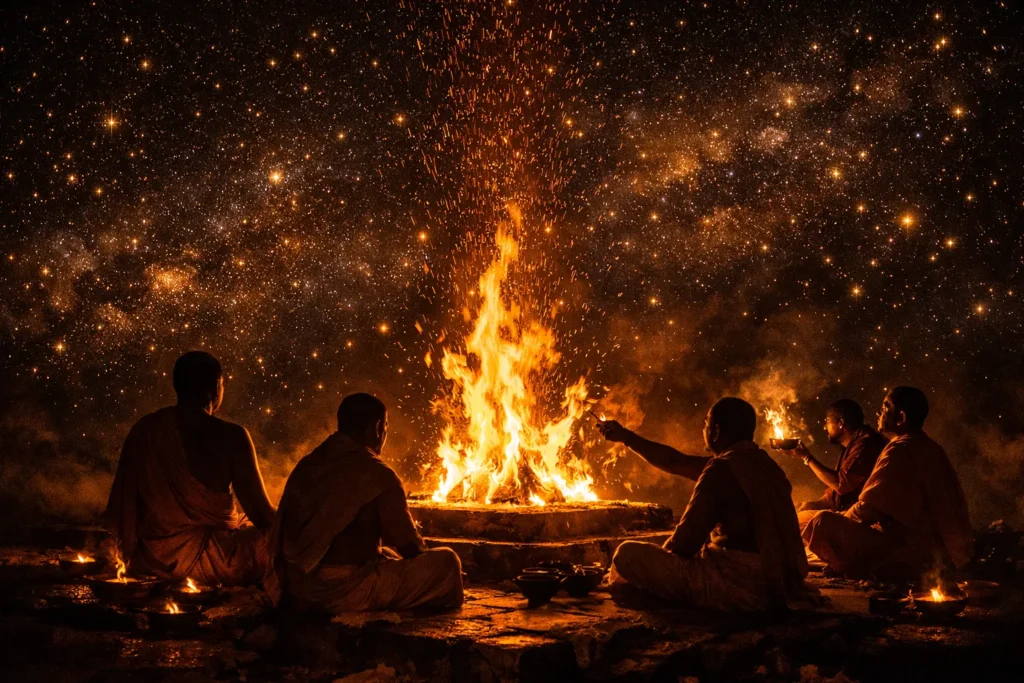
Every morning, at every one of these temples, before the first devotee arrives, before the town has properly woken, a priest enters the inner sanctum in the dark. He lights a lamp. He chants. He bathes the presiding deity with milk, with water, with honey and sandalwood paste. He offers flowers. He waves a flame. He prostrates.
He has done this every morning of his adult life. His father did it before him. His grandfather before that. The chain of mornings reaches back — unbroken, daily, without exception for festival or famine or flood — for generations beyond counting.
Outside, the river continues its journey to the sea. The sun continues its arc across the sky. The monsoon comes when it comes and goes when it goes. The paddy fields green and gold with the seasons. The farmers plant and harvest in their ancient rhythms.
All of this — the river, the sun, the priest, the rain, the seed — is held together by the same principle. The ancient Indians perceived this principle with extraordinary clarity and named it with characteristic precision.
They called it Rta.
II. What Rta Actually Is
The difficulty with Rta is not that it is complicated. The difficulty is that it is so fundamental — so prior to any particular way of carving up reality — that no single English word can hold it. Every translation loses something essential.
Scholars have translated Rta as cosmic order, natural law, truth, righteousness, and the right. All of these are accurate. None of them is sufficient. Because Rta is not any one of these things. It is all of them simultaneously — and the fact that we need different words for them in English is itself a symptom of the fragmentation of understanding that Rta, by its nature, refuses.
Let us approach it from three directions at once.
💡 Key Concept: Rta as Physical Law
The regularities of nature — the patterns that make the universe predictable. The sun rises. The seasons turn. The river flows downhill. Water freezes at a consistent temperature. Cause reliably produces effect. In our vocabulary, these are the laws of physics — and they are Rta. The Vedic understanding did not separate these natural regularities from moral or metaphysical principles. The same word covers all three dimensions because, in the Vedic understanding, they are all expressions of the same underlying reality
💡 Key Concept: Rta as Moral Law
The standard of right conduct in human life — the cosmic measure against which human actions are evaluated. To speak truly is to align with Rta. To fulfil a promise is to align with Rta. To act with justice and fairness is to align with Rta. To lie, to break faith, to act unjustly — these are violations of Rta, and they create disorder not merely in the social world but in the cosmic order itself. The Vedic tradition does not separate ethics from physics: both are expressions of the same underlying principle of right order.
💡 Key Concept: Rta as Metaphysical Principle
The expression of Brahman — the Absolute — in the manifest world. If Brahman is the ocean, Rta is the law that governs how waves move. It is the way in which the infinite makes itself knowable through pattern, regularity, and order. To perceive Rta clearly — in the movement of the stars, in the sequence of the seasons, in the consequences of one’s own actions — is to perceive Brahman at work in the world. The temple ritual is, at its deepest level, a deliberate act of alignment with Rta — a human being consciously participating in the cosmic order rather than merely being swept along by it.
The word itself comes from the Sanskrit root r — to move, to flow. Rta is that which flows rightly, that which moves in its proper course. A river in its channel is Rta. The sun in its orbit is Rta. A human life lived with integrity, in fulfilment of its duties and relationships, is Rta. A priest performing the morning ritual at the correct hour, in the correct manner, with the correct intention — is Rta.
III. Varuna — The God Who Sees Everything
Imagine being watched.
Not by a human observer who can be deceived, distracted, or bribed. Not by a CCTV camera with blind spots and corrupted footage. But by an awareness so total, so penetrating, so patient that it perceives not merely your actions but the intentions behind them — the thoughts you have not yet fully formed, the calculations you make before you make them, the private rationalizations you deploy when you are about to do something you know you should not.
He is one of the oldest and most majestic deities in the Rigveda — and one of the most misunderstood, because later tradition reduced him to a minor god of water and oceans, stripping him of the cosmic grandeur he possessed in the earliest hymns. In the Rigveda, Varuna is the guardian of Rta — the all-seeing sovereign of the cosmic order who holds every being, human and divine, to the standards of right conduct.
Veda maaso dhritavrato dvadasha prajavatah Veda ya upajayate
“He knows the twelve months with their progeny, and he knows the one that is born thereafter.” Rigveda 1.25.8 — Varuna’s omniscience extends to the cosmic calendar itself: he knows the twelve months, the seasons, and even what comes after the cycle ends and begins again. This is not merely meteorological knowledge — it is the knowledge of Rta, the cosmic order that governs all of time.
What makes Varuna philosophically extraordinary — and what explains why his Rigvedic portrait feels more like a description of cosmic law than of a conventional deity — is the nature of his omniscience. He does not merely know what you have done. He knows what you were thinking when you did it. He knows the truth of things not as they appear but as they are.
The Rigveda describes him with an image of haunting beauty: he has spread his net across the sky, and every action of every being is caught in its meshes. Not to punish — though Varuna can and does hold beings accountable for violations of Rta — but to know. To perceive. To hold the universe in awareness.
📜 From the Rigveda
वि यस्य ते पृथिवीं सूर्यो न रश्मिभिस्ततान । आ यस्य ते मनो जगाम दूरम् ।।
Vi yasya te prithivim suryo na rashmibhistatana Aa yasya te mano jagama duram
“He has spread his net across the earth as the sun spreads its rays. He reaches to where your very mind has gone far away.” Rigveda 7.87.3 — The extraordinary final line — ‘He reaches to where your very mind has gone far away’ — describes an omniscience that is not external surveillance but interior presence. Varuna knows the secret places of the mind, the unspoken thought, the intention before it becomes action. He is simultaneously the external law and the internal witness.
But Varuna is not merely a cosmic policeman. What makes him one of the most moving figures in the entire Rigveda is his capacity for mercy. Several of the most personal and emotionally powerful hymns in the Rigveda are addressed to Varuna by human beings who have transgressed Rta — who have lied, broken faith, acted unjustly — and who approach him not with bribes or rituals but with honest confession and genuine remorse. And Varuna forgives them.
📜 From the Rigveda
यत्किंचेदं वरुण दैव्ये जने अभिद्रोहं मनुष्याश्चरामसि । अचित्ती यत्तव धर्मा युयोपिम मा नस्तस्माद् अनसो देव रीरिषः ।।
Yat kinchid idam Varuna daivye jane abhidrohum manushyash charaamasi Achitti yat tava dharma yuyopima maa nas tasmad anaso deva ririshaha
“Whatever offence we have committed against the divine order, O Varuna — whatever transgression among men — if through ignorance we have violated your laws, do not destroy us for that sin, O God.” Rigveda 7.89.5 — This is one of the most moving confessional prayers in ancient literature. Note the phrase ‘through ignorance’ — the Vedic tradition recognises that many violations of Rta are committed not from malice but from unawareness. The prayer is not for escape from consequences but for forgiveness and continued relationship with the cosmic order.
There is a reason this hymn moves people across cultural and religious boundaries when they encounter it. The experience it describes — the recognition of one’s own failures, the fear of cosmic consequence, the appeal to a mercy that exists beyond justice — is as universal as human nature itself. Varuna is not a god in the sense of a supernatural being with arbitrary powers. He is the personification of a truth that every thoughtful person encounters sooner or later: that the universe keeps accounts, and that the only adequate response to that fact is honesty.
IV. Living Rta — The Ancient Indian Way
It is easy to read about Rta as an abstract philosophical concept.
It is another thing entirely to understand how it shaped the daily life of the people who first articulated it — how a civilisation organised itself around the conviction that the universe was a moral order, not merely a physical one, and that human wellbeing depended on alignment with that order.
The Vedic civilisation that produced the Rigveda was not a society of professional philosophers debating metaphysics in lecture halls. It was a pastoral and agricultural society — cattle-herding, river-farming, monsoon-dependent — in which the stakes of cosmic alignment were extremely concrete. When the rains came, the cattle were fat, the crops were good, and people ate. When the rains failed, they did not.
The Vedic fire sacrifice — the yajna — was, among other things, a technology of alignment with Rta. By performing the ritual correctly, at the correct times, with the correct materials and the correct mantras, the sacrificer was understood to be actively participating in the maintenance of cosmic order. The rains did not fall because they randomly fell. They fell because the cosmic order was maintained — and the cosmic order was maintained, in part, because human beings performed their proper role within it.
This may sound primitive to modern ears. But consider: the Vedic understanding that human action has cosmic consequences — that how we live affects not only ourselves but the world we inhabit — is not far from what climate science is telling us right now. The ancient Indians were wrong about the mechanism. They were not wrong about the principle.
In Vedic society, Rta expressed itself in a set of sacred duties and obligations that governed every dimension of life. The householder owed obligations to the gods (through ritual), to the ancestors (through offerings and progeny), to human guests (through hospitality), to all living beings (through non-harming), and to the Rishis (through study of the Vedas). To fulfil these obligations was to live in Rta. To neglect them was to drift into Anrta — the cosmic disorder that brought suffering in its wake.
The Vedic world was not one in which God watched and judged. It was one in which the universe itself was the standard — and alignment with it was both the path to flourishing and the definition of virtue.
V. The Chain — How Rta Became Dharma Became Karma
Over the centuries that separated the composition of the Rigveda from the great philosophical flowering of the Upanishads, the concept of Rta underwent a remarkable evolution — deepening, differentiating, and ultimately giving birth to three of the most important concepts in all of Hindu thought.
The chain runs like this:
Rta → Dharma → Karma → Samsara → Moksha
Each link in this chain is a development of the one before it — a more precise, more personally applicable articulation of the same fundamental insight that the universe is a moral order and that human wellbeing depends on alignment with it.
From Rta to Dharma: Rta is cosmic order at the universal scale. Dharma is Rta translated into human terms — the principle of right order as it applies to individual human lives, relationships, and communities. Where Rta governs the movement of the stars and the flow of rivers, Dharma governs how a parent should treat a child, how a ruler should treat a subject, how a guest should be received. Dharma is more socially differentiated than Rta — different beings have different Dharmas depending on their nature, their role, and their stage of life — but it draws its authority from the same cosmic ground.
From Dharma to Karma: Karma is the mechanism by which Dharma operates at the individual level. If Dharma is the law, Karma is the enforcement — not by an external judge but by the nature of things themselves. Every intentional action creates a consequence — a samskara, an impression — that shapes future experience. Actions aligned with Dharma create harmonious consequences. Actions opposed to Dharma create discord. The consequences may not be immediate — Karma operates across lifetimes in the Vedic understanding — but they are inexorable. The universe keeps accounts.
From Karma to Samsara: The accumulation of Karma across lifetimes creates the condition called Samsara — the cycle of birth, death, and rebirth. The individual soul takes successive births, shaped by the Karma it has accumulated, until the accumulated Karma is exhausted and the soul recognises its true nature as Atman — pure consciousness, identical to Brahman. This recognition is liberation — Moksha — the point at which the individual soul steps out of the cycle of Samsara and returns, consciously, to the ground from which it never actually departed.
The entire structure — Rta, Dharma, Karma, Samsara, Moksha — is a single coherent vision of the universe as a moral order that is simultaneously a spiritual curriculum. The universe is arranged in such a way that, given enough time and enough experience, every soul eventually learns what it needs to learn to be free. The temples on The Sacred Trails are stations on this journey — places where the curriculum is concentrated, where the cosmic order is made visible in stone and ritual, where a human being can step deliberately into alignment with Rta and feel, perhaps for the first time, what it means to be exactly where one is supposed to be.
VI. Rta in the Vedas— The Temple Ritual as Cosmic Alignment
Back to the Cauvery delta. Back to the temple in the early morning dark.
The priest has been awake since before sunrise. He has bathed in cold water — not for hygiene but for purification, the ritual cleansing that marks the transition from ordinary waking consciousness to the heightened, consecrated state required for temple service. He has performed his personal morning prayers. He has dressed in the prescribed manner. And now he enters the inner sanctum.
To the casual observer, what follows looks like a sequence of domestic actions performed for a stone image: bathing, dressing, feeding, fanning. But this reading misses the entire point — in the same way that watching a conductor wave a baton misses the point if you cannot hear the music.
Every element of the morning puja is an act of Rta. The timing is Rta — the Agamas prescribe exactly when each of the daily worship sessions must be performed, aligned with the movements of the sun and the sacred calendar. The sequence is Rta — the sixteen steps of the Shodashopachara puja follow the precise order prescribed for the reception of a divine guest, which is itself a reflection of the cosmic order of hospitality.
The materials are Rta — each substance offered (milk, honey, sandalpaste, flowers) has a specific cosmic correspondence and a specific effect on the subtle atmosphere of the temple. Even the posture of the priest — the angle of his body, the position of his hands, the direction he faces — is Rta, prescribed in precise detail by the Agamic tradition.
The priest does not perform these actions because someone is watching and will punish him if he gets them wrong. He performs them because they are the correct actions — aligned with the cosmic order, consonant with the nature of the deity being served, harmonious with the subtle energies of the time and place. He performs them because they are Dharma — his particular, irreplaceable Dharma as the hereditary priest of this specific temple, serving this specific deity, in this specific sacred space.
And outside, as he performs these actions, the sun continues its arc. The river continues its flow. The roosters of the temple town begin their morning announcements. The world assembles itself, as it has every morning, into its proper order.
This is not coincidence. In the Vedic understanding, it is not coincidence. The morning ritual is part of the cosmic mechanism — a human node in a vast network of order that extends from the movement of galaxies to the offerings on a small stone altar in a temple on the banks of a river in South India. The priest is not performing a private devotional act. He is performing a cosmic service. He is doing his part — his precise, non-substitutable, irreplaceable part — in keeping the universe running.
Every act of Dharma is a vote for the universe. Every ritual correctly performed is a thread in the fabric of Rta. Every temple, functioning as it was designed to function, is a generator of cosmic order.
VII. Why This Matters Now
We live in a time that has largely lost the concept of Rta — not the reality of it, which cannot be lost, but the conscious recognition of it.
We have natural law without moral law — we know with extraordinary precision how the physical universe behaves, but we have severed this knowledge from any framework of ethical implication. The universe, in the dominant modern understanding, has no opinion about how we treat each other, how we treat the earth, or what kind of beings we choose to become. Physics describes. It does not prescribe.
The Vedic tradition would find this severance not merely philosophically unsatisfying but practically dangerous. A universe that has no moral dimension is a universe that offers no guidance, no consequence, no framework for the kind of wisdom that human beings need to live well together. A civilisation that operates as though only physical laws exist and moral laws are merely conventions is, in the Vedic understanding, a civilisation in Anrta — in cosmic misalignment — whatever its technological achievements.
This is not an argument for theocracy or for the imposition of any particular religious tradition’s moral code on anyone. It is an argument for the recognition that the universe — whatever its ultimate nature — appears to be organised in ways that reward certain ways of living and punish others, not arbitrarily but systematically. That justice, truth, care for the vulnerable, respect for the natural world, and the fulfilment of genuine obligations are not merely nice ideas but expressions of something real — something that the ancient Indians, with their characteristic combination of philosophical rigour and devotional warmth, called Rta.
When you stand in a South Indian temple and watch a priest perform a morning ritual, you are watching a human being consciously participating in that something. He may not be able to articulate it in these terms. He may not think of it as cosmic alignment or as the expression of Brahman in the manifest world. He may simply think of it as what he does — as his Dharma, his duty, the thing he was born to do. But the ancient insight embedded in what he does is there nonetheless, encoded in the timing of the ritual, in the sequence of the offerings, in the direction he faces and the mantras he chants.
Rta has not gone anywhere. It was there before the first temple was built. It will be there after the last one crumbles. It is the principle by which the universe sustains itself — the operating system beneath every operating system, the law beneath every law, the order that makes any order possible.
The ancient Indians simply had the wisdom to notice it. And the devotion to align their entire civilisation — their rituals, their ethics, their architecture, their poetry, their understanding of time — with what they had noticed.
That is what we are tracing, on The Sacred Trails. Not the ruins of a dead civilisation. But the living expression of a perception that is as true today as it was three thousand five hundred years ago on the banks of the Cauvery, in the dark before dawn, when the first priest lit the first lamp and the first river continued its ancient, faithful, Rta-keeping flow toward the sea.
The river does not ask why it flows. The priest does not ask why he serves. The sun does not ask why it rises. Rta is the answer they are all living.
VIII. Closing — The Bridge to What Comes Next
We have now established the two foundational pillars of the Vedic worldview: the nature of consciousness (Purusha / Brahman — explored in the previous blog) and the nature of order (Rta / Dharma — explored here). Everything that follows in this series rests on these two pillars.
In the next blog, we will explore the third foundational element: the Vedas themselves — not merely as texts, but as the universe’s own self-disclosure, and how their structure, their transmission, and their content shaped everything that followed. We will ask: what exactly are the Vedas? How were they organised? What do they contain? And how did they give rise to the extraordinary philosophical tradition that eventually produced the temples we are here to explore?
After that, we will meet the great philosophers — Shankara, Ramanuja, Madhva — who took the Vedic foundation and built upon it the sophisticated intellectual structures that still govern how Hindus understand the relationship between the individual self, the cosmos, and the divine.
And then — through the saints, through the hymns, through the sacred geography of the Cauvery delta and beyond — we will arrive, finally, at the entrance of the first temple. Prepared. Understanding what we are about to enter. Ready, at last, to truly see.
Next in the Sacred Foundations Series:
The Vedas — How the Universe Wrote Its Own Source Code. We explore the structure, transmission, and extraordinary content of the four Vedas, and how they gave rise to the entire tradition of Hindu temple worship.
Coming soon on thesacredtrails.com 🙏
2 thoughts on “Rta in the Vedas — The Cosmic Operating System – Blog 2”


Great job, this is a high-quality article. The site itself is incredibly practical and
helpful.
Excellent Article. Synchronisation of our Veda with modern science has been well articulated