
4,000 Hymns. 12 Saints. One Language. How Tamil Became the Voice of God — and How the Azhwars Shaped the Devotional World of the 108 Divya Desams.
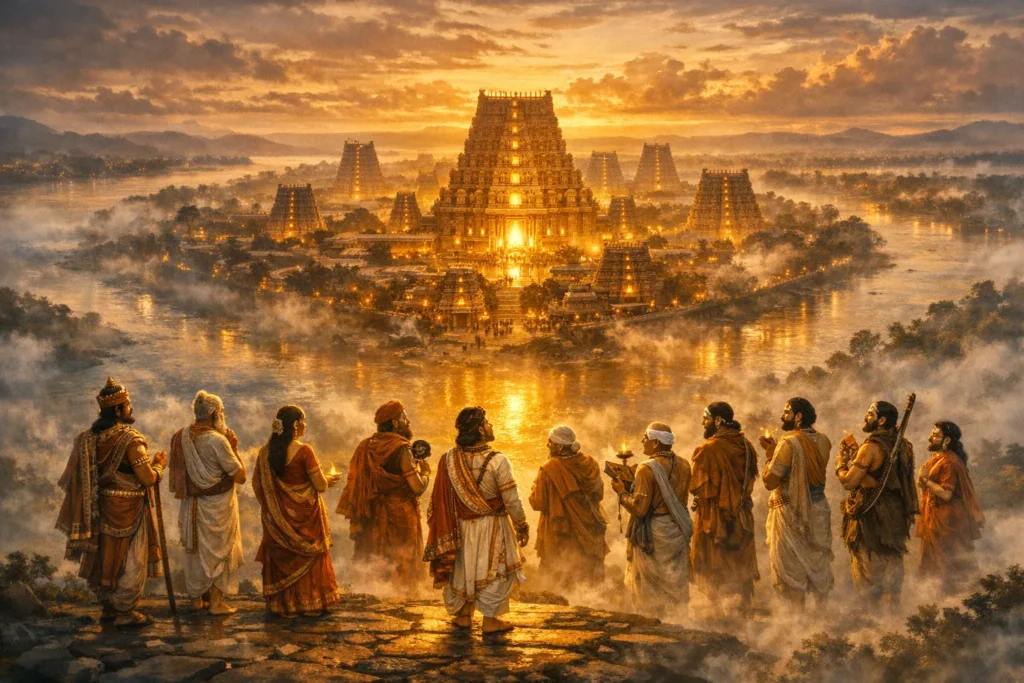
There is a temple in Srirangam — on a river island in the Cauvery, in the heart of Tamil Nadu — that is, by area, one of the largest functioning temple complexes in the world. Its outermost wall encloses an entire town. It has twenty-one gopurams. It has been receiving daily worship — without interruption — for over two thousand years.
At the heart of this extraordinary structure, in the innermost sanctum, Vishnu reclines. Not standing, not seated — reclining, in the posture of cosmic rest, on the great serpent Adishesha, dreaming the universe into existence. His name here is Ranganatha — the Lord of the Sacred Stage.
And every morning, before the outer gates open, before the first pilgrim arrives, before the town within the temple walls has properly woken — the priests of Srirangam sing. Not Sanskrit hymns. Tamil hymns. Specifically, the hymns of the Azhwars — the twelve Vaishnava poet-saints who composed the Divya Prabandham between the 6th and 9th centuries CE.
They have been singing these hymns every morning at Srirangam for over a thousand years.
This is the world the Azhwars created. And understanding it — understanding who they were, what they felt, what they sang, and why their songs became the permanent devotional voice of 108 temples across South India — is the essential preparation for everything that follows on The Sacred Trails.
In Blog 6 and Blog 7, we met the Nayanmars — the sixty-three Shaiva saints whose Tirumurai hymns transformed the Shaiva temple tradition. Now we cross to the Vaishnava world — and find there, running parallel to everything we have already explored, an equally extraordinary devotional revolution, an equally diverse community of saints, and an equally enduring legacy of song.
I. The Parallel World — Vaishnavism and the Azhwars
The bhakti revolution that swept through Tamil Nadu between the 6th and 10th centuries CE was not a Shaiva phenomenon alone.
Simultaneously — or nearly so, with some overlap in both period and geography — an identical transformation was occurring in the Vaishnava world. The same impulse that drove the Nayanmars to walk from temple to temple singing their hearts out to Shiva was driving a different group of saints to walk from temple to temple singing their hearts out to Vishnu.
These were the Azhwars. The word means those who are immersed — specifically, those who are immersed in the love of God. Immersed as in drowning. Immersed as in unable to surface. Immersed as in having found the depth and having no desire to return to the shallows.
There were twelve of them. Like the Nayanmars, they came from every social background imaginable. Like the Nayanmars, they walked — pilgrimaging from temple to temple across South India, composing hymns at each stopping place. Like the Nayanmars, they composed in Tamil — the language of the people, the language of the soil, the language that could carry the full weight of devotional love without the mediation of Sanskrit learning.
And like the Nayanmars, what they created was not merely literature. It was a sacred geography — a map of divine presence, encoded in verse, that permanently altered the spiritual landscape of South India.
But the Azhwars are not simply the Vaishnava version of the Nayanmars. Their tradition has its own distinctive character — its own theological emphasis, its own emotional register, its own way of understanding the relationship between the human soul and the divine. To understand the difference is to understand something important about the two great streams of South Indian devotion that together create the complete picture of the tradition we are here to explore.
II. The Theology of the Azhwars — Love as the Path
The Nayanmars’ relationship with Shiva is characterised by a particular quality: intensity.
The ecstasy of Sambandar, the gratitude of Appar, the argument of Sundarar, the surrender of Manickavasagar, the absolute sacrifice of Kannappa — these are all forms of intensity. The Shaiva bhakti tradition is a tradition of fire: burning, consuming, transforming.
The Azhwars’ relationship with Vishnu has a different quality — though no less intense. It is characterised by longing. By the ache of separation and the overwhelming joy of reunion. By the specifically relational quality of love between the soul and a personal God who is understood not merely as the infinite but as the beloved — present, accessible, responding.
This reflects the Vaishnava theological framework we encountered in Blog 4 — Ramanuja’s Vishishtadvaita — in which the individual soul and God are genuinely distinct beings in a genuine relationship. The soul is not Brahman (as in Shankara’s Advaita). The soul is a part of Brahman’s body — real, individual, eternally related to God as a beloved is related to the one who loves them.
This theological distinction has devotional consequences. In the Azhwar tradition, the soul’s relationship to Vishnu is frequently expressed through the imagery of romantic love — specifically the love of a woman for her beloved. The soul is feminine; God is the beloved. This is not metaphor decorating theology — it is the most precise available language for the specific quality of the Azhwars’ experience: a love that longs, that seeks, that is sometimes united and sometimes separated, that cannot rest until the reunion is complete.
💡 Key Concept: Bridal Mysticism in the Azhwar Tradition
The use of romantic and bridal imagery for the soul’s relationship with God — the soul as bride, God as the eternal beloved — is one of the most distinctive features of Azhwar devotion.
It appears in many world mystical traditions (the Song of Solomon in the Hebrew Bible, the poetry of Rumi in the Sufi tradition, the mysticism of St. Teresa of Avila in the Christian tradition) — but in the Azhwar tradition it is not a metaphor adopted for literary effect. It is the most theologically precise available language for the specific quality of Vishishtadvaita devotion: the soul and God are genuinely distinct, genuinely related, genuinely in love.
The most famous expression of this bridal mysticism is Andal — whom we will meet in full in Blog 9.
III. The Twelve — Who Were the Azhwars?
The Azhwars span approximately three centuries — from the 6th to the 9th century CE — and their twelve lives represent, like the Nayanmars, a deliberate cross-section of humanity.
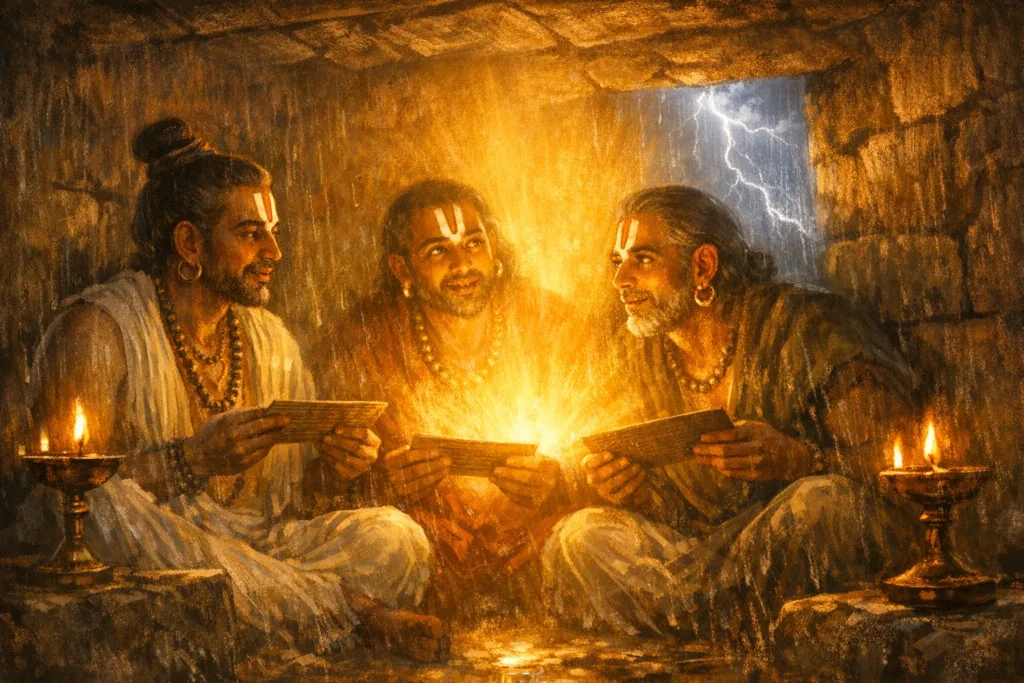
Poigai Azhwar, Bhuthathu Azhwar, and Peyazhwar — the first three Azhwars — are associated with a single legendary meeting. Tradition holds that they met by divine arrangement in a small shelter during a rainstorm: one arrived first and said the space was enough for one; the second arrived and said it was enough for two if they squeezed; the third arrived and said it was enough for three if they were willing to be pressed together.
And then, in the darkness of the crowded shelter, they each independently perceived the divine presence — Vishnu himself, invisibly present in the compressed space — and composed, on the spot, three hymns that became the opening of the Divya Prabandham.
Thirumazhisai Azhwar — a saint of extraordinary longevity (tradition credits him with several hundred years of life) who is said to have explored every philosophical and religious tradition available in his era before arriving, through direct experience, at Vaishnavism.
Nammazhwar — “Our own Azhwar” — the greatest of the twelve, whose Thiruvaimozhi (the Sacred Utterance) alone comprises 1,102 of the Divya Prabandham’s 4,000 verses and is considered the Tamil Veda — the complete distillation of the Upanishadic wisdom in the Tamil language and the devotional register. We will meet him fully in Blog 9.
Madhurakavi Azhwar — unique among the twelve for composing hymns not to Vishnu but to Nammazhwar himself. His eleven verses in praise of his guru are the tradition’s most direct expression of the principle that the saint’s love for God is itself divine — that to love the one who loves God is to love God.
Kulasekara Azhwar — a king who abandoned his throne for the life of a devotee — his royal background giving his hymns a particular quality of knowing surrender: the man who had everything choosing the one thing that everything could not provide.
Periyazhwar — “The Great Azhwar” — whose hymns focus particularly on the childhood of Krishna, describing the divine child with a tenderness and a domestic intimacy that make them unique in the devotional literature of any tradition. His relationship to Vishnu is parental — the love of a parent for a child — adding yet another emotional register to the already vast emotional range of the Azhwar tradition.
Andal — the daughter of Periyazhwar. The only woman among the twelve Azhwars. And, in the tradition’s understanding, the most perfectly surrendered of all — whose bridal mysticism, whose absolute refusal to be separated from her God, and whose ultimate translation into the divine presence make her story the most extraordinary in the entire Azhwar canon.
Thondaradipodi Azhwar — whose name means “the dust of the feet of the devotees of the Lord” — chose the most self-effacing identity imaginable: not a devotee of Vishnu but the dust beneath the feet of Vishnu’s devotees. Born into a Brahmin family in Thirumandangudi, he is said to have been briefly distracted from his devotion by worldly attachments — before Vishnu himself intervened, restoring him to his path.
He composed two works: the Thirumaalai — a deeply personal hymn of surrender that is among the most direct confessions of human weakness and divine grace in the Divya Prabandham — and the Thiruppalliyezhuchi, a dawn hymn gently waking Vishnu from his cosmic sleep at Srirangam. His particular theological emphasis is on the accessibility of divine grace to the unworthy — the tradition’s assurance that God’s love does not require the devotee to be perfect, only sincere.
Thiruppaan Azhwar — born into a community of musicians considered outside the caste hierarchy. He never entered a temple — not from lack of devotion but from a profound sense of unworthiness that the tradition understands as itself a form of perfect devotion.
He composed a single hymn of ten verses — the Amalanadhipiran — that is considered the distilled essence of Vaishnava devotion: ten verses that move from the feet of Vishnu to his crown, describing each aspect of the divine form with a sensory precision and an emotional intensity that has never been surpassed. He entered the Srirangam temple — tradition says — carried on the shoulders of a Brahmin priest, at Vishnu’s own command.
Thirumangai Azhwar — the last of the twelve chronologically, a former chieftain and highwayman who converted to Vaishnavism and composed the most voluminous body of hymns after Nammazhwar. His hymns have a vigour and a directness that reflect his background — a man who had lived fully in the world and brought that full-worldliness into his devotion.
📜 From the Divya Prabandham — Nammazhwar
யாயும் ஞாயும் யாரா கியரோ எந்தையும் நீயும் எம்முறைக் கேளிரோ செய்த நல்லதும் தீதும் அறியேன் தெய்வமே உன்னை விட்டு ஒழியேன்
Yaayum nyaayum yaara kiyaro Enthaiyum neeyum emurai keliro Seytha nallathum theethum ariyyen Theivame unnai vittu ozhiyen
“What are my mother and my father to me? What are friends and relations? I know neither the good I have done nor the evil. O God — I will not leave you.” Thiruvaimozhi, Nammazhwar — This verse captures the essential quality of Azhwar devotion in four lines: the complete dissolution of every other attachment in the overwhelming reality of the divine relationship. Not renunciation through discipline — dissolution through love. The soul has found what it was looking for and simply cannot leave.
IV. Azhwars and The Divya Prabandham — 4,000 Verses, One Sacred Geography
The 4,000 verses of the Divya Prabandham are not a random collection.
They are organised — both internally and geographically — with a precision that reflects the Azhwar tradition’s understanding of what they are doing. Each hymn is addressed to Vishnu as he is present at a specific temple. Each temple at which a hymn was composed becomes, by that act of composition, a Divya Desam — a divine abode, a place of special divine presence.
There are 108 Divya Desams. The number 108 is not arbitrary — it is one of the most sacred numbers in the Hindu tradition, appearing in multiple contexts (108 beads on a mala, 108 Upanishads, 108 names of the principal deities). The Azhwars’ sanctification of exactly 108 temples is understood as the completion of a sacred number — the divine geography of the Vaishnava world, mapped in verse, complete and perfect.
The geographical spread of the Divya Desams is remarkable:
| Region | Desams | Notes |
| Tamil Nadu | 84 | Concentrated in Cauvery delta and coastal regions |
| Kerala | 13 | Including the extraordinary Thiruvananthapuram |
| Andhra Pradesh | 2 | Including Tirupati — the most visited pilgrimage site in the world |
| North India | 8 | Including Mathura, Vrindavan, Ayodhya, Badrinath |
| Celestial | 1 | Thiruparkadal — the cosmic ocean where Vishnu reclines on Adishesha |
This last entry is significant: one of the 108 Divya Desams is not a physical location at all. It is the cosmic ocean — the primordial waters on which Vishnu reclines before creation. The Azhwars are saying something specific by including it: the sacred geography they are mapping is not merely a geography of earthly places. It is a geography of divine presence — and divine presence is not limited to the terrestrial.
💡 Key Concept: The Divya Desam Experience
Visiting a Divya Desam is understood by the Vaishnava tradition as qualitatively different from visiting any other sacred site. The difference is not merely historical — that a great saint once visited and composed a hymn here. The difference is present and ongoing: the Azhwar’s hymn encodes their direct perception of Vishnu’s specific presence at this specific location, and when that hymn is sung in the temple — as it has been sung every morning for over a thousand years — the perception is renewed and the presence is confirmed.
You are not entering a memorial. You are entering a living field of divine attention, recognised by a perfected soul and maintained by an unbroken chain of devotional singing.
The Divya Prabandham was, like the Tevaram, at risk of being lost. The tradition records that the hymns had fallen into neglect — their texts partially forgotten, their melodies no longer reliably transmitted — until the great Vaishnava teacher Nathamuni (9th–10th century CE) undertook a remarkable recovery effort.
Meditating intensely at the temple of Nammazhwar in Alwar Tirunagari, Nathamuni received the complete 4,000 verses by divine revelation — and then spent years travelling across South India to recover the melodies, organising the texts into the four collections we have today, and establishing the system of daily recitation in Vaishnava temples that has continued ever since.
This recovery — the Divya Prabandham received anew through meditation, reconstructed through pilgrimage, and established in daily practice — is itself a story that reflects the tradition’s deepest understanding of how sacred knowledge is transmitted: not primarily through manuscripts or institutions but through the living, dedicated, personally invested attention of human beings who love what they are preserving.
V. The Divya Prabandham in the Temple — The Living Voice
Every morning in every Divya Desam temple, the Divya Prabandham is sung.
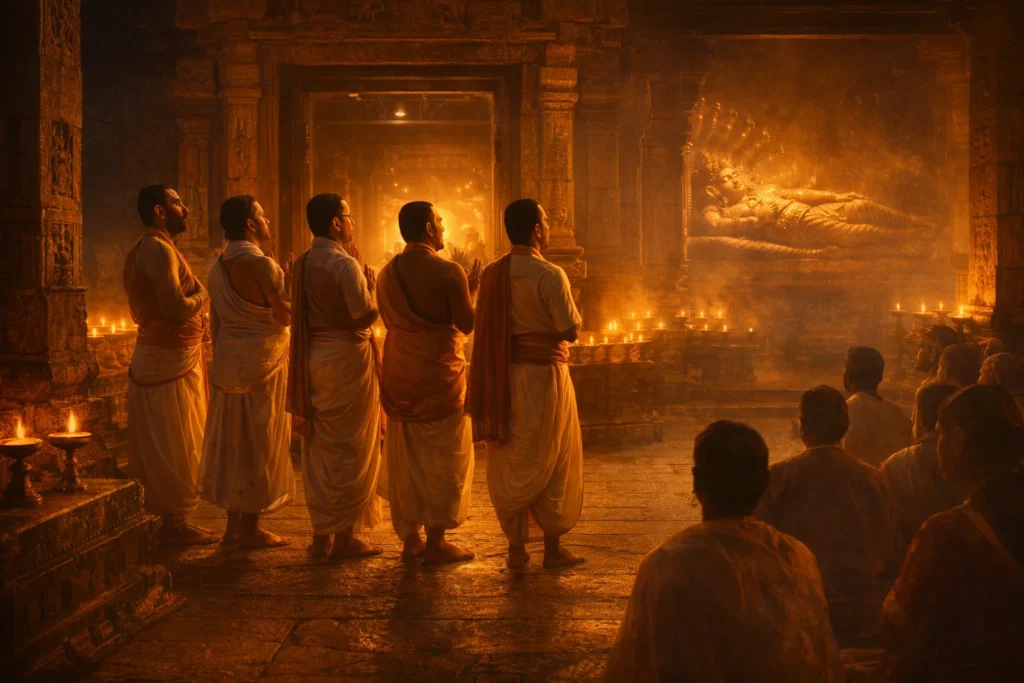
Not recited. Sung — in the specific melodic frameworks that Nathamuni recovered and that have been transmitted, teacher to student, for over a thousand years. The singing of the Divya Prabandham in a Vaishnava temple is not a preliminary to the worship. It is the worship — or rather, it is inseparable from the worship, woven into the ritual sequence at specific moments, addressing the deity in the specific emotional register of the specific Azhwar whose hymn is being sung.
This creates a remarkable quality in a Vaishnava temple that the sensitive visitor invariably notices: the worship feels personal. The priest is not performing a ritual for a general divine presence — he is addressing a specific deity at a specific location, in the words of a specific saint who stood in this very place centuries ago and felt the specific quality of the divine presence here. The Divya Prabandham gives the ritual its individuality — its sense that this temple, this deity, this presence is unlike any other.
The most important single moment in the Vaishnava liturgical year — the Adhyayanotsavam festival at Srirangam — centres entirely on the recitation of the complete Divya Prabandham. Over twenty days in the Tamil month of Margazhi (December-January), the entire 4,000 verses are sung in the presence of Ranganatha. The festival has been observed, tradition says, since the time of Nathamuni — over a thousand years of continuous annual recitation.
Standing in Srirangam during Adhyayanotsavam — surrounded by thousands of devotees, hearing the 4,000 verses of the Divya Prabandham fill the great colonnaded halls of the world’s largest functioning temple — is one of the most extraordinary devotional experiences available anywhere on earth. The Sacred Trails will, in time, guide you there.
VI. Nayanmars and Azhwars — Two Streams, One River
It is tempting to see the Nayanmar and Azhwar traditions as competitors — Shaiva versus Vaishnava, Tirumurai versus Divya Prabandham, Shiva versus Vishnu.
The tradition itself resists this reading — and so does The Sacred Trails.
The two traditions are better understood as two streams of the same river: the great bhakti revolution that swept through Tamil Nadu between the 6th and 10th centuries CE, transforming the temple tradition from a preserve of the learned into a living reality accessible to all.

Both traditions composed in Tamil. Both traditions walked. Both traditions sanctified specific temples through specific hymns composed at those specific locations. Both traditions democratised devotion — making the divine accessible to the hunter and the king, the woman and the untouchable, the scholar and the farmer, with equal completeness.
And both traditions are present, simultaneously and harmoniously, in the sacred geography of Tamil Nadu. Many temple towns contain both a Padal Petra Sthalam (Shaiva, sanctified by the Nayanmars) and a Divya Desam (Vaishnava, sanctified by the Azhwars). The town of Thiruvarur contains both. Kanchipuram contains both. The Cauvery delta — the heartland of the Sacred Trails — contains both in extraordinary concentration.
This is the living reality of Shanmatham that we encountered in Blog 5: not a philosophical abstraction but a geographical and devotional fact. The Shaiva and Vaishnava traditions exist side by side — in the same towns, sometimes within sight of each other’s gopurams — each complete in itself, each enriching the other’s presence, together creating a sacred landscape of extraordinary depth and beauty.
VII. Closing — The Bridge to What Comes Next
We have now met the Azhwars as a movement — their theology, their geography, their 4,000-verse treasury, and their enduring presence in the morning ritual of 108 temples.
In Blog 9, we go closer. We meet four Azhwar lives in full: Nammazhwar — the greatest of the twelve, whose Thiruvaimozhi is the Tamil Veda; Andal — the girl who refused to marry anyone but God, whose bridal mysticism remains the most complete expression of the soul’s love for the divine in any Tamil text; Thiruppaan Azhwar — the untouchable saint whose single hymn of ten verses contains the entire devotional world of the Divya Prabandham in concentrated form; and Periyazhwar — the tender father whose hymns of Krishna’s childhood gave the tradition its most intimate domestic register.
Four lives. Four ways of loving the same God. And four windows into the devotional world that the Divya Desam temples were built to house.
Next in the Sacred Foundations Series :
She Was a Girl Who Refused to Marry Anyone But God. He Was a Saint Who Never Spoke. Meet the Azhwars — four lives that distil the entire devotional world of the 108 Divya Desams.
Coming soon on thesacredtrails.com 🙏