
Meet the Azhwars

In Blog 8, we met the Azhwars as a movement — twelve saints, 4,000 verses, 108 temples, one sacred geography of divine presence mapped in song across South India.
Now we go closer.
Because four of these twelve lives contain, in concentrated form, everything the Azhwar tradition is — its theological depth, its emotional range, its social radicalism, and its enduring devotional power. Four lives that between them cover every register of the love between the human soul and the divine: the philosophical, the bridal, the silent, and the parental.
Their names: Nammazhwar. Andal. Thiruppaan Azhwar. Periyazhwar.
The greatest. The bride. The untouchable. The father.
Four completely different human beings. Four completely different relationships with the same God. And together — the most complete portrait of Vaishnava devotion that the Tamil tradition has ever produced.
Read these four lives not as examples of religious perfection but as explorations of possibility — of what the human capacity for love looks like when it is directed, without reservation, toward the infinite.
I. Nammazhwar — The Greatest
His name means Our Own Azhwar.

The possessive is deliberate and significant. Not merely an Azhwar — our Azhwar. The tradition’s way of saying: this one belongs to all of us. This one speaks for all of us. This one is, of all the twelve, the most completely representative of what every soul is, at its deepest level, doing — whether it knows it or not.
Nammazhwar was born in Alwar Tirunagari in the southernmost Tamil country — a region of paddy fields, rivers, and ancient Vishnu temples. His birth story is one of the most unusual in the Azhwar tradition: he was born in a state of perfect stillness, eyes closed, apparently neither eating nor drinking nor speaking — simply seated in meditation from the moment of birth. His parents, bewildered, placed him in the hollow of a tamarind tree near the local Vishnu temple, where he sat for sixteen years — unmoving, unseeing, apparently unreachable.
Then a wandering saint named Madhurakavi Azhwar arrived — drawn, tradition says, by a supernatural light he had seen from the north while on pilgrimage in distant lands. He found Nammazhwar in the tamarind tree. He threw a stone to attract attention. He asked a riddle: “If the small is born in the dead, what does it eat and where does it dwell?”
Nammazhwar opened his eyes. And answered — in verse.
What followed was a continuous outpouring of devotional poetry of extraordinary depth and range: the Thiruvaimozhi (1,102 verses), the Thiruviruttam (100 verses), the Thiruvasiriyam (7 verses), and the Periya Thiruvandhadhi (87 verses). Together they form the core of the Divya Prabandham — the four works that contain the tradition’s most complete philosophical and devotional statement.
📜 From the Thiruvaimozhi — Nammazhwar
உயர்வற உயர்நலம் உடையவன் யவனவன் மயர்வற மதிநலம் அருளினன் யவனவன் அயர்வறும் அமரர்கள் அதிபதி யவனவன் துயரறு சுடரடி தொழுதெழென் மனனே
Uyarvara uyarnalam udaiyavan yavanavan Mayarvara mathinalam arulinaan yavanavan Ayarvarum amararkal athipathi yavanavan Thuyararu sudaradi thozhudhezhen manane
“He who possesses the highest goodness beyond all else — he who bestowed on me wisdom free from confusion — he who is the lord of the immortals who never tire — bow to his radiant feet that remove all sorrow, and rise, O my mind.” Thiruvaimozhi 1.1.1.
The very first verse of Nammazhwar’s greatest work. Note the triple repetition of “he who” — yavanavan — building through three cosmic attributes (supreme goodness, wisdom-giving grace, lordship over the divine) before arriving at the personal: the feet that remove sorrow, and the direct address to his own mind. In four lines, Nammazhwar moves from the cosmic to the intimate — which is the entire movement of the Thiruvaimozhi in miniature.
The Thiruvaimozhi is organised into one hundred decades (pathigams), most carrying eleven verses each — the eleventh a phala shruti, a closing verse on the merit of singing that decade — totalling 1,102 verses in all. Its emotional range is extraordinary: philosophical argument, devotional ecstasy, anguished separation, joyful reunion, tender description of the divine form, fierce assertion of the soul’s belonging to God.
It has been called the Tamil Veda — and the comparison is not hyperbole. It is understood by the tradition to contain, in Tamil, the complete wisdom of the Sanskrit Upanishads — made accessible, made emotional, made singable.
Nammazhwar composed all of this without, according to tradition, ever leaving the tamarind tree. The saint who wandered physically across Tamil Nadu and beyond was Madhurakavi — his disciple, his recorder, his devoted shadow. Nammazhwar stayed. And the world came to him — or rather, through his verses, he went to every place where the Divya Prabandham is sung. Which is to say: he is everywhere.
II. Andal — The Bride Who Would Not Settle
Her name means She Who Rules.
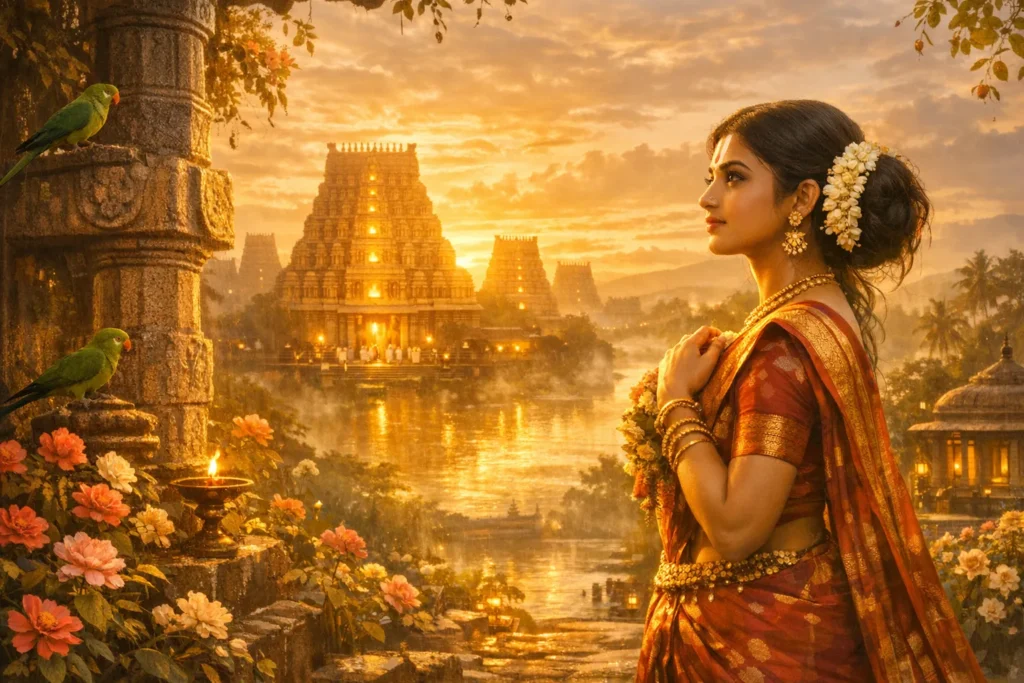
She was born — or rather, found — in Srivilliputtur in southern Tamil Nadu, in the garden of the Vishnu temple where her father Periyazhwar served as priest. Periyazhwar found her as an infant among the sacred tulsi plants and raised her as his own daughter — in the atmosphere of the temple, surrounded by the hymns he was already composing, immersed from her earliest consciousness in the reality of Vishnu’s presence.
She grew up knowing, with absolute certainty, that she was Vishnu’s bride.
Not metaphorically. Not as a theological position. As a fact of her own experience — as direct and as undeniable as the fact of the temple in front of her and the sacred tulsi garden around her.
Her father composed hymns in praise of Vishnu. Andal composed hymns as Vishnu’s beloved — addressing him not as the devotee addresses the divine but as a woman addresses the man she loves and intends to marry. The Tiruppavai — thirty verses composed during the Tamil month of Margazhi (December-January) — is a bridal poem: Andal and her friends preparing for their wedding with the divine, waking before dawn, bathing in the sacred river, adorning themselves, approaching the deity’s chamber.
📜 From the Tiruppavai — Andal
மார்கழித் திங்கள் மதி நிறைந்த நன்னாளால் நீராட போதுவீர் போதுமினோ நேரிழையீர் சீர் மல்கும் ஆய்ப்பாடி செல்வச் சிறுமீர்காள் கூர் வேல் கொடுந்தொழிலன் நந்தகோபன் குமரன்
Margazhi thingal madhi niraindha nannaalaal Neeraada podhuveeer podhumino neriyazhiyeer Seer malgum Aaypaadi selvach chirumeergaal Koor vel kodunthozhilan Nandagopan kumaran
“On this auspicious full moon day of Margazhi — come, jewelled ones, come to bathe! O wealthy girls of prosperous Ayarpadi — come, let us seek the son of Nandagopa who wields the sharp spear.” Tiruppavai 1.
The opening verse of Andal’s most celebrated work. The invitation is to a pre-dawn ritual bath — the purification that precedes the approach to the divine — but it is simultaneously a bridal invitation: come, adorned ones, we are going to meet our beloved.
The Tiruppavai is sung every morning during Margazhi in Vaishnava temples across South India — and its opening verse, with its image of jewelled young women rising before dawn to approach their God, has been sung every morning for over twelve hundred years.
The story of Andal’s devotion took a form that alarmed and eventually moved her father. She would take the garlands that Periyazhwar made for the temple deity — wearing them herself first, to see if they suited, before offering them to Vishnu. When Periyazhwar discovered this, he was horrified: garlands worn by a human being were considered ritually impure for divine offering. He stopped making the garlands.
And then Vishnu appeared to Periyazhwar in a dream — telling him that he preferred the garlands Andal had worn. That the warmth of her love, transferred to the flowers through her wearing them, was itself an offering. That the garland touched by Andal’s devotion was more pleasing to him than the most ritually perfect offering that had never been touched by such love.
After which Periyazhwar made garlands specifically for Andal to wear first.
Andal composed two works: the Tiruppavai (thirty verses) and the Nachiyar Thirumozhi (143 verses). The Nachiyar Thirumozhi is the more personally intense of the two — a sustained exploration of the soul’s longing for the divine, sometimes tender, sometimes anguished, sometimes ecstatic, always completely unguarded. It contains some of the most psychologically honest devotional poetry in any tradition — a young woman describing, without embarrassment or euphemism, the physical reality of longing for her absent beloved.
Her story ends — or rather, does not end — at Srirangam. Tradition records that when Andal was brought to the Srirangam temple to be formally presented to Ranganatha — the culmination of her earthly pilgrimage — she walked into the inner sanctum and did not come out. She merged with the deity. She became, in the tradition’s understanding, permanently present in Srirangam — not as a memory but as a living reality, the eternal bride of Ranganatha, whose presence in the temple is felt by devotees who are sufficiently still to notice.
The Tiruppavai is sung every morning during Margazhi in every Vaishnava temple in South India. Every morning. Without exception. For over twelve hundred years.
This is Andal’s legacy: not a historical text but a living daily practice — the bride’s voice, calling every morning before dawn, inviting every soul to rise and come and approach the beloved.
III. Thiruppaan Azhwar — The Saint Who Never Entered
He was born into a community of musicians — a community that the caste hierarchy of his time placed outside the boundaries of temple entry.

He never entered the Srirangam temple.
Not because he did not want to. Because he did not feel worthy. The tradition records that Thiruppaan Azhwar spent his days on the banks of the Cauvery opposite Srirangam — singing, always singing, his eyes fixed on the gopuram across the water, his heart fixed on the deity within. He would not approach. He could not bring himself to approach. The distance between himself and the sacred space felt, to his profound humility, like the distance between the finite and the infinite — real, absolute, unbridgeable.
And then Vishnu intervened.
The tradition records that Vishnu appeared in a dream to the chief priest of Srirangam — a Brahmin of impeccable ritual standing — and commanded him to carry Thiruppaan Azhwar into the temple on his shoulders. The priest obeyed. Thiruppaan Azhwar entered Srirangam carried on the shoulders of a Brahmin priest — a reversal of every social hierarchy imaginable, enacted at divine command.
And standing in the presence of Ranganatha, Thiruppaan Azhwar composed ten verses. Just ten. The Amalanadhipiran — “The Lord who is pure and flawless.”
📜 From the Amalanadhipiran — Thiruppaan Azhwar
அமலனாதிபிரான் அடியார்க்கு என்னை ஆட்படுத்த விமலன் விண்ணவர்கோன் விரையார் பொழில் வேங்கடவன் நிமலன் நின்மலன் நீதி வானவன் நீள்மதிள் அரங்கத்தம்மான் திருக்கமல பாதம் வந்து என் கண்ணினுள்ளே நிறையுமே
Amalanaadhipiraan adiyaarkku ennai aatpaduththa Vimalan VinnavarkOn viraiyaar pozhil Venkatavan Nimalan ninmalan Needhi vaanavan neelmathil Arangaththammaan thirukkamala paadham vandhu en kanninulle nirayume
“The feet of the Lord of Srirangam — the pure one, the flawless one, the lord of the heavenly ones, the Lord of Venkatam surrounded by fragrant groves — have come and filled my eyes.” Amalanadhipiran, verse 1.
The hymn begins with the feet of Vishnu and moves, verse by verse, upward through the divine form — anklets, waist, chest, arms, neck, lips, eyes, crown — until, in the tenth verse, Thiruppaan Azhwar declares that having seen all of this, his eyes will see nothing else. Ten verses. One complete vision. The entire Vaishnava devotional world in concentrated form.
After composing the tenth verse, tradition records that Thiruppaan Azhwar merged with Vishnu — permanently absorbed into the divine presence he had spent his life approaching from across the river.
The Amalanadhipiran is ten verses long. It takes perhaps five minutes to recite. And yet it is considered, by the tradition’s unanimous verdict, to contain the entire Divya Prabandham in concentrated form. The saint who never felt worthy enough to enter the temple composed the hymn that distils everything the temple is about.
This is the tradition’s most direct statement about the relationship between worthiness and love: that the deepest love may be found precisely in the one who does not feel worthy — and that the divine, who sees the heart and not the resume, responds to the depth of the love and not the height of the social standing.
IV. Periyazhwar — The Father
He is called the Great Azhwar — Periyazhwar — not because of the size of his output (though his 473 verses are substantial) but because of the quality of his love.
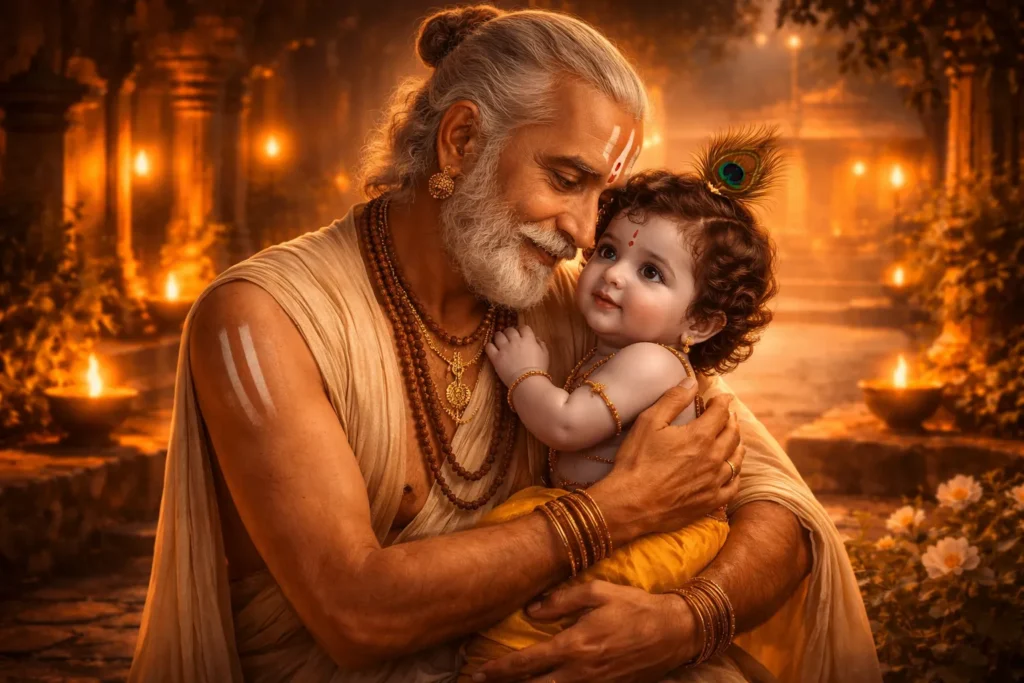
His love for Vishnu is parental.
Not the love of the devotee for the lord. Not the love of the bride for the beloved. Not the love of the philosopher for the truth. The love of a parent for a child — anxious, tender, protective, delighting in every small thing the child does, unable to stop watching, unable to stop providing.
Specifically: his love for Vishnu in the form of the child Krishna.
Periyazhwar was a scholar-priest serving at the Vishnu temple in Srivilliputtur when the Pandya king — in the great tradition of Tamil kings seeking philosophical guidance — convened a debate among all the learned men of his kingdom to determine the highest truth. Periyazhwar participated. He won. And in the moment of his victory — mounted on an elephant in the royal procession, garlanded and honoured — he was overwhelmed not by pride but by fear for Vishnu.
Not his own fear. Fear on Vishnu’s behalf — the anxiety of a parent who sees their child standing in a place of danger and rushes to protect them. He composed, on the spot, the Thiruppallandu — “May you live long” — a protective blessing addressed to Vishnu, asking the divine to be shielded from harm. The God who needs no protection, blessed by the devotee who cannot stop being a parent.
📜 From the Thiruppallandu — Periyazhwar
பல்லாண்டு பல்லாண்டு பல்லாயிரத்தாண்டு பலகோடி நூறாயிரம் மல்லாண்ட திண்தோள் மணிவண்ணா உன் செவ்வடி செவ்வி திருக்காப்பு
Pallaandu pallaandu pallayirathaandu Palakodi noorayiram Mallaanda thindol manivannaaa un Sevvadi sevvi thirukkappu
“May you live long, long, thousands of years — many crores, hundreds of thousands — O jewel-hued one with powerful shoulders that conquered the strong — may your beautiful red feet be protected.” Thiruppallandu.
The opening verse of Periyazhwar’s first composition. The God who is eternal is being blessed with long life by a devotee who cannot stop being a parent. The theological impossibility is the devotional point: love does not calculate. Love simply loves — and a parent’s love, when it turns toward the divine, blesses the eternal with the only blessing it knows how to give.
Periyazhwar’s subsequent hymns — the Periyazhwar Thirumozhi — focus almost entirely on the childhood of Krishna: his birth, his early miracles, his mischief, his beauty as a child. They describe Krishna’s mother bathing him, feeding him, protecting him from the evil eye — and Periyazhwar himself, unable to separate his own identity from hers, participating in every domestic act of care with the absorbed attention of someone who cannot believe the privilege of being this close to the divine.
These hymns occupy a unique place in the Azhwar tradition. Every other register of devotional love is here — philosophical, bridal, sacrificial, humble — but this one adds something that the others do not: the tenderness of the ordinary. The bath, the meal, the lullaby, the protective blessing against the evil eye — the most domestic, most everyday acts of love, offered to the infinite, and received.
V. Lives of Four Azhwar Saints — The Complete Picture
What do these four lives, taken together, tell us?
They tell us that the divine is large enough to receive every form of love that a human being is capable of feeling.
The philosopher’s love — Nammazhwar’s systematic, comprehensive, intellectually precise devotion that encompasses the entire spectrum of the soul’s relationship to God.
The beloved’s love — Andal’s bridal, personal, completely unguarded surrender to the divine as the only acceptable object of the heart’s deepest longing.
The humble one’s love — Thiruppaan Azhwar’s love from across the river, from outside the gates, from the posture of one who does not feel worthy — and who is, precisely because of that love, more worthy than anyone.
The parent’s love — Periyazhwar’s tender, anxious, delighted, protective love for the divine child — the love that blesses the eternal with long life because it cannot help itself.
Together, these four forms of love constitute a complete map of the human heart’s relationship to the divine. Not a theological argument. Not a philosophical system. A lived reality — four specific human beings who felt these things so completely that their feelings became hymns, their hymns became tradition, their tradition became the morning voice of 108 temples across South India.
VI. The Azhwars and The Sacred Trails
Every Divya Desam on The Sacred Trails carries the presence of one or more Azhwars.
When you stand before Ranganatha at Srirangam — the greatest of the Divya Desams — you are standing in the space where Nammazhwar’s verses have been sung every morning for over a thousand years, where Thiruppaan Azhwar merged with the deity after composing his ten perfect verses, where Andal arrived as a bride and did not return.
When you visit Srivilliputtur — the temple town where Andal was found and where the Tiruppavai was composed — you are entering the domestic space of the tradition’s most celebrated divine marriage.
When you walk the Cauvery delta — through the concentration of ancient temples that forms the heart of The Sacred Trails’ Vaishnava circuit — you are walking through a landscape that the Azhwars walked, sang, and sanctified. Their presence is not historical. It is atmospheric — encoded in the stones of the gopurams, carried in the morning air with the sound of the Divya Prabandham, present in the eyes of every devotee who arrives before dawn and stands quietly in the darkness of the inner sanctum.
This is what The Sacred Trails is here to help you experience — not merely to observe but to enter. To stand in these places with the stories of these lives in your mind and heart, and to feel what becomes possible when you understand not just what you are looking at but who has been here before you and what they felt.
VII. Closing — The Bridge to What Comes Next
We have now completed the devotional heart of the Sacred Foundations series.
We have the Nayanmars — sixty-three saints whose Tirumurai hymns gave the Shaiva tradition its devotional voice (Blogs 6 and 7). We have the Azhwars — twelve saints whose Divya Prabandham gave the Vaishnava tradition its devotional world (Blogs 8 and 9). Together, these two traditions constitute the bhakti revolution — the transformation that made the abstract divine of the Upanishads into the personally present, intimately loved God of South Indian temple worship.
What remains in the Sacred Foundations series is the completion of the Shanmatham picture — the four traditions we have not yet explored in depth: Saktham (the way of the Divine Mother), Ganapathyam (the way of Ganesha), Koumaram (the way of Murugan), and Sowram (the way of Surya). Blogs 10 through 13 will give each of these traditions its own devoted exploration — their theology, their sacred sites, their saints, and their specific contribution to the extraordinary religious landscape of South India.
And then — The Sacred Trails arrives, finally, at the entrance of the temples themselves — temple by temple, stone by stone, hymn by hymn — The Sacred Trails begins its journey into the temples themselves.
Ready to enter. Ready to see. Carrying everything we have learned — the cosmic philosophy, the institutional wisdom, the devotional fire, the saints’ songs — as the only luggage that truly matters when you are about to stand before a deity who has been receiving love, without interruption, for a thousand years.
Next in the Sacred Foundations Series:
The Divine Mother — Saktham, the Shakti Peethas, and the Feminine Face of the Infinite.
Coming soon on thesacredtrails.com 🙏