
How the Elephant-Headed Son of Shiva Became the First Word of Every Prayer, the Guardian of Every Doorway, and the Grace That Makes Every Journey Possible
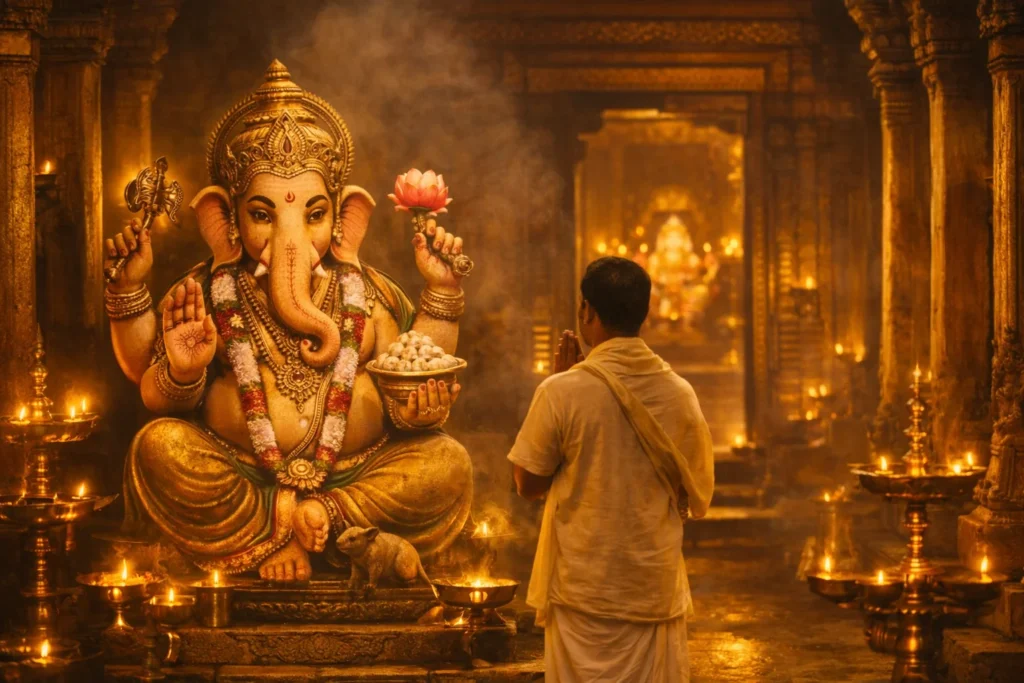
He Was Formed from Turmeric. He Changed the Order of the Universe.
Parvati was alone.
Shiva had gone into his deep meditation — the samadhi that could last decades, centuries, an immeasurable stretch of cosmic time in which he was entirely absent to the ordinary world. Parvati was left in their home on Mount Kailash with the ganas — Shiva’s attendants, the wild, imperfect, devoted creatures who served the great ascetic — and no one of her own. No attendant who was entirely, unconditionally hers.
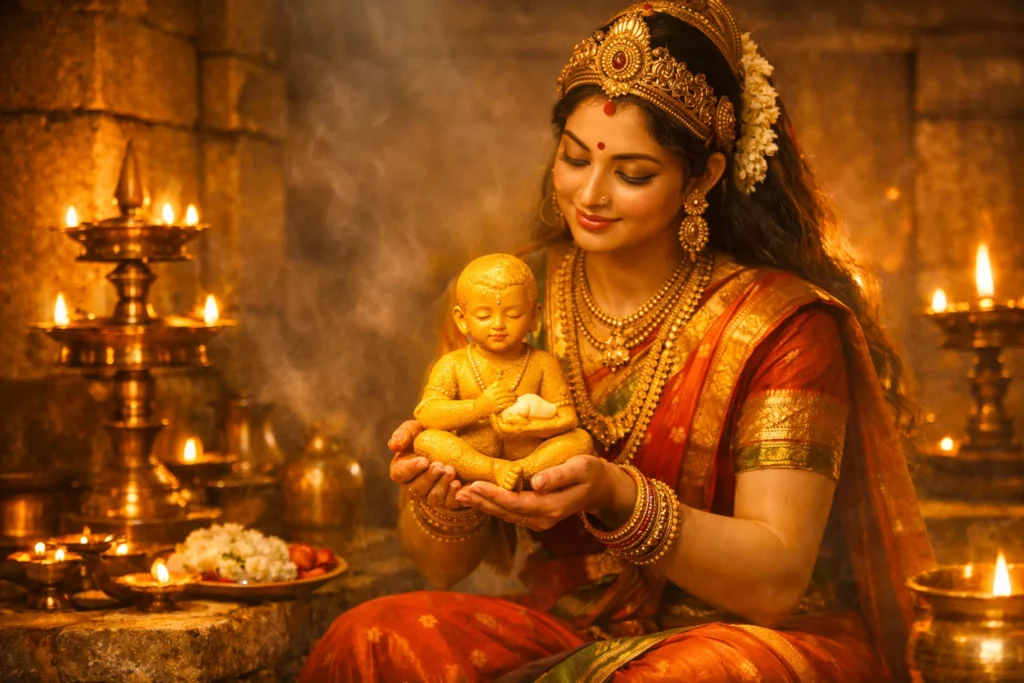
She wanted to bathe. She wanted, for the first time, a space that was fully her own — private, protected, sovereign.
She took the turmeric paste from her body — the haldi that South Indian women have applied since time beyond memory as a preparation for bathing — and she shaped it in her hands. She breathed life into it. She created, from the substance of her own body, a child. A boy. Perfect in form, radiant with her own divine energy, completely and exclusively hers in a way that nothing else in creation was.
“Guard the door,” she told him. “Let no one enter while I bathe. No one — no matter who they claim to be.”
The boy stood at the entrance to Parvati’s chamber. And when Shiva returned from his meditation and attempted to enter — not recognising the child, not knowing that Parvati had created a son in his absence — the boy stopped him.
“You cannot enter.”
Shiva — the destroyer of the universe, the god before whom even Brahma and Vishnu bow — was refused entry to his own home by a child he did not know.
The confrontation that followed is one of the most dramatic passages in the Shiva Purana. Shiva’s ganas attacked the boy. The boy defeated them. Shiva’s great commanders — Karttikeya, Nandi, the most powerful of the divine army — fell before the child made of turmeric. The boy was entirely his mother’s creation. He had Parvati’s power in every cell of his body. He could not be defeated by any force his father commanded.
The conflict escalated beyond the control of the ganas. Finally Shiva himself raised his trishul — the trident of cosmic destruction — and severed the boy’s head.
Parvati’s grief when she emerged from her bath and saw what had happened was not merely a mother’s sorrow. It was a force of cosmic magnitude. Parvati’s anger — the Devi in her most terrifying aspect — threatened to unmake the universe itself. The gods fell silent. Even Brahma and Vishnu were afraid.
Shiva understood what he had done. He sent his attendants north — the direction of auspicious emergence — with a single instruction: bring back the head of the first living creature you encounter, sleeping with its head pointing north.
They returned with the head of an elephant.
Shiva placed it on the boy’s body. He breathed life back into the joined form. And then — in an act that transformed not merely this one child but the entire cosmic order — he made a proclamation that has echoed through every Hindu ceremony, every temple ritual, every sacred journey in India for thousands of years:
“This child shall be worshipped first. Before any deity is invoked, before any ritual begins, before any journey is undertaken, before any new venture is started — he shall be worshipped first. He who worships him at the beginning shall find his path clear of obstacles. He who neglects him shall find obstacles multiplying at every step. He is the lord of all beginnings. He is Ganapati — the lord of the ganas, the commander of all the divine attendants. He is Vigneshvara — the lord of obstacles, the one who both places and removes them. He is my son.”
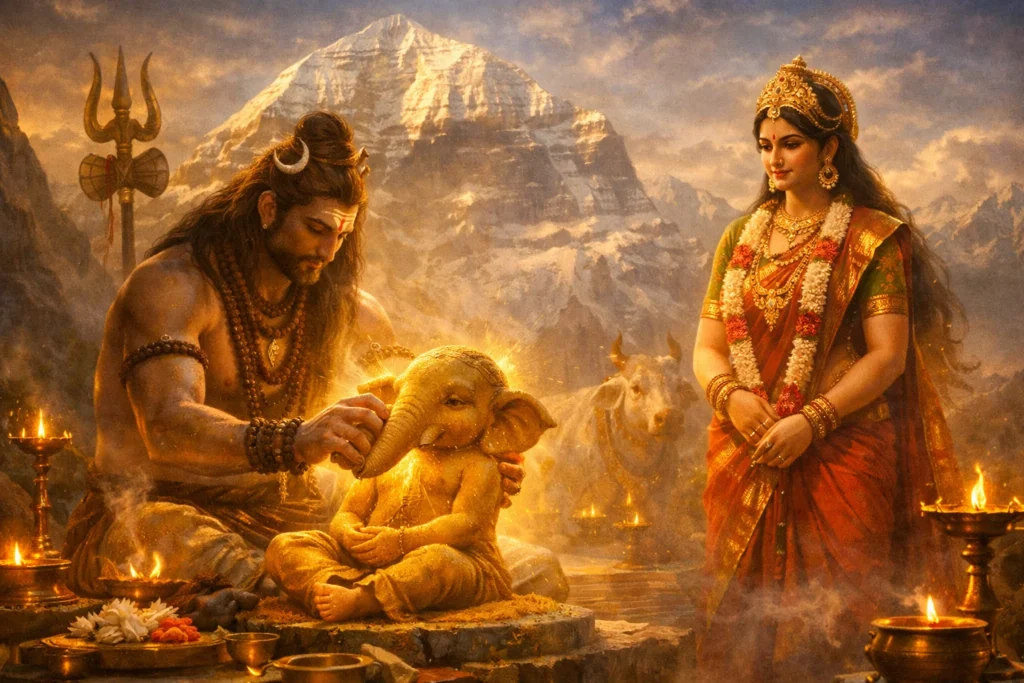
From that moment, every door in the universe acquired a guardian. Every threshold acquired a presence. Every beginning acquired a prayer. The elephant-headed god — made from turmeric paste, decapitated and restored, crowned by his father with sovereignty over all beginnings — took his place at the entrance to everything.
Ganapathyam is one of the six major paths of Hindu worship, centered around Lord Ganesha — the deity who stands at the beginning of every sacred journey.
I. Ganapathyam — The Fourth Path of Shanmatham
We have now walked through three of Shanmatham’s six paths. Shaivam — the way of Shiva, whose Nayanmars sang 276 temples into sacred existence. Vaishnavism — the way of Vishnu, whose twelve Azhwars composed 4,000 hymns that sanctified 108 Divya Desams across India. Saktham — the way of the Divine Mother, whose body became the subcontinent itself and whose fifty-one Shakti Peethas mark the sacred geography of the goddess’s eternal presence.
The fourth path is Ganapathyam — the way of Ganesha, the elephant-headed son of Shiva, the lord of beginnings, the remover and placer of obstacles, the deity who stands at the threshold of every sacred journey.
Ganapathyam, in the Shanmatham framework, worships Ganesha as the supreme manifestation of Brahman — not merely as an auspicious deity to be invoked at the start of rituals, but as the complete expression of the infinite in the form of the divine child who governs access to all sacred knowledge and all sacred space.
In the Ganapathyam understanding, Ganesha is not the doorkeeper of a higher reality. He is the reality itself, in the form most immediately accessible to the human being who stands at the beginning of any path. The threshold is not a boundary. It is the beginning of understanding.
💡 Key Concept: Vigneshvara — Lord of Obstacles
Ganesha is Vigneshvara — the lord of vighnas, obstacles. This title is frequently misunderstood.
Ganesha does not merely remove obstacles. He is the lord of them — meaning he both places and removes them.
An obstacle placed by Ganesha is not a punishment. It is a teaching — a redirection, a test, a moment of enforced stillness that serves a larger purpose.
An obstacle removed by Ganesha is not merely cleared away. It is transformed — the blockage becoming the opening, the resistance becoming the momentum.
This is why Ganesha is worshipped at the beginning of every undertaking: not to guarantee smooth passage, but to ensure that whatever obstacles arise will serve the journey rather than end it. The devotee who worships Ganesha is not asking for an easy path. They are asking for the wisdom to navigate whatever path appears.
II. The Stories That Made Him — Four Defining Myths
The Scribe of the Mahabharata
The sage Vyasa had completed the Mahabharata in his mind — every verse, every narrative, every philosophical conversation, the entire eighteen books and supplements — and he needed a scribe. Not just any scribe. A scribe capable of writing at the speed of his composition without pause, without error, without interruption.
He went to Brahma. Brahma told him: only one being in all of creation has the intelligence and the quickness of hand to serve as your scribe. Ganesha.
Ganesha agreed — but on one condition. “You must dictate without pause,” he said. “If you stop, I stop. And if I stop, I will not continue.” Vyasa accepted. And then added his own condition: “You must understand every verse completely before you write it. You may not write a word you have not fully understood.”
The composition began. Vyasa dictated. Ganesha wrote — his tusk moving across the palm leaf manuscripts with a speed no human hand could match. When Vyasa needed time to compose a particularly complex verse, he would construct it with such deliberate philosophical density that Ganesha needed several moments to fully grasp its meaning before writing it down. In those moments, Vyasa would compose the next ten verses.
When Ganesha’s writing instrument broke — his quill, snapping under the pressure of the unbroken composition — he did not pause. He broke off his own tusk and continued writing.
This is why Ganesha is depicted with one full tusk and one broken tusk. The broken tusk is not a wound or a defect. It is the mark of the scribe who chose the completion of the sacred text over the integrity of his own body. It is the mark of total, unconditional dedication to the task of preserving the truth.
For The Sacred Trails — this story matters beyond its mythological charm. Ganesha is Vidyapati — the lord of learning, of knowledge, of writing, of all sacred texts. Every temple in India that contains inscriptions, every palm leaf manuscript library, every school built adjacent to a temple — all of these are under Ganesha’s guardianship. He is the deity of the written word. And the written word is how the tradition has survived.
The Circumambulation — And What Murugan Lost
Narada arrived at Kailash with the Jnana Pazham — the mango of wisdom, the fruit that contained within it all divine knowledge. “It cannot be divided,” he told Shiva and Parvati. “It must go whole to whichever of your two sons demonstrates the greater wisdom.”
Murugan, hearing the challenge, immediately mounted his peacock and set off to circumambulate the universe — confident that the physically greater journey would demonstrate the greater devotion.
Ganesha sat quietly for a moment. Then he rose, walked around his parents three times, and sat down again.
“Why have you not begun your journey?” Shiva asked.
“I have completed it,” Ganesha replied. “You and my mother are the entire universe. To walk around you is to walk around all of creation. There is no greater circumambulation possible, and none is needed.”
Parvati wept with joy. The mango was given to Ganesha.
This story contains one of the most compact theological statements in the entire Hindu tradition. The knowledge that Ganesha demonstrates is not the knowledge of facts or texts or cosmic geography. It is the knowledge of what is truly central — the recognition that the divine is not at the end of a journey but at the beginning, not in a distant sacred place but in the immediate presence of the mother and father who are themselves the universe.
Ganesha won the mango not by travelling farther than Murugan but by understanding something Murugan had not yet grasped: that the longest journey is sometimes three steps around what is already sacred.
The Mouse and the Moon — A Lesson in Laughter
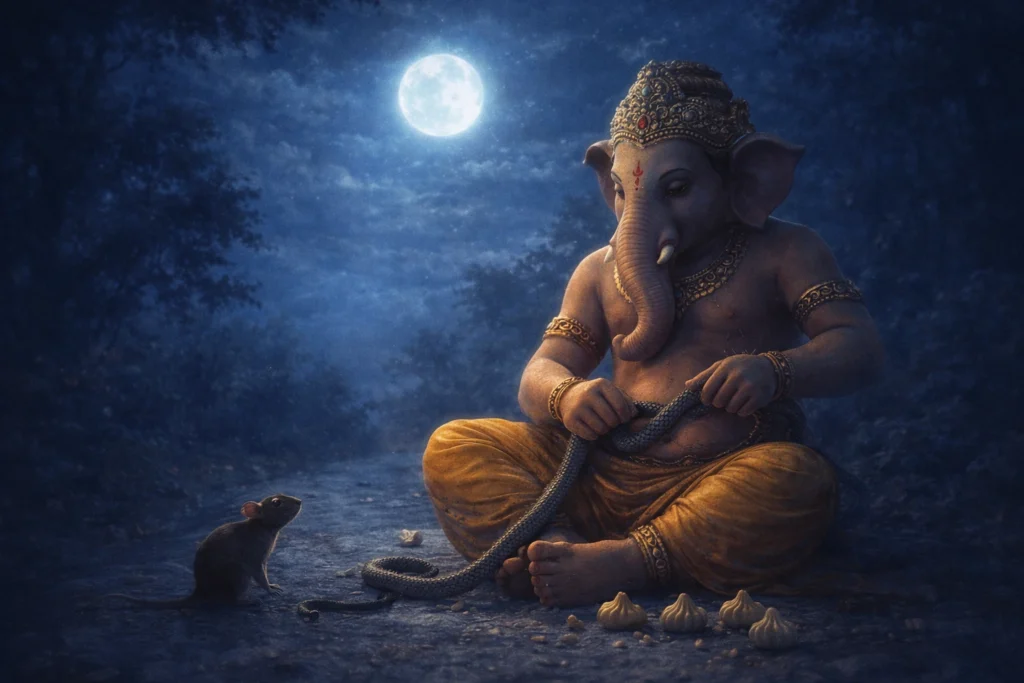
Ganesha’s vahana — his divine vehicle — is the mooshika, the mouse. For a deity of such cosmic stature, the mouse seems an incongruous choice. The disproportion is the point.
The story varies across traditions, but the most widely told version involves Ganesha travelling on his mouse one night after an enormous feast — his rotund belly full of modaks, the sweet rice flour dumplings that are his most beloved offering. In the dark, the mouse stumbled over a snake. Ganesha fell. His belly struck the ground and split open, and all the modaks rolled out.
The moon — Chandra — witnessed this from the sky and laughed. The laughter of the moon at the fallen Ganesha was not kind. It was the laughter of the beautiful at the ungainly, the laughter of the graceful at the awkward, the laughter that diminishes rather than includes.
Ganesha calmly gathered his modaks, returned them to his belly, and tied the snake around his stomach as a belt. Then he looked up at the moon and cursed him: “No one shall look at you on this night of Ganesh Chaturthi. Those who do shall face false accusations and undeserved shame.”
To this day, on Ganesh Chaturthi — the great festival of Ganesha celebrated across India — the tradition holds that one should not look at the moon. And the mouse remains Ganesha’s vehicle: the small carrying the large, the humble bearing the magnificent, the creature who moves through the smallest gaps in the world guiding the lord of all beginnings through every obstacle.
The modak — the sweet offering — became Ganesha’s most essential prasad, present at every Ganesha worship across India. Its shape — a rounded dumpling pinched at the top — is said to represent the universe: the filling within is the sweetness of divine knowledge, and the outer covering is the body of the world that contains it.
Ganesha and the Kaveri — The Story of Thiruvalanchuzhi
In the story specific to the Tamil temple tradition — and inseparable from the sacred geography of the Cauvery delta — Ganesha played a role in one of the most consequential events in cosmic history: the churning of the milk ocean.
When the Devas and Asuras undertook the Samudra Manthan — the churning of the cosmic ocean to extract the nectar of immortality — they used the Mandara mountain as their churning rod and the great serpent Vasuki as the churning rope. The operation was immense, its stakes absolute. But in their urgency and their ambition, the Devas had forgotten something essential. They had begun without first worshipping Vinayaka.
The consequences were immediate. Unable to bear the speed and weight of the churning, Vasuki began to spit his venom — a poison so devastating it threatened the destruction of all three worlds. The operation ground toward catastrophe. In desperation, the Devas surrendered to Shiva. His response was not reassurance but correction: the work had begun without worshipping Vinayaka. The error had to be corrected before anything else could proceed.
The Devas returned to the churning ocean. From its sacred foam they fashioned an image of Vinayaka. They offered their worship with full devotion. And then — the churning resumed, the poison was contained, the nectar emerged, and the cosmic order was restored.
The Vinayaka formed of that sacred ocean foam — Swetha Vinayaka, the white one, the radiant one, the deity born of the moment the Devas understood what they had forgotten — did not dissolve when the churning was complete. He remained. And it was through Indra — Devendra, the king of the Devas — that he found his home.
The White Ganesha of the Cauvery
Indra had committed a grave wrong toward the sage Agastya and carried the weight of the sage’s curse. Seeking relief, he descended to earth with Swetha Vinayaka, moving from Shiva temple to Shiva temple in devotion and penance. At last he arrived at a place in the Cauvery delta where the river spirals in a sacred whirlpool — and here, the Swetha Vinayaka who had travelled with him expressed his own wish: to remain in this place forever.
Indra agreed and went to complete his worship of Shiva. But Shiva had other plans. He appeared before Indra as a small boy and offered to hold the Vinayaka while Indra worshipped. Indra handed him the deity — and when he returned, the boy had vanished.
Indra searched. He found the Swetha Vinayaka beneath the Bali Peeta of the temple — but immovable, rooted to the earth as if he had always been there, as if the ground itself had claimed him. No force could lift him. Indra brought the divine sculptor to build a ceremonial chariot and attempted to carry the deity to a proper installation — but in vain. A divine voice then spoke: this is where Swetha Vinayaka has chosen to remain. Worship him here on each Vinayaka Chaturthi and the merit of daily worship for the entire year shall be yours.
It is believed that Indra returns to this temple on every Vinayaka Chaturthi to fulfil that promise — and the worship of Swetha Vinayaka at Thiruvalanchuzhi continues to carry that ancient blessing for every devotee who comes. The deity’s origin in ocean foam has shaped his worship in a way unique among Ganesha temples in Tamil Nadu. No abhishek is offered. No flowers, no vastras, no sandalwood paste touch him. Only powdered Borneol — Pachai Karpuram — is sprayed upon the image without contact of hand.
The Swetha Vinayaka of Thiruvalanchuzhi is worshipped as he was born — pure, white, untouched — the deity who emerged from the sacred foam of the cosmic churning and chose, of his own will, to make the Cauvery delta his eternal home.
III. The Ganapathi Atharvashirsha — The Scripture of Ganesha
The principal scriptural text of the Ganapathyam tradition is the Ganapathi Atharvashirsha — a short upanishad of the Atharva Veda tradition, consisting of about twenty-five verses, that identifies Ganesha with Brahman — the ultimate reality — and establishes the philosophical basis for his worship as the supreme deity.
The Ganapathi Atharvashirsha is recited at the beginning of Ganesha worship across India and is memorised by millions of devotees. Its opening declaration is the foundational statement of Ganapathyam theology:
📜 From the Ganapathi Atharvashirsha
त्वमेव प्रत्यक्षं तत्त्वमसि
Tvameva pratyaksham tattvamasi
“You alone are the directly perceived truth — ‘That thou art’.”
The phrase “Tat tvam asi” — That thou art — is one of the four Mahavakyas, the great philosophical statements of the Upanishads, meaning the individual soul and Brahman are identical.
By applying this statement directly to Ganesha — “You are the directly perceived truth of ‘That thou art'” — the Ganapathi Atharvashirsha is making a precise philosophical claim: Ganesha is not a deity pointing toward Brahman. He is Brahman, in the form most immediately accessible to the devotee who stands at the beginning of their journey. The “directly perceived” quality is the key: Ganesha is the form in which the infinite becomes perceivable, approachable, present — at the threshold, at the beginning, in the first moment of any sacred undertaking.
The text goes on to identify Ganesha with the pranava — the sacred syllable Om — and with all the elements of the cosmos. He is the earth, the water, the fire, the air, the space. He is the sun and the moon. He is the past, the present, and the future. The Ganapathi Atharvashirsha is, in its few verses, a complete statement of non-dual philosophy expressed through the form of the elephant-headed deity — the Advaita of Shankaracharya made available through the most beloved and accessible of all divine forms.
IV. The Sacred Temples — Where Ganesha Is Most Powerfully Present
Ganesha is the most universally present deity in all of Hinduism — there is no temple in India that does not have a Ganesha shrine. But there are specific temples where he is the presiding deity, where he is the primary — and where the quality of his presence has been recognised, sung, and worshipped with a concentrated devotion that makes these places extraordinary.

Pillayarpatti — The Rock-Cut Karpaga Vinayagar
Pillayarpatti — whose name means the town of Pillayar, the Tamil name for Ganesha — is one of the most ancient and sacred Ganesha temples in Tamil Nadu, located in Sivaganga district near Karaikudi in the Chettinad region.
The presiding deity is Karpaga Vinayagar — the wish-fulfilling Ganesha, the one who grants all desires as freely as the divine wish-fulfilling tree (karpagam) grants its fruits. What makes Pillayarpatti singular is the deity’s form: the Karpaga Vinayagar is a rock-cut image carved directly into the living granite of the hillside — not a sculpted idol placed in a chamber, but the god emerging from the rock itself, as if he was always there within the stone and the sculptor merely revealed him.
The cave temple at Pillayarpatti is dated by inscriptions to the Pandya dynasty — making it one of the earliest surviving Ganesha temples in Tamil Nadu. The rock-cut mandapa, the ancient stone pillars, the quality of stillness in the inner sanctum — all of it carries the specific atmosphere of a sacred space that has been receiving worship continuously for over a thousand years.
The Karpaga Vinayagar here is depicted in a specific posture that is unique in the Tamil Ganesha tradition: seated with one leg folded and the other touching the ground, in a posture of gracious accessibility — the god leaning slightly forward, as if attending to every prayer with particular care. Pilgrims come to Pillayarpatti with specific requests — for children, for the resolution of legal disputes, for the clearing of long-standing obstacles — and the tradition of the wishes granted here runs through centuries of devotional memory.
Ucchi Pillayar — The Ganesha Above the Rock Fort
Above the city of Tiruchirappalli — at the very summit of the extraordinary granite outcrop known as the Rock Fort, 83 metres above the surrounding plains — sits one of the most dramatically positioned temples in all of Tamil Nadu.
The Rock Fort itself is an ancient geological formation of exceptional character: a single mass of granite rising sheer from the flat Cauvery plains, its sides carved with cave temples dating to the Pallava period. To reach Ucchi Pillayar — the Ganesha of the summit — requires climbing 437 steps cut into the living rock, passing two cave temples of great antiquity dedicated to Shiva, ascending through the narrowing granite corridors as the city of Trichy spreads out below and the silver ribbon of the Kaveri becomes visible in the distance.
At the summit, in a small but ancient shrine, Ganesha presides. The view from here — the Ranganathaswamy temple at Srirangam visible across the river, the gopurams of a dozen other temples rising from the plains in every direction, the Kaveri delta spreading south toward the sea — is one of the great panoramic sacred views in Tamil Nadu. Ucchi Pillayar is the Ganesha who sees everything from above — who holds the entire landscape in his gaze, who presides over the city and the river and the surrounding temple geography from his position of absolute elevation.
Kanipakam — The Self-Manifested Ganesha
Kanipakam in Andhra Pradesh — near Chittoor, in the region between Tamil Nadu and Andhra — houses one of the most extraordinary Ganesha shrines in South India: the Vara Siddhi Vinayaka temple, where the deity is swayambhu — self-manifested, not sculpted by human hands but emerging from the earth itself.
The deity at Kanipakam is immersed in water — the sanctum is a sacred tank, and the Ganesha emerges from its depths. The tradition records something remarkable about this image: it grows. Slowly, imperceptibly, but measurably across centuries — the image of Kanipakam Vinayaka has been expanding, and the ornaments and coverings that fitted the deity in earlier centuries no longer do. The living presence in the stone is, the tradition says, still manifesting, still emerging, still in the process of its divine revelation.
Kanipakam is also celebrated for its Brahmotsavam festival and its tradition of resolving disputes — devotees who cannot settle conflicts by ordinary means come to the Kanipakam Vinayaka, make their oaths before the deity, and trust that false oaths will be punished and true ones honoured. The temple has a long history as a court of divine justice in the popular devotional tradition of the Telugu and Tamil communities of the region.
The Ashtavinayak — Eight Sacred Presences in Maharashtra
While the Tamil Ganesha tradition is the most directly relevant to The Sacred Trails’ South India focus, no account of Ganesha’s sacred geography is complete without mentioning the Ashtavinayak — the eight self-manifested Ganesha temples of Maharashtra that form the most celebrated Ganesha pilgrimage circuit in India.
The eight temples — Morgaon (Mayureshwar), Siddhatek (Siddhi Vinayak), Pali (Ballaleshwar), Mahad (Varad Vinayak), Theur (Chintamani), Lenyadri (Girijatmaj), Ozar (Vighnahar), and Ranjangaon (Mahaganapati) — are all within approximately a hundred kilometres of Pune and form a circuit that Maharashtrian devotees complete in one continuous journey, typically over three to five days.
Each of the eight is swayambhu — self-manifested. Each is associated with a specific episode from the Mudgala Purana, the primary Ganapathyam scripture of the Maharashtra tradition. And each represents a specific aspect of Ganesha’s divine nature — the remover of obstacles, the granter of wisdom, the bestower of prosperity, the protector of devotees, the one born in the mountain cave. Together they constitute a complete theological portrait of Ganesha, distributed across the sacred landscape of Maharashtra as the Divya Desams are distributed across South India.
Siddhi Vinayak — Mumbai
The Siddhi Vinayak temple in Prabhadevi, Mumbai — built in 1801 — is the most visited temple in Maharashtra and one of the most visited religious sites in India. Its Ganesha, the Siddhi Vinayak, is depicted with his trunk turned to the right — a form considered particularly powerful and relatively rare among Ganesha images, most of which show the trunk curving to the left. The right-trunk Ganesha is considered Siddhi Vinayak — the Ganesha who grants direct realisation, who removes obstacles at their root rather than merely at their surface.
The temple draws millions of devotees annually — from every walk of life, every religious background, every corner of India — making it one of the most vivid expressions of Ganesha’s universal, all-inclusive presence in the contemporary world.
V. Ganesha in South Indian Temple Tradition — The First Face You See
In every Shaiva temple in Tamil Nadu — every one of the 276 Padal Petra Sthalams we are preparing to visit on The Sacred Trails — there is a Ganesha shrine near the entrance. Not inside the innermost sanctum. At the threshold. Specifically positioned so that the devotee encounters Ganesha before any other deity, before crossing into the inner sacred space, before approaching the presiding deity of the temple.
This placement is not merely traditional — it is theologically precise. Ganesha is Kshetrapala — the guardian of the sacred field, the protector of the temple precinct. His presence at the entrance consecrates the act of entering. The devotee who pauses before the Ganesha shrine, who offers a moment of recognition, who silently asks for the obstacles of distraction and ego to be cleared before entering the inner space — that devotee has already begun the true worship before reaching the main sanctum.
The Vighnesvara shrines in Tamil Nadu temples often carry specific local names and specific local stories. In some temples, the Ganesha at the entrance is ancient — a small, worn image that has been touched by millions of hands across centuries, its features softened by the accumulated devotion of generations. In others, the shrine is large and elaborately adorned, with a separate festival cycle and a dedicated priest.
In all of them, the function is the same. Ganesha stands at the door and asks, in the tradition’s understanding, a single quiet question: Are you ready? Have you set aside, at least for the duration of this visit, the obstacles of your own making — the preoccupations, the ego, the habitual mental noise that prevents the temple’s atmosphere from reaching you? If yes — enter. If not — stand here a little longer. I will help.
🗺️ A Note for the Temple Visitor
When you enter any Shaiva or Vaishnava temple on The Sacred Trails, look for the Ganesha shrine near the entrance before you proceed to the main sanctum.
In most Tamil Nadu temples it will be to your right as you enter — a small or medium shrine, often with fresh flowers and a burning lamp.
The traditional greeting is simple: palms together, a moment of stillness, the internal acknowledgement that you are crossing from the ordinary world into a sacred space.
The Ganapathyam tradition holds that this moment — the pause at the threshold, the recognition of the deity who guards the entrance — is not a formality. It is the beginning of the real visit. Ganesha at the door is saying: the inner sanctum is real. What you are about to encounter is real. Come prepared to be present.
VI. Vinayaka Chaturthi — The Festival of New Beginnings
The great festival of Ganesha — Vinayaka Chaturthi, celebrated on the fourth day of the waxing moon in the Tamil month of Avani (August-September) — is one of the most joyful and most widely observed festivals in the Hindu calendar.
In its public, communal form — the form that Bal Gangadhar Tilak transformed into a mass nationalist festival in Maharashtra in the late 19th century, deliberately using the ten-day celebration to build community solidarity across caste lines during the Indian independence movement — Vinayaka Chaturthi involves the installation of large Ganesha images in public spaces, ten days of communal worship, and the final immersion of the images in water bodies on Ananta Chaturdashi, the fourteenth day.
In its domestic, intimate Tamil form — which predates and runs alongside the public celebration — Vinayaka Chaturthi is observed in the home. A clay image of Ganesha is made or purchased, installed on a decorated platform, worshipped with modaks and flowers and the twenty-one varieties of leaves (patri) that are Ganesha’s specific offering, and then immersed in water at the close of the day or the next morning. The image returns to the earth. The deity remains.
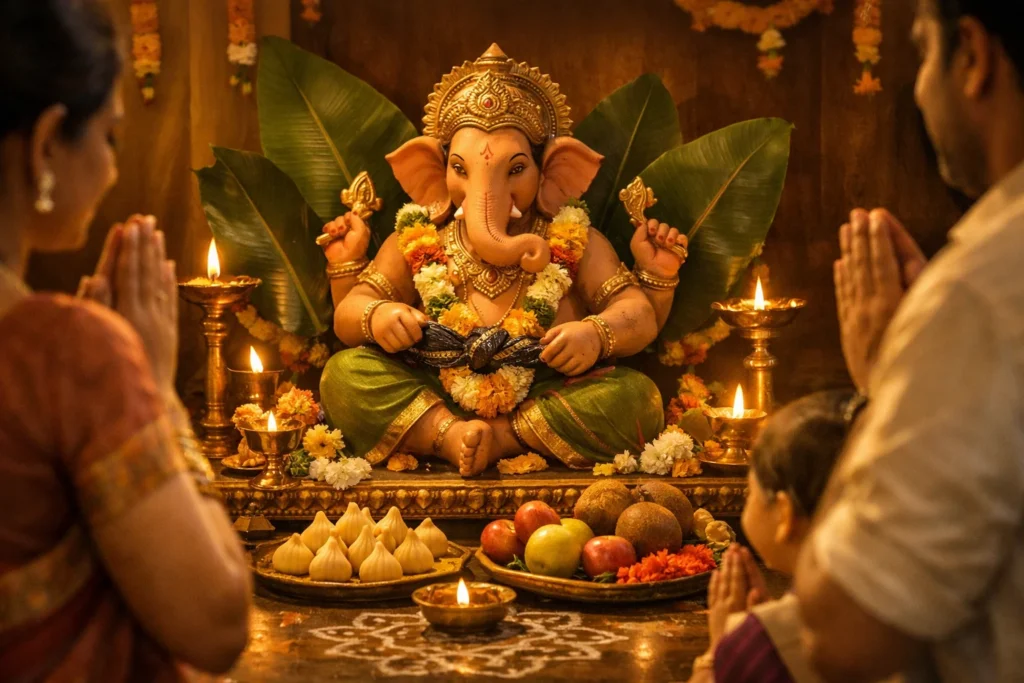
There is a theological statement in the immersion that is worth dwelling on. The clay Ganesha — made from earth, worshipped, adored, and then returned to the water and the earth from which it came — is a miniature enactment of the entire universe’s relationship with the divine. The form arises. It is recognised as sacred. It is worshipped. And then it is released — not because it was not real, but because the reality was never in the clay. The clay was the occasion for the recognition. The recognition remains.
VII. The God at Every Threshold — A Bridge to What Comes Next
We have now met four of Shanmatham’s six paths.
Shaivam — the path of Shiva and the Nayanmars, whose devotional fire sanctified 276 temples across Tamil Nadu. Vaishnavism — the path of Vishnu and the Azhwars, whose longing love sanctified 108 Divya Desams. Saktham — the path of the Divine Mother, whose body became the subcontinent and whose Shakti Peethas mark the earth with her presence. And now Ganapathyam — the path of the deity who stands at every entrance, guards every threshold, governs every beginning.
There is a quiet logic in where Ganapathyam falls in this sequence. We are ourselves at a threshold. The Sacred Foundations series — these sixteen blogs of preparation, of philosophical and devotional context-building — is approaching its completion. The temples themselves are close. And before we cross into that new section of The Sacred Trails, we have been asked to pause at the door. To acknowledge the deity who guards the entrance. To ask, in the traditional way, for the obstacles of our own unpreparedness to be cleared before we step inside.
Ganesha stands at the door of the temples we are about to enter. He has been standing there for a thousand years. He is standing there now.
Two paths remain before the Sacred Foundations are complete.
In Blog 12, we meet Koumaram — the path of Murugan, the Tamil God par excellence, the beautiful warrior of the hills whose Six Abodes form one of the most beloved pilgrimage circuits in South India. He is the son who taught his father the meaning of Om. He is the hunter’s god and the philosopher’s god and the poet’s god — simultaneously ancient and urgently, intimately present in the Tamil world.
Next in the Sacred Foundations Series:
The God of the Tamil Hills. Koumaram, the Six Abodes of Murugan, and the tradition that has kept a deity both ancient and alive for two thousand years.
Coming soon on thesacredtrails.com 🙏