
The 276 Padal Petra Sthalams — How the Nayanmars Turned Tamil Nadu Into the Most Densely Sacred Landscape on Earth

The Philosopher Finished Speaking. The Land Began.
Meykandar sat in Chidambaram and wrote the Sivagnana Botham.
He wrote about Pati — the Lord. About Pasu — the soul. About Pasam — the bonds that hold the soul from the Lord. He wrote about liberation not as an escape from the world but as the recognition of what the world always was: the presence of Shiva in every form, every substance, every moment of experience. He gave Tamil Shaivism its philosophical ground — the intellectual foundation on which two thousand years of temple tradition could stand without trembling.
And when he finished — when the last verse of the Sivagnana Botham was complete and the philosophy was whole — he did not close his eyes and disappear into the infinite.
He would have looked out across the Tamil land.
He would have seen the gopurams.
Not one. Not ten. A landscape threaded with them — rising from rice paddies and riverbanks, from hilltops and coastal headlands, from the edge of forests and the hearts of ancient cities. Towers of carved granite catching the light of a thousand mornings.
Each one marking a place where Shiva had chosen to be present — not as an abstraction, not as a philosophical principle, not as the attributeless Brahman of the Advaitic tradition — but as a specific deity in a specific place, available to a specific devotee who had walked a specific road to find him.
The philosophy was the map.
The temples were the territory.
And the territory — Tamil Nadu as a sacred landscape — is one of the most extraordinary things human devotions has ever created.
I. What the Nayanmars Made
We have met the Nayanmars.
We met them in Blogs 6 and 7 — the sixty-three Tamil Shaiva saints who lived between the 6th and 9th centuries CE, who sang their devotion in a poetry of such intensity and precision that it transformed the entire religious landscape of South India. We met Thirugnana Sambandar, the child-saint who sang before he could walk. We met Appar, who returned to Shaivism after a detour into Jainism and never looked back. We met Sundarar, the aristocrat who loved Shiva with the familiarity of a friend. We met Manickavasagar, whose Tiruvachakam is still described as the text that can melt even a stone heart.
What we did not fully dwell on — what could not be fully understood until this moment in the Sacred Foundations series — is what those saints actually made.
They did not merely compose poetry. They made a map.
Every hymn in the Tevaram — the sacred canon of the Nayanmars — was addressed to Shiva at a specific temple. Not Shiva in general. Not the cosmic Shiva of the Puranas. Shiva at this place, in this form, with this specific name, worshipped in this specific way, encountered by a specific saint on a specific day in a specific season of their life.
Sambandar sang of Shiva at Chidambaram. Of Shiva at Sirkazhi. Of Shiva at Thiruvarur. Appar sang of Shiva at Thiruvannamalai. Of Shiva at Sri Kalahasti. Of Shiva at Vedaranyam. Sundarar sang of Shiva at temples across the Cauvery delta and beyond. Each hymn was a coordinate. Each verse was a pin on a map.
When the tradition gathered these hymns and counted the temples that had been sung — the temples that had been consecrated not by royal patronage or Agamic ritual alone but by the devotional poetry of the saints themselves — it arrived at a number. Two hundred and seventy-six.
II. What Makes a Temple a Padal Petra Sthalam
What are Padal Petra Sthalams?
The phrase Padal Petra Sthalam means, in Tamil: a place that has received a song.
Not a place that was built by a great king, though many were. Not a place where a miracle occurred, though most have their miracles. Not a place that is architecturally magnificent, though several are among the greatest temples on earth.
A Padal Petra Sthalam is a place that a Nayanmar saint stood, looked at Shiva’s form in that temple, was moved by what they saw, and sang.
This is the criterion. This is the threshold. And it is both more demanding and more intimate than any architectural or historical standard could be.
More demanding — because the saints did not sing of every temple they visited. They sang of the temples where something happened. Where the encounter with the deity was so immediate, so overwhelming, so specific that it produced poetry. Where the divine presence in that particular place struck the particular saint with a force that could only be expressed in verse. Where the quality of Shiva’s presence in that consecrated space was so unmistakable that a human being of extraordinary spiritual sensitivity felt it enter them like light enters a room when a door is opened.
More intimate — because the song is personal. When Sambandar sang of Shiva at Sirkazhi, he was not writing a temple guidebook. He was recording an encounter. He was saying: I was here. I stood before this form of Shiva. This is what I felt. This is what I understood. This is what I want you to understand too, if you will come and stand here and open yourself to what I found.
The Padal Petra Sthalams are therefore not merely temples. They are the preserved record of two hundred and seventy-six places where encounters between human devotion and divine presence — encounters so powerful that they produced some of the greatest poetry in any language, encounters so precisely located that every temple on the list is a specific address for the infinite.
Shiva is everywhere — the Shaiva tradition has never denied this. But Shiva is most accessibly, most immediately, most powerfully present at the places where the saints found him. The Padal Petra Sthalams are those places.
III. The Poets Who Mapped the Land
Three saints bear primary responsibility for the 276 Padal Petra Sthalams — and understanding who they were, and how differently they loved Shiva, is essential for understanding why the circuit they created is so extraordinarily rich.
Thirugnana Sambandar sang of 220 temples — more than any other Nayanmar. He began singing as a child, fed divine milk by Parvati herself at the Sirkazhi temple. His hymns carry the quality of a prodigy who has been given direct access to divine knowledge before the world has had time to complicate it — they are fresh, immediate, luminous, full of the specific physical details of the temples he visited. The colour of the flowers in the temple garden. The sound of the ocean at the coastal temples. The way the light falls on the deity’s form in the inner sanctum at a particular time of day. Sambandar noticed everything and sang everything he noticed.
Appar — who was born Marulneekkiyar, became a Jain monk named Dharmasena, and returned to Shaivism after a divine encounter that changed his entire life — composed over 300 hymns across many temples throughout Tamil Nadu. His poetry carries the weight of a man who has lived fully, erred deeply, and been found by grace he did not deserve. There is a quality of gratitude in Appar’s hymns that is unlike anything in Sambandar’s — the gratitude of someone who knows, from personal experience, what it means to be lost and then found. He speaks to Shiva with the directness of someone who has nothing left to lose.
Sundarar sang of 100 temples with the voice of a man who treats Shiva not as the cosmic Lord but as his oldest and most beloved companion. He called Shiva his pithan — his madman, his eccentric, his impossibly lovable friend who asks too much and gives everything. Sundarar’s hymns have a quality of playful intimacy that is unique in the entire Bhakti tradition — a poet who teases the infinite, who complains to the divine, who asks Shiva for gold with the same directness he asks him for liberation. His temples are full of laughter as well as tears.
These three poets — different in temperament, different in background, different in the quality of their love — created between them a sacred geography of 276 specific addresses for Shiva’s presence in the Tamil land.
IV. The Sacred Grid — Circuits Across the Tamil Landscape
For those seeking a complete list of 276 Shiva temples in Tamil Nadu, what follows is not merely a list — but a way to understand how they live within the landscape.
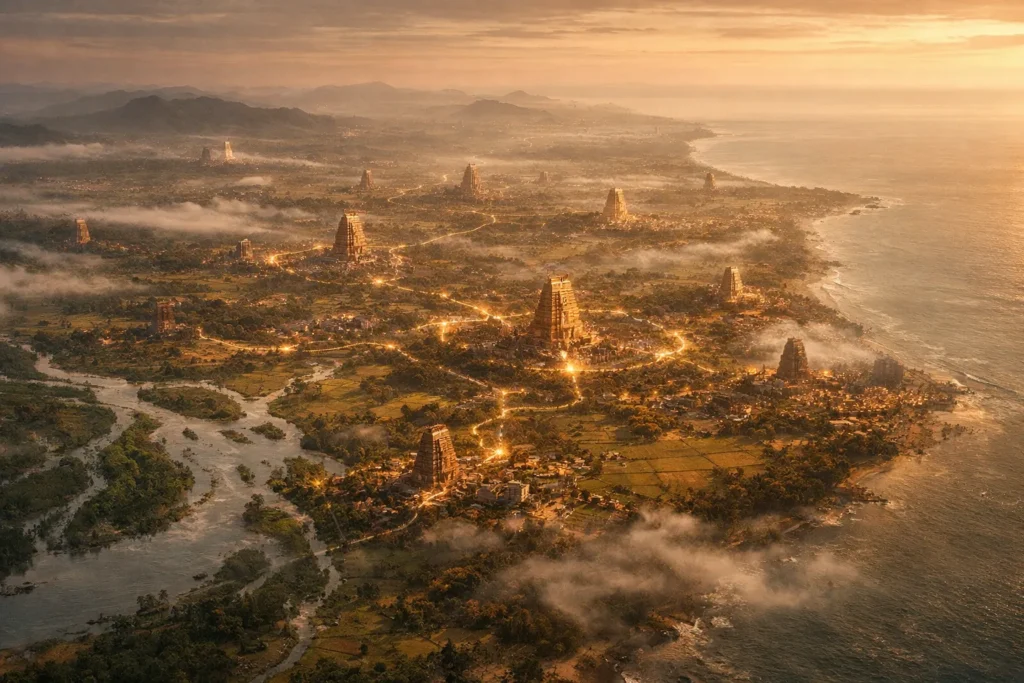
The 276 temples are not randomly distributed. They cluster — along rivers, along ancient trade routes, along the coastal plains, in the hills. And the clusters create natural circuits — journeys of devotion that move through the landscape with an internal logic that is simultaneously geographical, mythological, and spiritual.
The Landscape — 276 Padal Petra Sthalams
The 276 Padal Petra Sthalams are not evenly distributed across Tamil Nadu — they cluster, the way devotion clusters, around the places where the sacred and the geographical converge most powerfully.
The greatest concentration lies in the Cauvery delta — the Chola heartland, where the river’s sacred waters feed a landscape so dense with temples that a traveller can visit a different Padal Petra Sthalam every morning for months without exhausting the circuit.
Further south, the temples cluster along the Vaigai river in the ancient Pandya kingdom — a different landscape, a different quality of sacred atmosphere, a different character of Shiva’s presence.
Along the coast, from Nagapattinam in the south to Kanchipuram in the north, the temples follow the line where the land meets the sea. In the interior — the Kongu Nadu, the Tondai region — the temples are more scattered, more solitary, carrying a quality of undisturbed sacred atmosphere that the crowded delta temples can rarely offer.
To understand this distribution is to understand what the Nayanmars actually created: not a list of individual sacred sites, but a living network — a web of devotion woven across every landscape, every river valley, every coastal headland of the Tamil land. Shiva is everywhere. And in 276 specific places, the saints confirmed it in verse.
Understanding these circuits is the key to understanding how to walk the Padal Petra Sthalams. Not as a checklist. Not as a pilgrimage marathon to be completed in the minimum possible time. But as a series of immersions — each circuit offering a different quality of landscape, a different quality of Shiva’s presence, a different quality of the devotional encounter.
The Five Sacred Regions — How the 276 Temples Cluster
The Padal Petra Sthalams fall naturally into five regional groupings — each with its own landscape character, its own dominant dynasty, its own quality of sacred atmosphere. Understanding these regions is the first step toward designing a pilgrimage that moves with the landscape rather than against it.
The Cauvery Delta is the heart — approximately one hundred and ninety temples packed into the most sacred river geography in South India. Chidambaram, Thiruvarur, Kumbakonam, Sirkazhi — the names alone are a litany of the greatest Shaiva sacred sites on earth. This is where the Chola dynasty reached its fullest architectural expression, where the Nayanmars sang their most celebrated hymns, where the density of sacred atmosphere is so concentrated that first-time visitors often find the experience overwhelming. Begin here if you are beginning anywhere.
Pandya Nadu carries the sacred geography of the deep south — the Madurai region, the Tirunelveli plains, the approaches to the southernmost tip of the subcontinent. The temples here have the character of the Pandya tradition — older in feeling, more primal in atmosphere, rooted in the red earth of the south with a directness of devotional energy that distinguishes them from the architectural refinement of the Chola heartland.
The Tondai region — Kanchipuram, Thiruvannamalai, the districts surrounding Chennai — is where the Padal Petra tradition meets the great philosophical institutions of the north. Kanchipuram alone contains multiple Padal Petra Sthalams of the first order.
Thiruvannamalai, with its fire lingam and its circumambulable hill, stands at the spiritual edge of the Nadu Naadu (Central region) as one of the most atmospherically powerful sacred sites in all of India and other temples in Cuddalore, and Villupuram districts.
The Kongu Nadu — the interior of Tamil Nadu, the Tiruppur, Karur and Erode region — holds temples that are less visited and therefore carry a quality of undisturbed sacred atmosphere rarely found in the more famous circuits. These are the temples where the morning abhisheka happens before fifty devotees rather than five thousand. Where the priest knows every regular visitor. Where the encounter with the deity is unmediated by crowds or commercial activity.
The remaining ten temples spread across one each in Kerala, Karnataka, Nepal, Tibet, and two each in Andhra Pradesh, Uttarakhand, Sri Lanka.
The Cauvery Delta — The Heart of the Sacred Grid
The Cauvery delta is where the density is greatest and the sacred atmosphere most concentrated. Approximately one hundred and ninty of the 276 temples lie within a relatively compact area — from Chidambaram in the north to Kumbakonam at the centre to Thiruvarur in the south, with the river and its branches threading between them.
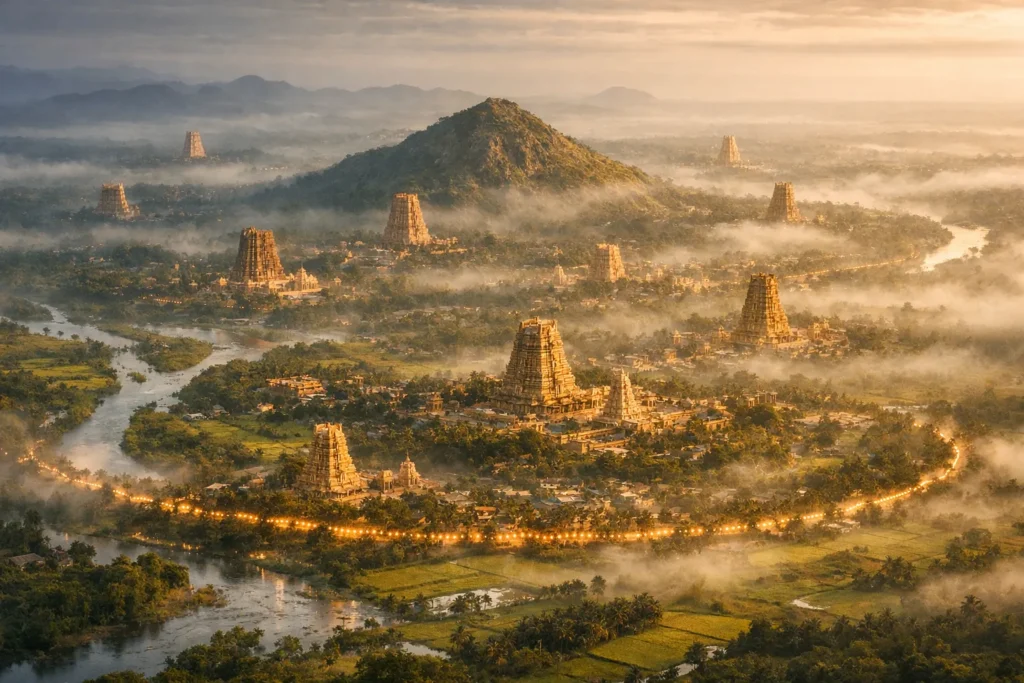
This is the Chola heartland — the land that the greatest dynasty in South Indian history built its civilisation upon — and it is no accident that the greatest concentration of Padal Petra Sthalams lies here.
The Cholas were the most lavish patrons of Shaiva temple building in history. They took the temples that the Nayanmars had sung and rebuilt them in stone, expanded them with corridors and gopurams and sacred tanks, endowed them with land and priests and daily rituals. The Cauvery delta temples are the result of this extraordinary convergence: Nayanmar devotion providing the sacred geography, Chola patronage providing the architectural magnificence.
Three towns anchor this circuit with particular force:
Chidambaram — Thillai Nataraja is the philosophical and geographic centre of the entire Padal Petra tradition. This is the temple of the cosmic dance — the Ananda Tandava, the dance of bliss in which Shiva simultaneously creates, sustains, dissolves, conceals, and reveals. The Nataraja image — Shiva dancing within a ring of fire, one foot raised, one hand pointing to the lifted foot in the gesture that says “this is the refuge” — is the most philosophically complete image in the entire Hindu tradition.
At Chidambaram, Shiva is worshipped not as a lingam but as pure space — the Akasha Lingam, the formless form, the space in which all creation dances. The inner sanctum of Chidambaram contains what the tradition calls the Chidambara Rahasyam — the secret of Chidambaram — which is simply the curtain that, when drawn back, reveals… nothing. Empty space. The formless infinite. Shiva as the space in which everything exists.
Sambandar sang here. Appar sang here. Manickavasagar sang here with such intensity that his Tiruvachakam begins and ends with Chidambaram. This is a temple that demands at least two visits — one to encounter it, and one to begin to understand what you encountered.
Thiruvarur — The Temple of Thyagaraja is the sacred heart of the Sapta Vidanga tradition and one of the most architecturally vast temple complexes in Tamil Nadu. The presiding deity is Thyagaraja — Shiva in his dancing form, but here the dance is not the Ananda Tandava of Chidambaram. It is a different dance, a different mood, a different quality of divine movement.
The temple tank at Thiruvarur — the Kamalalayam — is one of the largest temple tanks in India, and the festival procession here, in which the deity is taken in procession on the sacred tank on a float, is one of the most visually overwhelming ritual events in the Cauvery delta. Sambandar sang multiple hymns at Thiruvarur. The temple’s sacred history reaches back to the period of the Sangam literature.
Kumbakonam — The City of Temples is not a single temple but an entire sacred city — a cluster of major Shaiva and Vaishnava temples packed into a relatively small urban area, each with its own Puranic history, its own Nayanmar hymns, its own architectural character.
The Mahamaham tank at Kumbakonam — where the sacred waters of all India’s rivers are said to gather once every twelve years — is the site of one of the largest gatherings of pilgrims anywhere in the world.
For the Sacred Trails traveller, Kumbakonam is a base camp — a city from which the Cauvery delta temples can be visited in sequence, each morning a different temple, each evening a return to the city’s extraordinary concentration of sacred atmosphere.
Pandya Nadu — The Southern Sacred Land
The Pandya region — Madurai and its surroundings, extending south toward Tirunelveli and east toward Rameswaram — carries a different quality from the Cauvery delta. Where the delta temples feel ancient and architecturally layered, the Pandya temples feel primal — older in feeling if not always in construction, rooted in the red earth of the south with a directness of devotional energy that is distinct from the refinement of the Chola heartland.
The Pandya kings were patrons of the Shaiva tradition who competed with the Cholas in the grandeur of their temple building. The great Meenakshi Amman Temple at Madurai — while primarily a Shakta temple — stands in a Pandya sacred landscape that includes significant Padal Petra Sthalams.
Further south, approaching the tip of the Tamil peninsula, the temples carry the atmosphere of a land that ends at the sea — the specific quality of sacred sites where the earth runs out and the ocean begins. Kanyakumari is not itself a Padal Petra Sthalam but its spiritual gravity pulls the entire southern circuit toward the southernmost point — the place where three seas meet and the land surrenders itself to the water.
Tondai Nadu — The Northern Threshold
The Tondai region — roughly the area of modern Chennai and its surrounding districts, including Kanchipuram — is where the Padal Petra tradition meets the great Shaiva philosophical institutions of the north.
Kanchipuram — one of the seven sacred cities of Hinduism, the city of the thousand temples — contains a significant cluster of Padal Petra Sthalams, including the extraordinary Ekambareswarar temple where Shiva is worshipped as the Earth lingam — Prithvi Lingam — one of the five Pancha Bhoota Sthalams. The Kanchipuram temples have a character shaped by centuries of Pallava patronage — the dynasty that first articulated the vocabulary of Dravidian temple architecture — and the stone carving here has a precision and an elegance that distinguishes it from the more exuberant Chola and Vijayanagara work of the delta temples.
Nadu Nadu
Thiruvannamalai — where the sacred Arunachala hill rises from the plains and Shiva is worshipped as the Fire lingam — stands at the edge of the Tondai region in the Nadu Naadu and demands its own extended visit. This is a temple and a landscape that operates at a different frequency from most sacred sites — the hill itself is considered the lingam, and the practice of pradakshina — circumambulating the hill — is one of the most powerful sacred walks in South India.
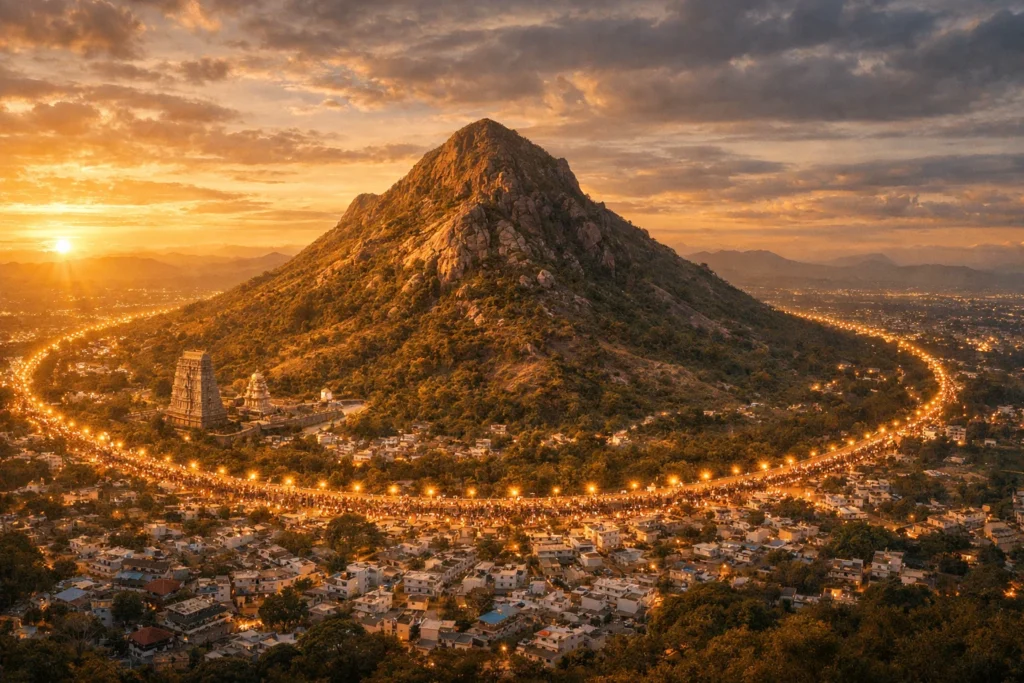
Ramana Maharshi lived in the shadow of Arunachala for fifty years and described the hill as a living teacher. Sambandar and Appar both sang here. The combination of the Nayanmar hymns and the more recent Advaita presence of Ramana gives Thiruvannamalai a layered sacred atmosphere that is unique in the Tamil sacred landscape.
The Kongu Nadu — Temples of the Interior
The Kongu region — the interior of Tamil Nadu, the area of Tiruppur, Erode, Namakkal and Karur, bounded by the Western Ghats to the west — carries a quality of sacred geography distinct from both the coastal and delta traditions. These are the temples of the Tamil interior — surrounded not by rice paddies and river channels but by dry land, granite outcrops, and the foothills of the Ghats.
The Kongu temples are less visited by the standard pilgrimage circuit and for precisely this reason they carry an atmosphere of particular authenticity, with the sound of the nadaswaram carrying across open land rather than echoing off corridor walls — offers a quality of direct encounter with the divine that the most famous and crowded temples can rarely provide.
The western edge of the Kongu region meets the temples of Kerala — where the Shaiva tradition takes on a distinctly different architectural and ritual character, shaped by the Kerala style of temple building with its steeply pitched wooden roofs and enclosed courtyards. The Sacred Trails’ future temple circuits will cross this boundary and explore the conversation between Tamil and Kerala Shaivism — a conversation that has been ongoing for over a thousand years.
Beyond Tamil Nadu — The Temples Outside the Borders
Not all 276 Padal Petra Sthalams lie within Tamil Nadu. A small but significant number extend beyond its borders — and their inclusion is not incidental, but deeply theological.
In Andhra Pradesh, temples such as Srisailam and Srikalahasti carry the hymns of the Nayanmars. To the west, Thiruvanchikulam in Kerala and Gokarna in Karnataka reflect the enduring continuity of Shaiva traditions beyond Tamil Nadu — a cultural and spiritual flow that predates modern linguistic boundaries. Across the sea, the shrines of Koneswaram and Ketheeswaram in Sri Lanka find their place within the canonical list, extending this sacred landscape beyond the Indian mainland.
The tradition reaches even further — to Gaurikund, Kedarnath, and regions of Nepal — marking the northern extent of this sacred geography.
Among the 276 are also sites that are not merely geographic destinations. Kailash — the abode of Shiva in the Himalayas — is included not as a temple one visits in the ordinary sense, but as a recognition of the source itself.
These are not inclusions made for completeness. They are statements.
They remind us that the Padal Petra Sthalams are not a map drawn by territory, but a map revealed through experience. The saints did not chart regions — they responded to presence.
The two hundred and seventy-six shrines that can be visited form a complete and living world. The few that lie beyond Tamil Nadu — whether across the sea or in the heights of the Himalayas — remain as markers of something larger:
that the sacred cannot be fully contained within geography, and
that no pilgrimage ever exhausts the map.
V. Walking the Sacred Grid — Three Ways to Enter
The 276 Padal Petra Sthalams cannot be visited in a single journey. Most serious pilgrims spend years — decades — completing the circuit, returning again and again to temples they have already visited, finding new layers of meaning on each return.
For the traveler approaching this tradition for the first time — for the Sacred Trails reader who has followed this series from the Vedas to the Nayanmars to this moment — the question is not how to complete the circuit. It is how to begin.
Here are three ways in.
Three Ways Into the Sacred Grid
The Elemental Journey — 5 to 7 days Five temples. Five elements. The most philosophically concentrated entry point into the Padal Petra tradition.
Begin at Kanchipuram — Earth — where Shiva is worshipped in the form the earth itself takes when it becomes sacred.
Move to Thiruvanaikaval — Water — where the lingam is partially submerged in the Cauvery’s sacred spring.
Travel to Thiruvannamalai — Fire — where the Arunachala hill is the lingam and the dawn pradakshina is one of the great sacred walks in India.
Continue to Srikalahasti — Air — where the sacred lamp flame moves in the invisible breath of the deity.
Complete the journey at Chidambaram — Space — where the curtain is drawn back and the secret of the universe is revealed as emptiness. Best season: October to February.
The Tevaram Trail — 8 to 12 days Seven temples. The living canon of Tamil Shaiva poetry, walked in stone. This circuit follows the temples where Sambandar, Appar, and Sundarar sang their most celebrated hymns — where the verses that Tamil children still memorise were first composed, in specific inner sanctums, before specific forms of Shiva, in specific seasons of the saints’ lives. Sirkazhi. Chidambaram. Thiruvarur. Thiruvannamalai. Thiruvaiyaru. Thirupadripuliyur. Tiruvidaimarudur. Read the hymns before you go. Read them again after. The temples will have changed what the words mean. Best season: November to January. Skanda Sashti and Karthigai Deepam add extraordinary depth if timing allows.
The Delta Immersion — 6 to 8 days One base. Many mornings. The Cauvery delta as a sustained sacred experience rather than a checklist of sites. Kumbakonam as your centre — each morning a different temple within forty kilometres, each evening a return to the city’s own extraordinary cluster of sacred sites. The Padal Petra Sthalams of Thiruvidaimarudur, Thiruvaiyaru, and Thiruvarur anchor the devotional circuit — these are the temples the Nayanmars sang, the temples where the Tevaram was first heard in the inner sanctum.
And within the same landscape, two temples that are not Padal Petra Sthalams but are architecturally unmissable: Darasuram’s Airavatesvara temple and Gangaikondacholapuram’s great Brihadeeswara — both UNESCO World Heritage Sites, both supreme achievements of Chola architecture, built by kings whose devotion shaped the same sacred landscape the saints had sung. They were not sung by the Nayanmars. They were built by the dynasties the Nayanmars inspired. The distinction matters — and both are worth your time.
The Kumbeshwarar, the Sarangapani, the Chakrapani — Kumbakonam’s own Padal Petra temples — complete each evening’s return. This is the circuit for the traveller who wants to go deep rather than wide — who wants the experience of living inside a sacred landscape for a full week. Best season: November to February. Mahamaham year at Kumbakonam — next in 2028 — is a once-in-a-generation experience.
VI. The Morning That Changes Everything
There is something that happens at a Padal Petra Sthalam in the early morning that cannot be fully described. It can only be pointed at — the way the Nayanmar hymns themselves point at the experience they are describing rather than containing it.
You arrive before sunrise.
The town around the temple is not fully awake — a few tea stalls with their first customers, the occasional motorcycle, a flower seller arranging jasmine and marigold in the lamplight. The air carries the specific combination of incense and river dampness and open land that is the signature of the Tamil sacred landscape in the hour before dawn.
At the temple entrance, you leave your footwear. The stone underfoot is cold — the cold of granite that has not yet received the sun’s heat, the cold that has been there all night, absorbing the darkness and the silence. You cross through the outer gopuram — its carved surface a universe of figures in the last of the darkness, faces you cannot quite read.
Inside, the corridors are lit by oil lamps. The light is not electric — not the flat, sourceless illumination of a modern building — it is directional, warm, flickering slightly in the air moved by the corridor’s draught. Every surface is alive with shadow and gold. The smell of camphor is strong now, and beneath it the older smell of the stone itself — the centuries of abhisheka, of milk and honey and rosewater, absorbed into the granite until the stone itself seems to breathe.
You hear the Tevaram before you see anything.
A priest in the inner sanctum — or several priests, voices layered — is singing. The specific hymn of the specific saint who sang at this specific temple, a thousand years ago, in this specific place. The sound moves through the stone corridors the way water moves through rock — finding every passage, filling every space, arriving at you from every direction simultaneously.
You reach the inner sanctum.
The deity is visible through the gateway — lit by the glow of the lamps, adorned with the morning’s fresh flowers, the abhisheka just completed, the sacred ash still fragrant in the air. For a moment — and this is the moment the tradition exists to create, the moment the Nayanmars sang about, the moment Meykandar’s philosophy points at — the distance between you and what you are looking at disappears.
Not because the stone statue has become divine. Because you have, for one unguarded moment, stopped insisting that it hasn’t.
This is what the Padal Petra Sthalams are for.
This is what the Nayanmars built when they sang. This is what two hundred and seventy-six temples, mapped across the Tamil land with the precision of two thousand years of devotion, are waiting to offer every traveller who arrives before sunrise, leaves their footwear at the entrance, and walks in with open eyes.
VII. The Land That Waits — A Bridge to What Comes Next
Two hundred and seventy-six temples.
Sung by sixty-three saints. Patronised by three dynasties. Served by thousands of priests across forty generations. Visited by hundreds of millions of pilgrims across a thousand years. Still receiving daily worship. Still fragrant with camphor and jasmine. Still echoing with the Tevaram that the child Sambandar sang, the farmer’s son Appar sang, the aristocrat Sundarar sang.
Still waiting.
The Padal Petra Sthalams are the Shaiva sacred geography of Tamil Nadu — the 276 specific addresses where the saints found Shiva and left behind, in verse, the record of what they found. They form the spine of every Shaiva pilgrimage circuit in South India. They are the living canon of Tamil temple geography — not a historical record but a present invitation.
But the Shaiva sacred landscape of Tamil Nadu is larger than the Padal Petra Sthalams alone. The 276 temples are the primary circuit — the canon — but surrounding them, nested within the same Tamil sacred geography, are other circuits of equally extraordinary significance.
The Pancha Bhoota Sthalams — where Shiva is worshipped as the five elements — offer the most philosophically concentrated journey in the entire tradition. The Sapta Vidanga Sthalams — where Shiva dances in seven specific forms along the Cauvery — offer the most mythologically layered. The Navagraha Sthalams — where the nine cosmic forces are worshipped as specific deities in nine temples of the delta — offer the most cosmologically rich.
And beyond all of these — the Pancha Sabhai, the five cosmic dance halls where Shiva’s dance is understood to be simultaneously occurring in five different forms, five different materials, five different qualities of the infinite movement.
In the next blog, we explore these circuits — the sacred networks that surround and enrich the Padal Petra tradition, and the ways in which a traveller can design their own journey through the Shaiva sacred landscape of Tamil Nadu. And we arrive, at last, at the practical invitation: not merely where to go, but how to go, what to carry, what to leave behind, and what the Tamil sacred landscape asks of anyone who enters it with genuine openness.
Next in the Sacred Foundations Series :
The Other Circuits — Pancha Bhoota, Sapta Vidanga, Navagraha, and the Complete Shaiva Sacred Map of Tamil Nadu.
Coming soon on thesacredtrails.com 🙏