
Rahu in Dhanishta and Political Turning Points in India
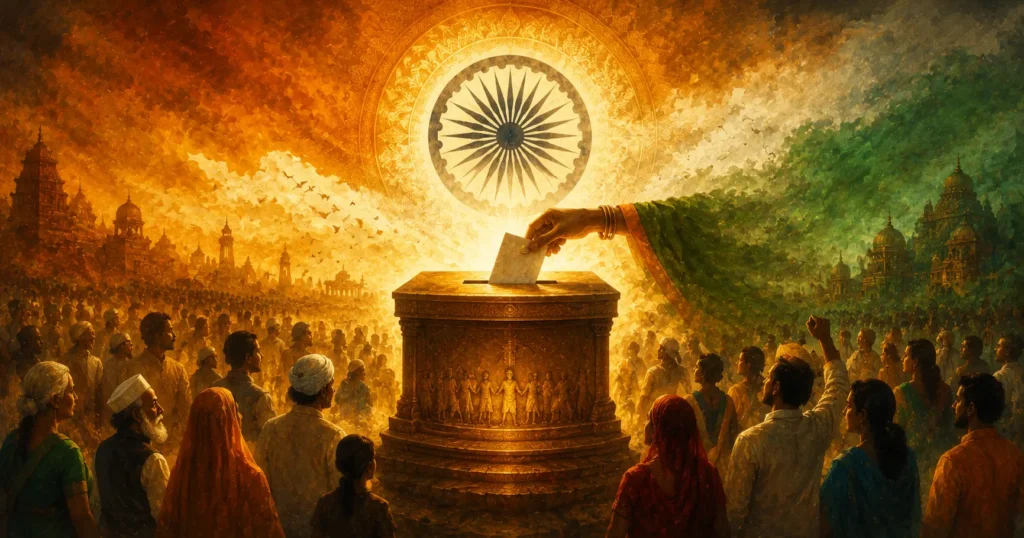
“Unlike financial markets, political systems do not collapse overnight. Institutions evolve gradually, governments lose or gain legitimacy over time, and electoral verdicts often reflect years of accumulated public sentiment. Yet history also contains moments when seemingly stable political structures undergo rapid transformation. It is these moments of transition that form the focus of this chapter.“
From Global Markets to Indian Democracy
The previous chapter examined Rahu’s transit through Dhanishta alongside major developments in the global financial system. While the historical contexts differed across each cycle, a recurring theme emerged: periods of institutional stress, economic restructuring, and financial transformation.
India’s political history since Independence presents a different, yet equally intriguing, pattern.
Since 1947, Rahu has transited Dhanishta four times:
- 1952
- 1970–1971
- 1989–1990
- 2007–2008
Each period coincided with significant developments in India’s political evolution. These were not always moments of governmental collapse or constitutional crisis. Rather, they marked phases during which the nation’s political landscape underwent meaningful realignment, institutional testing, or changes in the balance of power.
As with the financial analysis presented earlier, this chapter does not argue that planetary movements caused these developments. Instead, it examines whether the historical record reveals a recurring association worthy of further study.
1952
The Birth of Electoral Democracy
India at a Glance
- First General Election under the Constitution.
- Jawaharlal Nehru became the first elected Prime Minister.
- Election Commission conducted the world’s largest democratic exercise.
- Integration of administrative institutions continued.
- The Republic of India entered its first phase of elected governance.
When Rahu entered Dhanishta on 9 March 1952, independent India was less than five years old.
Unlike later cycles characterised by political instability or coalition negotiations, this transit coincided with the establishment of democratic legitimacy itself.
India’s first General Election, conducted between 1951 and 1952, was unprecedented in scale. More than 170 million citizens were eligible to vote, many of them participating in an election for the first time in their lives. Conducted across diverse geographies and multiple languages, the exercise demonstrated that universal adult franchise could function in a newly independent nation of extraordinary diversity.
The Indian National Congress secured a decisive mandate, and Jawaharlal Nehru assumed office as the country’s first democratically elected Prime Minister under the Constitution.
Equally important was the consolidation of institutions. The Election Commission established its credibility, Parliament began functioning as the principal forum of democratic governance, and the administrative integration of former princely states continued.
This period therefore differed fundamentally from the later transits examined in this chapter.
Rather than representing political instability, the 1952 transit marked the construction of democratic institutions—a foundational transformation that shaped every subsequent phase of Indian politics.
1970–1971
The Congress Split and the Emergence of a New Political Order
India at a Glance
- Internal conflict divided the Indian National Congress.
- Prime Minister Indira Gandhi consolidated authority.
- The Lok Sabha was dissolved ahead of schedule.
- General Elections were held in 1971.
- The Bangladesh Liberation crisis began to reshape South Asian geopolitics.
By the time Rahu entered Dhanishta on 14 October 1970, India’s political landscape was undergoing one of the most consequential transformations since Independence.
The split within the Indian National Congress had fundamentally altered the country’s dominant political force. Prime Minister Indira Gandhi’s differences with the party’s traditional leadership—often referred to as the “Syndicate”—resulted in a division that reshaped Indian politics for decades to come.
Following the split, Indira Gandhi led a minority government that depended on outside support while simultaneously strengthening her personal political authority. Her government advanced policies such as bank nationalisation and the abolition of privy purses, measures that generated both widespread support and intense political opposition.
The political uncertainty culminated in the early dissolution of the Lok Sabha and the General Election of 1971, in which Indira Gandhi secured a decisive mandate under the slogan “Garibi Hatao.”
At the same time, tensions in East Pakistan escalated rapidly, setting the stage for the Bangladesh Liberation War later that year. The conflict would profoundly influence India’s strategic and political position in South Asia.
Viewed historically, this transit coincided with the transition from an era dominated by collective party leadership to one increasingly centred on strong executive authority.
1989–1990
The End of Single-Party Dominance
India at a Glance
- Congress lost its parliamentary majority.
- Coalition governments emerged at the national level.
- V.P. Singh became Prime Minister.
- The Bofors controversy reshaped electoral politics.
- The Ram Janmabhoomi movement gained national prominence.
- Political instability increased in Jammu and Kashmir.
Rahu entered Dhanishta on 21 May 1989 at a moment when India’s post-Independence political order was approaching a historic turning point.
For much of the previous four decades, the Indian National Congress had remained the dominant force in national politics. Although opposition parties had periodically formed governments, Congress continued to define the country’s political landscape.
The General Election of 1989 fundamentally changed that equilibrium.
Public dissatisfaction over corruption allegations, particularly those arising from the Bofors controversy, weakened the Congress government. The election produced a fractured mandate, and V.P. Singh assumed office at the head of the National Front coalition with external support from both the Bharatiya Janata Party (BJP) and the Left parties.
For the first time, coalition politics became the defining feature of governance at the national level.
This period also witnessed the rapid rise of the Ram Janmabhoomi movement, which transformed political discourse and contributed to the emergence of identity-based politics as a major electoral force.
Simultaneously, Jammu and Kashmir experienced increasing political instability and the beginnings of a prolonged security challenge that would shape national policy for years to come.
Looking back, the 1989–1990 transit represented more than a change of government. It marked the beginning of a new political era in which coalition-building, regional parties, and shifting parliamentary alliances became central features of Indian democracy.
2007–2008
Coalition Politics Under Extraordinary Pressure
India at a Glance
- The Indo–US Civil Nuclear Agreement dominated national politics.
- Left Front parties withdrew support from the UPA government.
- Parliament held a historic confidence vote.
- The “Cash-for-Votes” controversy erupted.
- India continued to maintain high economic growth despite global financial turbulence.
When Rahu entered Dhanishta on 26 December 2007, India was governed by the United Progressive Alliance (UPA), led by Prime Minister Dr. Manmohan Singh.
Although the country was experiencing robust economic growth, the government’s political stability soon came under severe strain.
The central issue was the proposed Indo–US Civil Nuclear Agreement. The Left Front, which had been providing outside support to the UPA government, opposed the agreement on strategic and ideological grounds. Their withdrawal of support reduced the government to a minority, compelling it to seek new parliamentary allies.
The resulting confidence vote in July 2008 became one of the most dramatic parliamentary events in modern Indian history. The proceedings were overshadowed by the “Cash-for-Votes” allegations, generating widespread public debate regarding political ethics and parliamentary accountability.
Despite these challenges, the government survived the confidence motion, enabling the civil nuclear agreement to proceed and significantly influencing India’s international strategic relationships.
This period illustrates another recurring theme identified throughout this study: not necessarily governmental collapse, but moments when political institutions are subjected to exceptional pressure, forcing realignment, negotiation, and institutional testing.
Looking Across Four Political Cycles
Examined individually, each Rahu-in-Dhanishta transit occurred under vastly different political circumstances.
Yet several common themes emerge.
Institutional Transformation
In 1952, India established the democratic institutions that would define the Republic.
In 1971, the balance between party organisation and executive leadership underwent a profound shift.
In 1989, coalition politics permanently altered parliamentary governance.
In 2008, coalition management and parliamentary accountability were tested under extraordinary circumstances.
Leadership Transitions
Each cycle coincided with periods in which political leadership faced major challenges, strengthened its authority, or adapted to changing public expectations.
Some governments consolidated power.
Others lost it.
In every case, leadership became central to the political narrative.
Realignment Rather Than Collapse
An important observation distinguishes the Indian experience from the financial history discussed in Part II.
The financial cycles frequently involved crises.
India’s political cycles more often involved realignment.
Governments were reconfigured.
Political alliances shifted.
Institutions adapted.
The constitutional framework itself, however, remained resilient.
This distinction is important because it highlights that transformation need not imply instability. Political systems often evolve through negotiated change rather than systemic breakdown.
The Mundane Astrological Perspective
Within Vedic Mundane Astrology, practitioners commonly analyse India’s Independence chart alongside major planetary transits.
Rahu’s movement through Dhanishta is interpreted by many astrologers as a period during which questions surrounding governance, institutions, political alliances, and national priorities may become more prominent.
The historical review presented in this chapter neither validates nor disproves that interpretation. It simply demonstrates that each of the four completed Rahu-in-Dhanishta transits since Independence coincided with significant political milestones that altered the trajectory of Indian democracy in different ways.
Whether these recurring associations represent meaningful cycles or historical coincidence remains open to interpretation.
Looking Ahead to 2026–2027
As Rahu prepares to enter Dhanishta once again in August 2026, students of mundane astrology will undoubtedly observe developments in India’s political landscape with renewed interest.
Rather than anticipating specific outcomes, history suggests that attention may reasonably be directed toward broader themes:
- The evolution of political alliances.
- Institutional and constitutional developments.
- Leadership transitions within major parties.
- Electoral realignments.
- Significant policy initiatives with long-term implications for governance.
History does not reveal what will happen.
It merely shows what has happened before.
Coming in Part IV
Looking for the Pattern: Do Eight Cycles Reveal More Than Coincidence?
Having examined both global financial history and India’s political evolution, we now step back from the chronology to ask the central question of this investigation: Do these eight Rahu transits through Dhanishta reveal a recurring historical pattern, or are we simply connecting unrelated events across time?