
The Hindu Answer to ‘Why Does Anything Exist?’
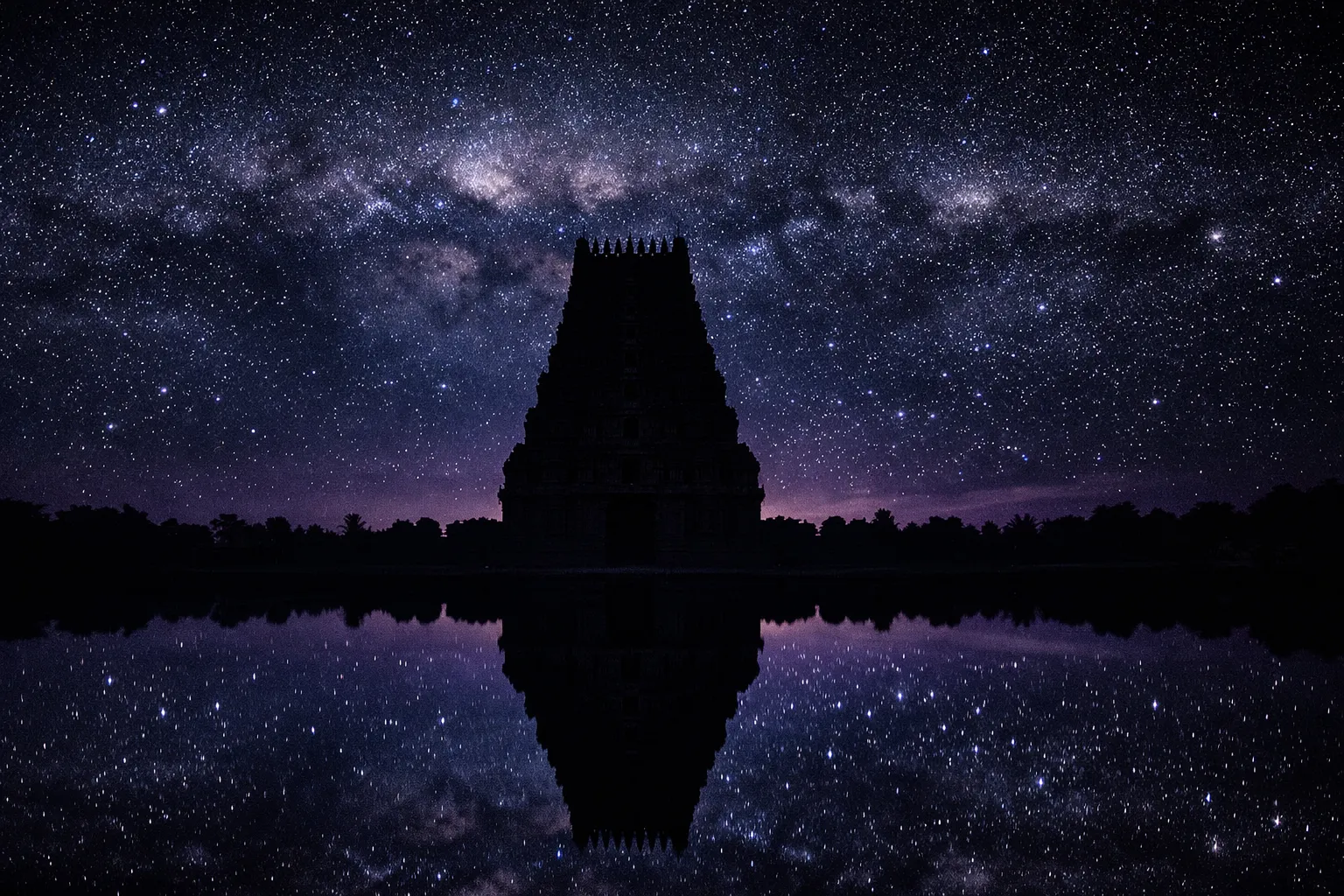
At the heart of Hindu cosmology lies a question older than any civilisation — why does anything exist at all? Every civilisation that has ever existed has asked the same question. The ancient Greeks asked it. The medieval Christian theologians asked it. Modern physicists, staring at equations that describe the first microseconds of existence, are still asking it. Three-year-olds ask it before they have the vocabulary for it.
Why is there something rather than nothing?
Many traditions approached the question differently. They called it mystery, or miracle, or the will of an inscrutable god, and moved on to more manageable questions. Ancient India did not give up. It sat with the question — for generations, in silence, with the discipline of people who understood that the greatest questions deserve the greatest patience — and it answered.
The answer they gave does not begin with a god who spoke light into being. It does not begin with an explosion of primordial matter. It begins somewhere stranger and more honest than either of those — in a poem, composed at least three thousand years ago, that describes the state before the universe existed by refusing to describe it at all.
What you are about to read is not religion. It is not mythology. It is one of the oldest, most rigorous attempts in human history to understand why existence exists — and why that question is inseparable from every temple on The Sacred Trails.
Before we walk through a single temple gate. Before we light a single lamp or hear a single bell. Before we stand before a deity that has been receiving prayers for two thousand years and try to understand what we are actually looking at — we need to go back. Not to the beginning of Indian history. Not to the founding of the first temple. But to the beginning of everything.
This is where the story starts.
I. The Question
Imagine a room with no walls.
No floor either. No ceiling. No air, no light, no time. No one to notice the absence of any of these things because there is no one — no thing, no awareness, no moment in which anything could be noticed.
Now imagine — if you can hold a thought in a place where thinking itself doesn’t yet exist — that this nothingness is not empty. That it is, in fact, so full of itself that the word ‘nothing’ insults it. That it is pure, undifferentiated potential. The universe before the first breath. The silence before the first word. The canvas before the first brushstroke.
This is where the story begins.
Not with a god who spoke light into being. Not with an explosion of primordial matter. But with a question — posed by a poet sitting in the dark somewhere in the Indian subcontinent at least three thousand five hundred years ago — that has never been satisfactorily answered since:
Why does anything exist at all?
Most civilisations that have faced this question have retreated, eventually, into one of two answers. Either something divine willed the universe into being — which simply relocates the mystery one step back: where did the divine come from? — or the universe has always existed, which merely declares the question unanswerable rather than answering it.
The poets of the Rigveda — the ancient Indians who composed what is now considered the oldest surviving text of the Indo-Aryan tradition — refused both retreats. They sat with the question. They held it. And they wrote something so strange, so honest, and so philosophically precise that modern cosmologists, when they first encounter it, sometimes experience the uncomfortable sensation of being anticipated.
📜 From the Rigveda
नासदासीन्नो सदासीत्तदानीं नासीद्रजो नो व्योमा परो यत् । किमावरीवः कुह कस्य शर्मन्नम्भः किमासीद्गहनं गभीरम् ॥
Nasad asin no sad asit tadanim nasid rajo no vyoma paro yat Kim avarivah kuha kasya sharmann ambhah kim asid gahanam gabhiram
“There was neither non-existence nor existence then; there was neither the realm of space nor the sky beyond. What stirred? Where? In whose protection? Was there water, unfathomably deep?” Nasadiya Sukta, Rigveda 10.129 — The Hymn of Creation. Composed approximately 1500–1200 BCE, though oral traditions likely predate this considerably.
Read that again. Not as a religious text. Read it as a thinker who refuses to be comforted.
There was neither non-existence nor existence. The poet is not saying the universe was empty. They are saying that the very categories of existing and not existing — the most fundamental categories the human mind possesses — did not yet apply. Whatever the primordial state was, it preceded the possibility of describing it. It was prior to language, prior to logic, prior to the subject-object distinction that makes both science and philosophy possible.
And then — the poem does something even more remarkable. It ends in uncertainty. He who surveys it all from highest heaven — he knows, or maybe he does not know. The poet acknowledges that even the divine perspective may not fully comprehend the nature of the beginning. This is not a failure of nerve. This is intellectual honesty so radical it feels almost modern.
This poem — the Nasadiya Sukta — is the foundation on which everything in The Sacred Trails rests. Before the first temple was built. Before the first priest lit the first fire. Before the first saint sang the first hymn to a presiding deity in a small stone shrine on the banks of the Cauvery. This question was already there. The temples are, in a sense, three-thousand-year-old attempts to answer it in stone.
II. The Answer — A Sacrifice That Created Everything
Here is what the ancient Indians believed happened.
In the beginning — if beginning means anything before time existed — there was only the Purusha. Not a person. Not a god in the conventional sense. Something closer to what modern physics might call a unified field, and what modern philosophy might call pure consciousness: the awareness that underlies all awareness, the intelligence that makes intelligence possible, the existence that makes existence possible.
The Purusha was complete. It lacked nothing. It needed nothing. It was — and this word will appear many times on this journey — Brahman: the Absolute, the Infinite, the ground of all being.
And then it chose to become finite.
Not because it was forced to. Not because something outside it compelled the act. But as an act of what can only be called — in the absence of a better word — love. Or play. Or the simple overflow of something so full that it naturally spills. The Sanskrit tradition uses the word lila for this: divine play, the universe as the spontaneous creative expression of consciousness delighting in its own infinite possibilities.
The Rigveda’s Purusha Sukta describes what happened next as a yajna — a sacrifice. And to understand this word is to understand the soul of the tradition we are entering.
📜 From the Rigveda
सहस्रशीर्षा पुरुषः सहस्राक्षः सहस्रपात् । स भूमिं विश्वतो वृत्वात्यतिष्ठद्दशाङ्गुलम् ॥
Sahasra-shirsha Purushah sahasrakshah sahasrapat Sa bhumim vishvato vritva atyatishthad dashangulam
“The Cosmic Being has a thousand heads, a thousand eyes, a thousand feet. Enveloping the earth on all sides, he stands beyond it by ten fingers’ breadth.” Purusha Sukta, Rigveda 10.90. The thousand is not a literal number — it means totality. Every head, every eye, every perspective that has ever existed or will ever exist is the Purusha looking at himself.
Notice that last line. The Purusha envelops the entire universe — and still extends beyond it by ten fingers’ breadth. This is not poetry for its own sake. It is poetry in the service of precision: the universe is not all there is of consciousness. Consciousness is larger than its own expression. The manifest world is real, but it is not the totality of the real. There is always a remainder — an excess of being that cannot be contained in any form, however vast.
From the Purusha’s self-sacrifice, the Purusha Sukta tells us, came everything. From his mind — the moon. From his eye — the sun. From his mouth — fire and the king of the gods. From his navel — the sky. From his feet — the earth. Every element of the cosmos is not merely created by the Purusha. Every element of the cosmos is a part of the Purusha.
This is the most important sentence in this essay, so let it settle: the universe is not made of matter that happens to be conscious in a few lucky corners. The universe is made of consciousness — and matter is what consciousness looks like from the outside.
This is the metaphysical ground on which every Hindu temple stands. When a devotee enters a temple and approaches the image of a deity, they are not approaching something external to themselves. They are approaching a mirror. The deity is a form of the same Purusha that is the devotee’s own deepest nature. The act of worship — at its most understood — is not petition. It is recognition.
III. The Law Beneath the Laws — Rta
Six in the morning on the Cauvery delta.
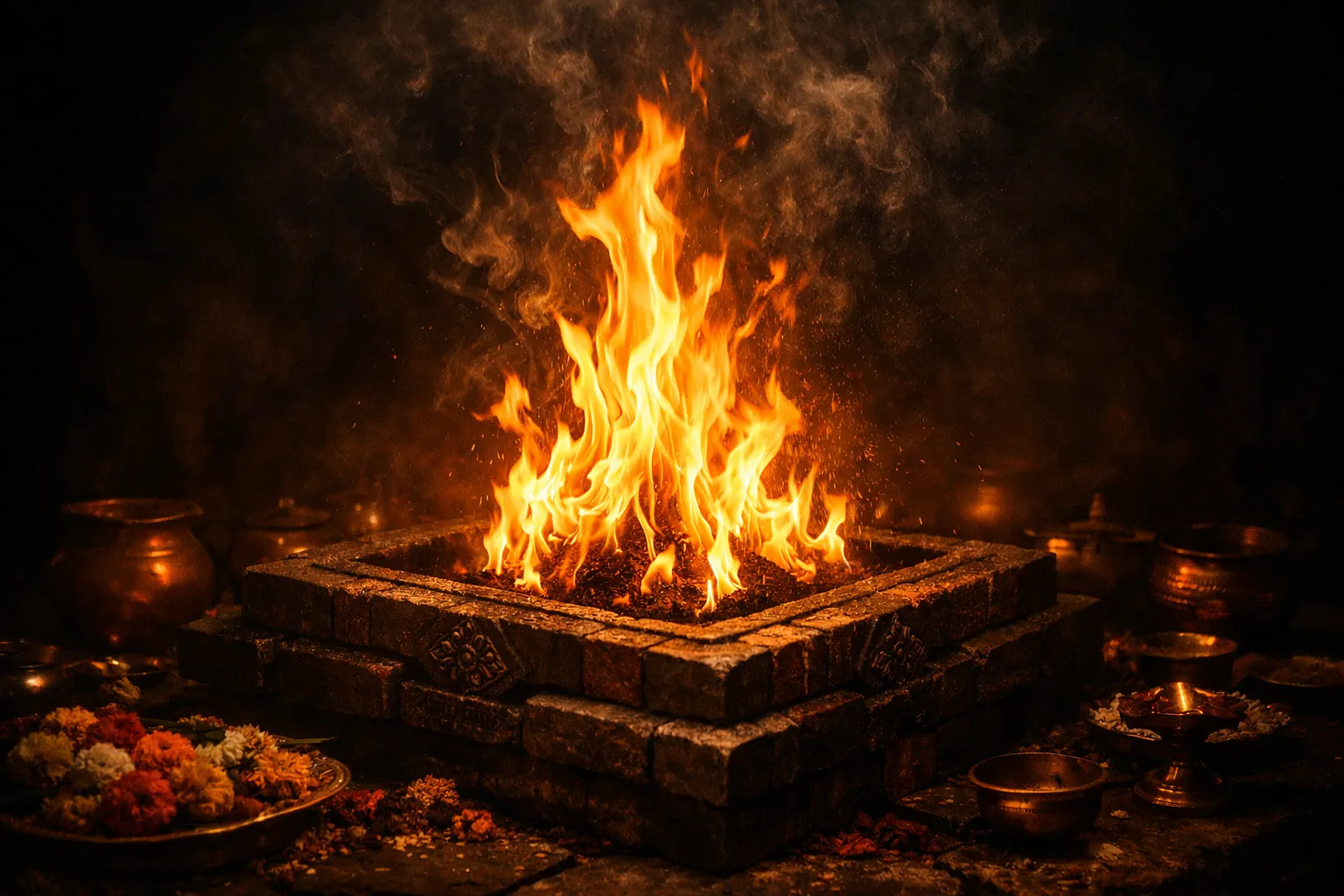
The sun is coming up over the paddy fields, exactly as it came up yesterday, exactly as it will come up tomorrow. The river is flowing south toward the sea, carrying the red soil of ten thousand years of agriculture. A priest in a temple somewhere along the bank is performing the morning ritual — the Kalasanthi puja — exactly as it was performed yesterday, exactly as it will be performed tomorrow. The incense smoke rises. The bells ring. The sun climbs.
There is a word for the principle that makes all of this possible. That makes the sun reliable, the river purposeful, the ritual meaningful. That makes the universe a cosmos — an ordered whole — rather than a chaos. The word is Rta.
Rta is one of the oldest concepts in the Rigveda, and one of the most difficult to translate because it operates simultaneously on three levels that modern thought has separated into different disciplines. As a physical principle, Rta is natural law — the regularities of nature that make the universe predictable enough to inhabit. As a moral principle, Rta is truth and righteousness — the cosmic standard against which human conduct is measured. As a metaphysical principle, Rta is the expression of Brahman in the manifest world — the way in which the infinite makes itself knowable through pattern, order, and regularity.
The guardian of Rta in the Vedic world is Varuna — not the minor deity of water that later tradition reduced him to, but the all-seeing cosmic sovereign who observes every action of every being and holds the universe to its own standards. He knows the flight of every bird, the path of every wind, the movement of every eye. He sees everything. He forgets nothing. He is less a god than a principle — the principle that the universe is a moral order as well as a physical one.
📜 From the Rigveda
ऋतस्य पन्थामन्वेति साधु विश्वा देवानां जनिमा विचष्टे ।
Rtasya pantham anu eti sadhu vishva devanam janima vichashtey
“He who follows the path of Rta goes well; the births of all the gods are made visible.” Rigveda 1.41.4 — To follow Rta is not mere obedience. It is alignment with the deep structure of reality itself — to participate in the ongoing act of cosmic creation.
Over centuries, Rta evolved into Dharma — the cornerstone of Hindu life. But the relationship between the two is essential: Dharma is not an arbitrary set of social rules. It is Rta translated into human terms — the particular form that cosmic order takes in human lives, relationships, and communities.
And when a temple priest performs the morning ritual at the prescribed hour, in the prescribed manner, with the prescribed words — he is not performing a superstition. He is performing Dharma. He is performing Rta. He is participating in the same cosmic order that makes the sun rise and the river flow. He is, in the most precise possible sense, aligned with the universe.
This is why — if you are ever fortunate enough to witness the dawn ritual at a great temple on the banks of a sacred river — the experience can feel so unexpectedly moving. Not because of the spectacle, but because of the recognition: this has been happening every morning, in this place, for a thousand years. The river has been rising. The sun has been climbing. The bells have been ringing. The cosmos has been, in its patient, unhurried way, held together.
IV. The Source Code — How the Universe Spoke
Somewhere in the foothills of the Himalayas, sometime between 1500 and 800 BCE, a teacher and a student are sitting in the early morning dark.
No books. No writing materials. No recording devices of any kind. The student is about to receive something that will take twelve years to learn — not a skill, not a trade, but a text. Thousands of verses of intricate Sanskrit poetry, composed in metres of extraordinary mathematical precision, carrying within them a complete philosophy of existence.
The teacher begins. The student listens. Not passively — with every cell of their attention, their memory tuned to a precision that modern educational psychology can barely imagine. Because there is no safety net. No manuscript to refer back to if the memory fails. No printed copy gathering dust on a library shelf. There is only the living transmission of sound from one human being to another — the oldest, most intimate, most demanding form of education the world has ever seen.
This is how the Vedas were preserved. Not in libraries. Not in archives. In human minds — generation after generation, for a period scholars conservatively estimate at between one and three thousand years before a single word was committed to writing.
The achievement is almost incomprehensible. The Rigveda alone contains 10,552 verses, composed in fifteen distinct metres. To memorise it with the accuracy the tradition demanded — not just the words but the correct pronunciation, the correct tone, the correct musical inflection of every syllable — required years of concentrated study beginning in childhood.
And the tradition did not stop at memorisation. It developed a system of cross-checking so sophisticated that errors were practically impossible. In the Jata patha — the intertwined recitation method — words were recited in patterns so complex that a single misremembered syllable would immediately reveal itself as a contradiction within the pattern. The text was its own error-correction system. The universe’s source code came with its own debugging tools.
Why did they do this? Why did a civilisation perfectly capable of writing choose to preserve its most sacred knowledge exclusively in living memory?
Because the Vedas are not primarily a text. They are a sound. The tradition holds that the universe itself is fundamentally sonic — that the first manifestation of the Absolute was not light, not matter, not energy, but sound. The Sanskrit word Nada refers to this primordial cosmic vibration. OM — the syllable that begins every Hindu ritual and every act of yogic meditation — is the human approximation of this primordial sound. The Vedas, in this understanding, are not records of human thought about the universe. They are the universe’s own self-expression, heard by human beings who had achieved sufficient stillness to receive them.
The word Shruti — meaning that which is heard — captures this precisely. The Rishis, the seers, did not compose the Vedas. They listened for them, in the deepest silence they could create, until the universe spoke.
The universe is not something that happened to consciousness. Consciousness is something the universe is doing.
Erwin Schrödinger — the Austrian physicist whose wave equation is one of the foundations of quantum mechanics, and who is better known to the general public for a thought experiment involving a cat in a box — kept a copy of the Upanishads on his desk throughout his working life. The Upanishads are the philosophical culmination of the Vedic corpus — the layer of text in which the cosmological insights of the Rigveda are developed into systematic metaphysics. Their central claim — that the observer and the observed are not ultimately separate, that the Atman (individual self) and Brahman (universal consciousness) are one — is, Schrödinger suggested, not unrelated to the problems he was encountering at the foundations of quantum physics.
He was not wrong to notice the resonance. Whether one chooses to see it as coincidence, as convergent evolution of human thought toward a deep truth, or as something more mysterious, the fact remains: the questions the Vedic poets posed three thousand years ago are still open. And the most advanced physics of the twenty-first century is still, in certain important respects, circling them.
V. Walking into the Hindu Cosmology
You are standing at the entrance of a South Indian temple.
The East Rajagopuram — the great gateway tower — rises before you, tier upon tier of carved stone figures climbing toward a sky so blue it seems almost artificial. You remove your shoes. The stone is warm under your feet from the morning sun. You step through the gate.
Inside, the world changes. The light changes. The sound changes. The very quality of the air changes — heavier with incense and the accumulated presence of ten thousand years of prayer. You are moving from the periphery of the cosmos toward its centre. This is not a metaphor. This is what the temple is — a cosmological model, built according to precise mathematical and metaphysical principles laid out in the Agama Shastra, the ancient manuals of sacred architecture, which derive their authority from the same Vedic revelation we have been tracing.
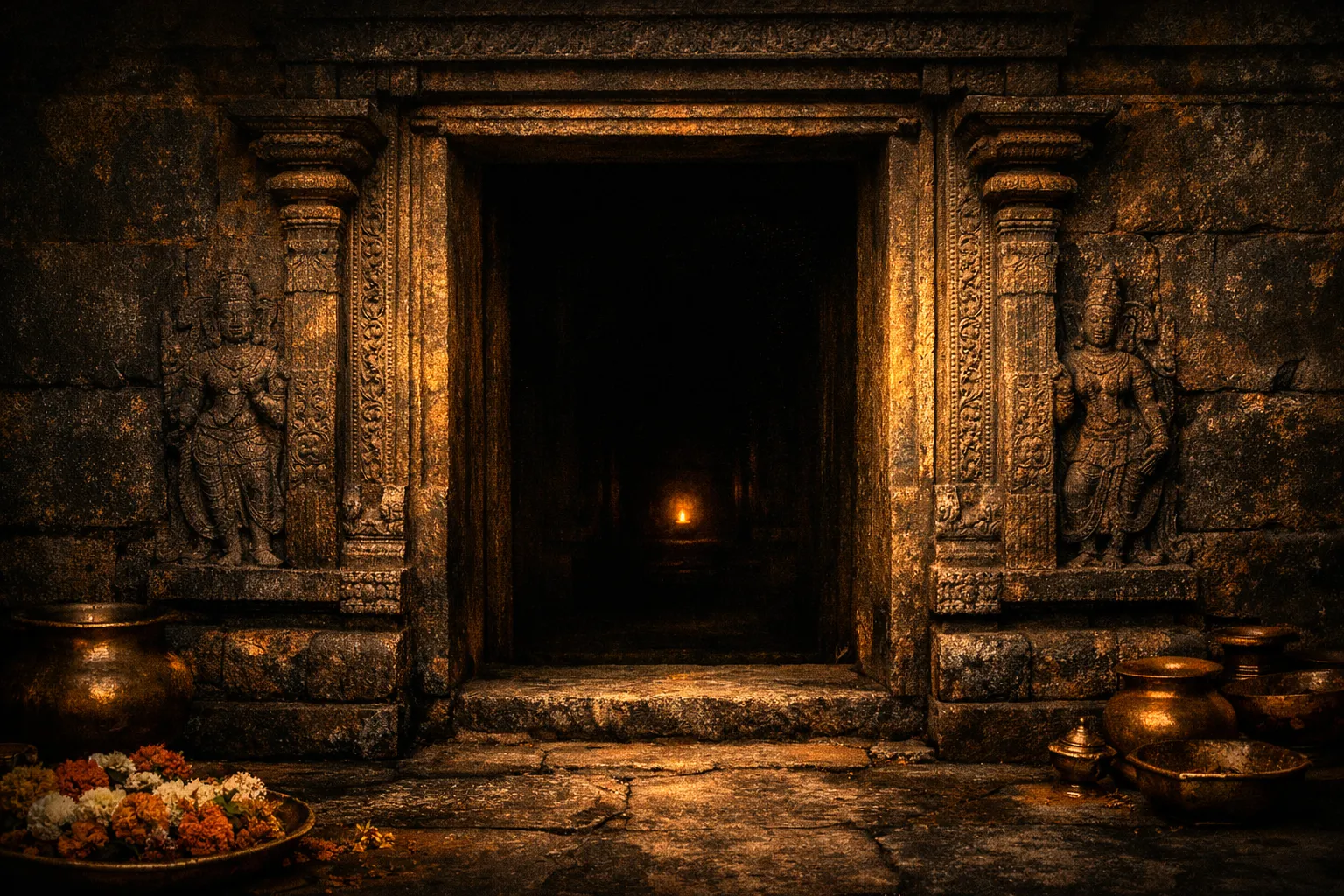
The garbhagriha — the innermost sanctum, literally the womb-chamber — is dark, low, and without windows. This is deliberate. The darkness corresponds to the primordial state described in the Nasadiya Sukta — the state before light, before form, before the categories of existence and non-existence. The deity within it is the focal point of the primordial presence — the Purusha himself, the cosmic consciousness that is simultaneously the universe’s origin and its innermost reality.
The tower above the sanctum represents the cosmic mountain — Mount Meru — the axis around which all of existence rotates. Its successive tiers represent the successive layers of creation that emerged from the cosmic sacrifice: from pure consciousness at the apex to gross matter at the base.
When you circumambulate the temple — walk around it in the clockwise direction called pradakshina — you are tracing the orbit of the cosmos around its own centre. You are enacting, in your own body, the movement of the universe around the Purusha. The pradakshina is not exercise. It is cosmology performed in flesh and bone.
And when the priest performs the morning ritual — lights the lamp, bathes the deity, offers flowers and food and incense, waves the flame in the arati ceremony — he is performing the original yajna. He is re-enacting the cosmic sacrifice that brought the universe into being. He is, in the most precise theological sense, keeping the universe running.
This is what every temple on The Sacred Trails represents. Not a religious building. Not a tourist attraction. A cosmological statement — the oldest, most persistent, most elaborated statement in human history — that the universe is conscious, that its fundamental nature is awareness, and that human beings who align themselves with that awareness are participating in the universe’s own ongoing act of self-understanding.
VI. Where this Leads
We began with a question posed in the dark, three thousand five hundred years ago, by a poet who refused to be satisfied with comfortable answers. We end, for now, at the threshold of a temple — standing in the morning light, shoes off, the warm stone under our feet, the great tower rising before us.
Between the question and the threshold lies everything: the cosmic sacrifice, the natural law, the source code of existence, the long chain of teachers and students who preserved the transmission through uncountable generations. The temple is the question’s answer — not a verbal answer, not a philosophical proposition, but a physical one. A structure that says, in stone and bronze and ritual and sound: here. Consciousness is here. The Purusha is here.
In the blogs that follow, we will explore how this cosmic philosophy became a living devotional tradition — through the Vedantic schools of Shankara, Ramanuja, and Madhva; through the extraordinary institutional achievement of Shanmatham; through the ecstatic poetry of the Nayanmars and the Azhwars. And then — temple by temple, stone by stone, hymn by hymn — we will walk the sacred trails themselves.
But we will never walk them the same way again. Because now we know what we are walking toward. Not a building. Not a deity. Not a religious experience in the narrow sense. But a three-thousand-five-hundred-year-old answer to the most fundamental question a human being can ask.
Why does anything exist?
Because consciousness could not remain only itself. Because the universe is not an accident or an explosion or a random fluctuation in a quantum field. It is an act of love. A sacrifice. A cosmic gesture of becoming — the infinite choosing, moment by moment, to be finite, to be here, to be this: this river, this temple, this dawn, this question, this seeker standing at the gate with their shoes off and their heart open.
Welcome to The Sacred Trails.
To enter a temple knowing what it means is to enter the universe knowing what you are.
Next in the Sacred Foundations Series:
Rta — The Cosmic Operating System. How the Vedic concept of natural law became the foundation of Hindu ethics, social order, and temple ritual.
Coming soon on thesacredtrails.com 🙏