
Five Lives That Changed a Civilisation

In the previous blog, we met the Nayanmars as a movement — sixty-three saints from every walk of Tamil life who composed the Tirumurai hymns that gave the Shaiva temple tradition its devotional heartbeat. We saw what they created together: a sacred geography of 276 Padal Petra Sthalams, sanctified by song, still alive after fourteen hundred years.
Now we go closer.
Because movements are made of people. And five of these people — four recognised by the tradition as the Samayacharyars, the great teachers of the Shaiva path, and one whose story the tradition has never stopped telling — deserve to be met not as representatives of a movement but as the specific, irreducible, completely individual human beings they were.
Their names: Thirugnana Sambandar. Thirunavukkarasar. Sundarar. Manickavasagar. And Kannappar.
A child who sang before he could walk. A man who spent eighty years being grateful. An aristocrat who argued with God. A minister who gave away a king’s treasury for love. And a hunter who gave his eyes.
Five lives. Five completely different relationships with the same God. And together — the most vivid, most humanly real portrait of what it means to love the divine that the Tamil tradition has ever produced.
These are not hagiographies — sanitised tales of impossible perfection designed to inspire from a safe distance. These are human stories — messy, urgent, sometimes bewildering — of real people who encountered something so overwhelming that their lives were never the same afterwards. Read them as you would read the letters of someone who has been to a place you have always wanted to go.
I. Thirugnana Sambandar — The Child Who Sang the Universe
He was three years old when it began.
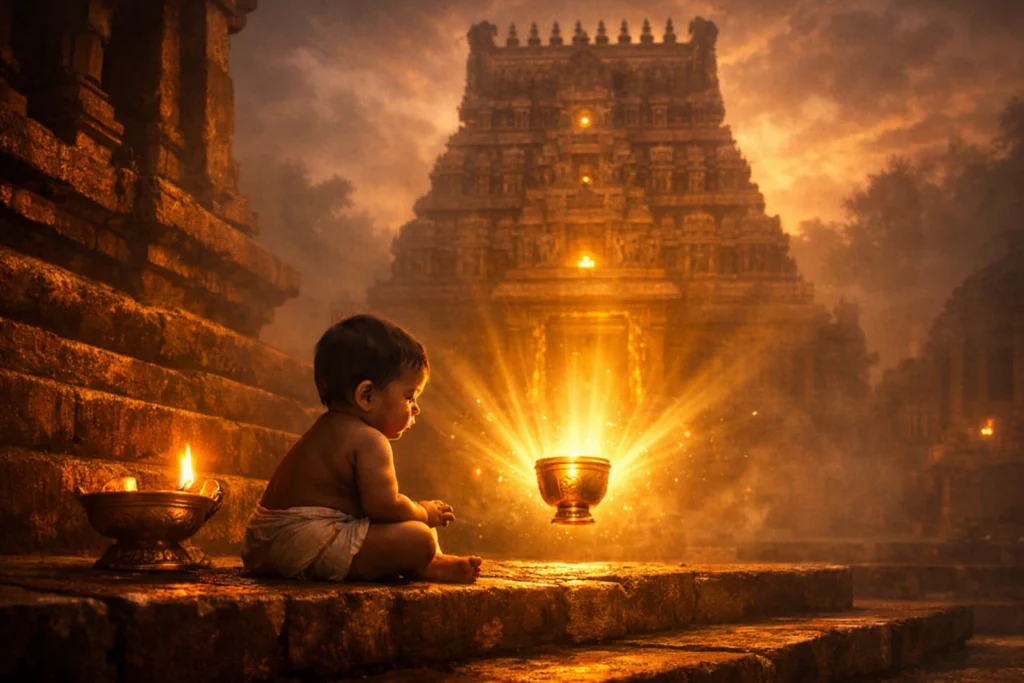
The story we told in Blog 6 — the infant on the temple steps at Sirkazhi, the crying, the golden cup of divine milk from Parvati, the first hymn sung before the child could properly walk — is the origin story of the entire Tevaram tradition. But it is only the beginning of Thirugnana Sambandar’s story.
What followed was a life of extraordinary productivity, extraordinary controversy, and extraordinary power — compressed into what the tradition suggests was no more than sixteen years.
Sambandar walked. Like all the Nayanmars, he was a pilgrim — moving from temple to temple across the Tamil country, composing hymns at each stopping place. But he did not walk quietly. He debated. He challenged. He confronted. In an era when Jainism and Buddhism had significant institutional presence in the Tamil kingdoms — royal patronage, established monasteries, considerable social influence — Sambandar engaged them in public debate with a confidence that contemporary accounts describe as both dazzling and infuriating.
📜 From the Tevaram — Thirugnana Sambandar
தோடுடைய செவியன் விடையேறியோர் தூவெண்மதி சூடி காடுடையசுடலைப் பொடிபூசிஎன் னுள்ளங்கவர் கள்வன்
Thodudaya seviyan vidaiyeriyOr thuvvenmathi soodi Kaadudaiya sudalai podi poosi en ullam kavar kalvan
“He who wears the earring, who rides the bull, who wears the white crescent moon — who smeared himself with the ash of the burning ground — he is the thief who has stolen my heart.” Tevaram, Thirugnana Sambandar 1.1 .
The very first verse of the very first hymn of the Tevaram. Note the paradox that Sambandar builds immediately: the God who wears cremation ash — the symbol of death and dissolution — is the one who steals the heart. From its very first line, the Tevaram tradition refuses the comfortable and reaches for the real.
At the temple of Sirkazhi — his home temple, the place where he received divine milk and where he returned repeatedly throughout his short life — Sambandar is said to have performed miracles: restoring sight to the blind, curing disease, bringing the dead back to life. The tradition records these not as metaphors but as facts — the natural consequence of a soul so aligned with divine energy that the boundary between the possible and the impossible became permeable.
His death — or rather, his departure — is one of the most extraordinary endings in the entire Nayanmar tradition. At the temple of Sirkazhi, surrounded by his followers, he led what the tradition describes as a mass ascension: hundreds of devotees, at his invitation, were liberated simultaneously — their bodies dissolved in divine light, their souls merged with Shiva. Sambandar was among them.
He was, by most reckonings, not yet twenty years old.
“What he left behind: 384 pathigams — sets of ten verses each — forming the first three volumes of the Tirumurai. A musical tradition. A devotional revolution. And the opening movement of a symphony that would not be complete until sixty-two more saints had added their voices.”
II. Thirunavukkarasar — Appar — The Man Who Was Found
His given name was Marulneekkiyar. The name he is known by — Appar, meaning Father — was given to him by Sambandar, his younger contemporary, in recognition of a spiritual seniority that had nothing to do with age.
Appar’s story is, at its core, a story about being lost and found. And about what it means to spend the rest of your life being unable to stop being grateful for having been found.
He was born into a Shaiva family but lost his parents young. His sister, who raised him, was a devout Shaiva — but in middle age, after a period of personal crisis, Appar converted to Jainism and entered a Jain monastery. He rose within the monastic hierarchy. He was learned, respected, settled.
And then he became ill. Severely, painfully, apparently incurably ill. In his suffering, the Shaiva devotion of his childhood returned to him — not as a theological position but as a cry. He prayed to Shiva. And the illness lifted.
What happened next is the defining fact of Appar’s life: he reconverted. He left the Jain monastery — an act of enormous social and institutional disruption — and declared himself a devotee of Shiva. The Jain establishment was furious. The Pallava king Mahendravarman I — who was himself a Jain at this period — had Appar arrested, tortured, and subjected to various attempts at execution. The tradition records that each attempt failed miraculously: the millstone thrown into the sea floated, the pit of lime became a cool pond, the rogue elephant became docile.
Mahendravarman converted to Shaivism.
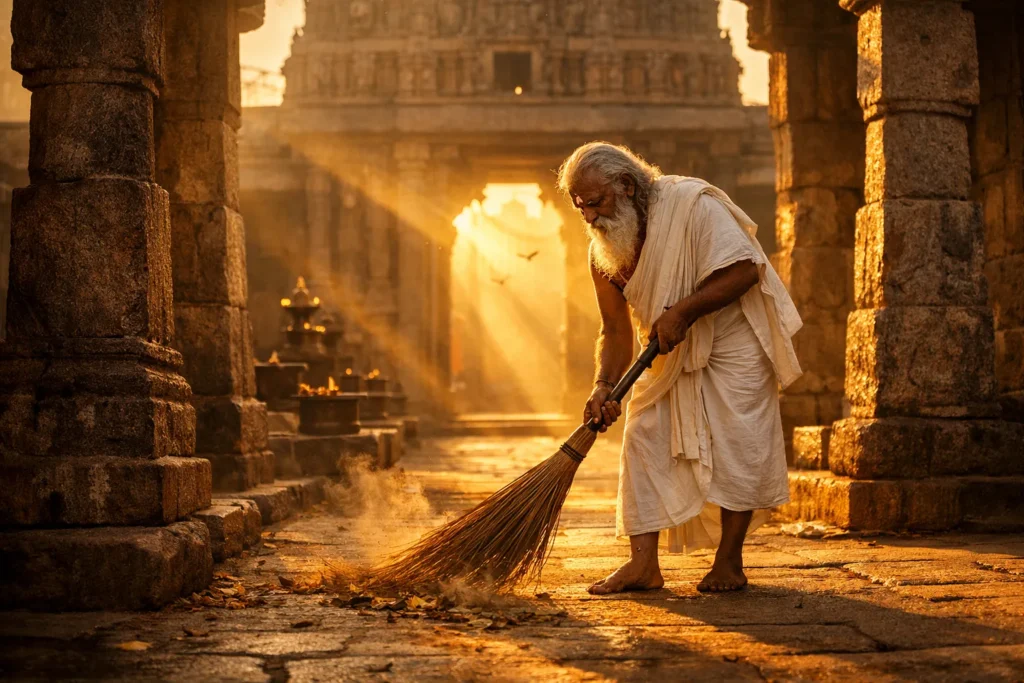
Appar spent the remaining decades of his long life — he lived to be over eighty — walking the Tamil country, composing hymns, serving at temples with a physical dedication that the tradition records in remarkable detail. He swept temple floors. He cleared weeds from temple grounds. He carried water for temple rituals on his ageing shoulders. The man who had been a respected Jain monastic elder became, by choice and with complete joy, the servant of the servants of the temple.
📜 From the Tevaram — Thirunavukkarasar (Appar)
நாமார்க்கும் குடியல்லோம் நமனை அஞ்சோம் நரகத்தில் இடர்ப்படோம் நடலை இல்லோம் ஏமாப்போம் பிணியறியோம் பணிவோம் அல்லோம் இன்பமே எந்நாளும் துன்பமில்லை
Naamaarkum kudiyallom namanai anjom Naragathil idarppadom nadalai illom Emaappom piniyariyom panivom allom Inbame ennaalum tunbamillai
“We bow to none. We fear not death. We know no suffering in hell. We know no sorrow. We shall not be deluded. We know no disease. We shall not submit to anyone. Joy always — no sorrow ever.” Tevaram, Thirunavukkarasar .
This is the hymn of a man who has been through the worst and come out the other side. The confidence here is not arrogance — it is the absolute security of someone who has found what they were looking for. After the illness, the imprisonment, the torture, the miraculous deliverances — Appar simply cannot be frightened anymore.
His hymns have the quality of his life: honest, direct, deeply personal, completely undeceived about the difficulty of the path and completely unshakeable in their certainty of the destination. They are the hymns of a man who knows what it cost to get here — and who would pay it again without hesitation.
III. Sundarar — The Beloved Who Argued with God
Of all the Nayanmars, Sundarar is the most human.
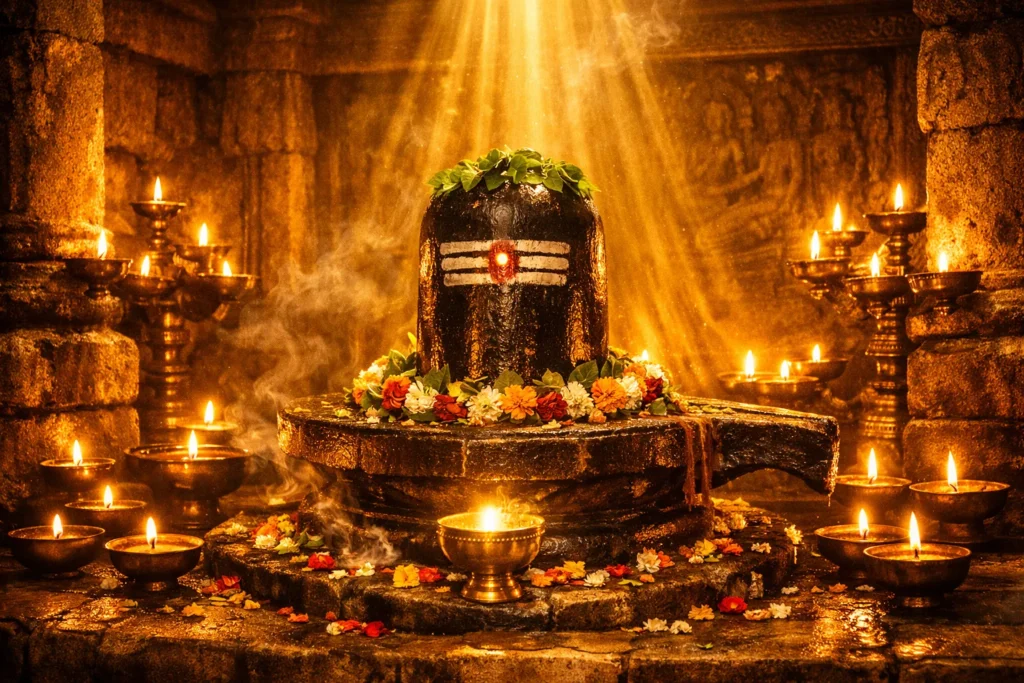
Not in the sense of being the most ordinary — he was anything but ordinary. But in the sense that his relationship with Shiva is the most recognisably human: complicated, demanding, full of the kind of negotiation and complaint and expectation that characterises relationships between people who are genuinely close.
Sundarar was born into a family of hereditary temple functionaries — a background of privilege and expectation. He was on his way to his own wedding when Shiva intervened — appearing as an old Brahmin, claiming that Sundarar was his devotee from a previous birth and had no right to marry. Sundarar was furious. He called the old man a madman — Pitthan, the crazy one. And this became one of his names for Shiva — an address that no one else in the tradition uses, and that captures the peculiar intimacy of their relationship.
He eventually married. Twice. He had complicated relationships with both wives — and with Shiva, who seems to have taken an active interest in Sundarar’s domestic life, sometimes facilitating his romantic adventures and sometimes interrupting them.
The hymns Sundarar composed during and around these episodes are among the most delightfully human documents in the entire devotional tradition: a man negotiating with God about his love life, complaining that Shiva has not sent the answer to his prayer quickly enough, demanding that a miracle be performed and then grumbling about the terms.
📜 From the Tevaram — Sundarar
பித்தா பிறைசூடீ பெருமானே அருளாளா வைத்தாய் என்னெஞ்சில் மறவாமல் உன்பாதம்
Pittha pirai soodi perumaane arulaala Vaitthaai en nenjil maravaamal un paadham
“O madman who wears the crescent moon — O gracious Lord — you have placed your feet in my heart, never to be forgotten.” Tevaram, Sundarar.
The address is breathtaking in its audacity: “O madman.” No other devotional tradition produces this — the devotee calling God crazy as a term of endearment, as an acknowledgment of the divine inexplicability, as evidence of a relationship close enough to sustain that kind of honesty. This is not irreverence. It is the deepest possible intimacy.
It is Sundarar who composed the Tiruthonda Thogai — the enumeration of all sixty-three Nayanmars — which became the canonical list of the tradition. This was not an administrative act. It was a devotional one: Sundarar asking Shiva, in hymn, to tell him the names of those who had truly loved him. And Shiva responding through Sundarar’s own voice.
Sundarar ended his life not in death but in translation: Shiva sent a white elephant from Kailash — his divine abode — to carry Sundarar home. The tradition records that he rode it to Kailash, where he was reunited with his fellow Nayanmar Siruthondar and entered the divine presence permanently.
IV. Manickavasagar — The Minister Who Gave Everything
His name means “he whose words are rubies.”
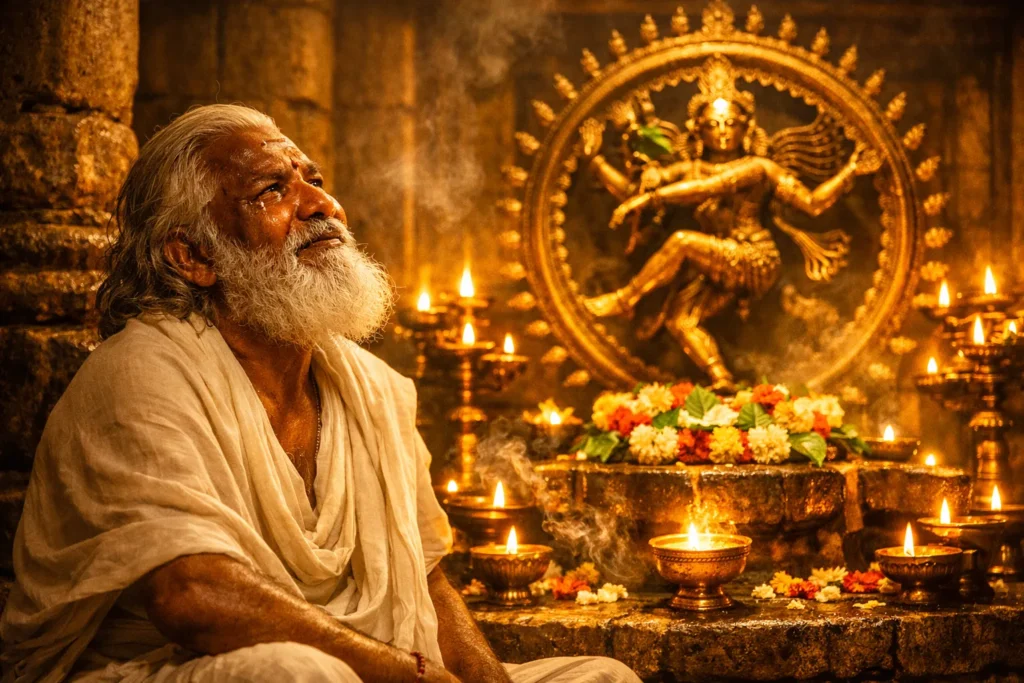
He earned it. The Thiruvasagam — the Precious Utterances — is Manickavasagar’s contribution to the Tirumurai, and it occupies a unique position in Tamil devotional literature: simultaneously the most philosophically sophisticated and the most emotionally raw devotional text in the tradition.
Manickavasagar was born into a high Brahmin family in Thiruvadavur, near Madurai. His intellectual gifts were recognised early — he rose to become prime minister of the Pandya king, one of the most powerful positions in the Tamil world. He was learned, trusted, wealthy, and secure.
Then Shiva appeared to him.
At the temple of Thiruperundurai — in the form of a guru seated under a tree, surrounded by disciples — the divine presence overwhelmed him completely. Manickavasagar fell. And then he did what people do when they fall completely: he gave everything.
The king had entrusted him with a substantial sum of money to purchase horses for the royal cavalry. Manickavasagar used the entire amount to restore the temple at Thiruperundurai. When the king discovered this — furious, demanding his horses — Manickavasagar had none to give. The king had him imprisoned and tortured.
And then Shiva sent horses. Divine horses, appearing on the beach at Maraiyoor — enough to satisfy the king’s demand. The king released Manickavasagar. And that night, the horses transformed back into foxes and howled at the moon. The king imprisoned Manickavasagar again. This time, Shiva flooded the Vaigai river — threatening the city of Madurai — and released him.
After which Manickavasagar simply walked away from everything — his position, his wealth, his social standing — and spent the rest of his life wandering from temple to temple, composing the Thiruvasagam.
📜 From the Thiruvasagam — Manickavasagar
சிவனவன் என்சிந்தை யுள்ளே நின்ற அதனால் அவனருள் ஆலோ அலோலம்பா ஆலோ
Sivanavanenchinthai ulle nindra athanaal Avanarul aalo alolambaa aalo
“Because Shiva stands within my mind — because of his grace — sing aloud, swing the cradle, sing.” Thiruvasagam.
This verse from the Thiruvempavai — Manickavasagar’s dawn hymn — has a quality unique in Tamil devotional literature: the ecstasy of someone who has lost everything and found that what they found is worth infinitely more than what they lost. The image of swinging a cradle — an image of domestic tenderness — in the context of divine grace is characteristic of Manickavasagar’s genius: finding the infinite in the intimate.
The Thiruvasagam ends, tradition says, at the great temple of Chidambaram — where Manickavasagar composed his final hymns and, in the presence of the dancing Nataraja, merged permanently with the divine. His physical form was never found. Only the hymns remained.
Of all the Tirumurai’s twelve volumes, the Thiruvasagam occupies a unique place in the Tamil devotional imagination. The ancient saying captures it precisely: “Those who are not moved by the Thiruvasagam will not be moved by any word in any tongue.“ Fourteen hundred years of Tamil readers have confirmed this verdict.
V. Kannappa — The Hunter Who Gave His Eyes
We have already met Kannappa in outline. Now we meet him fully — because his story is the one the tradition cannot stop telling, and for good reason.
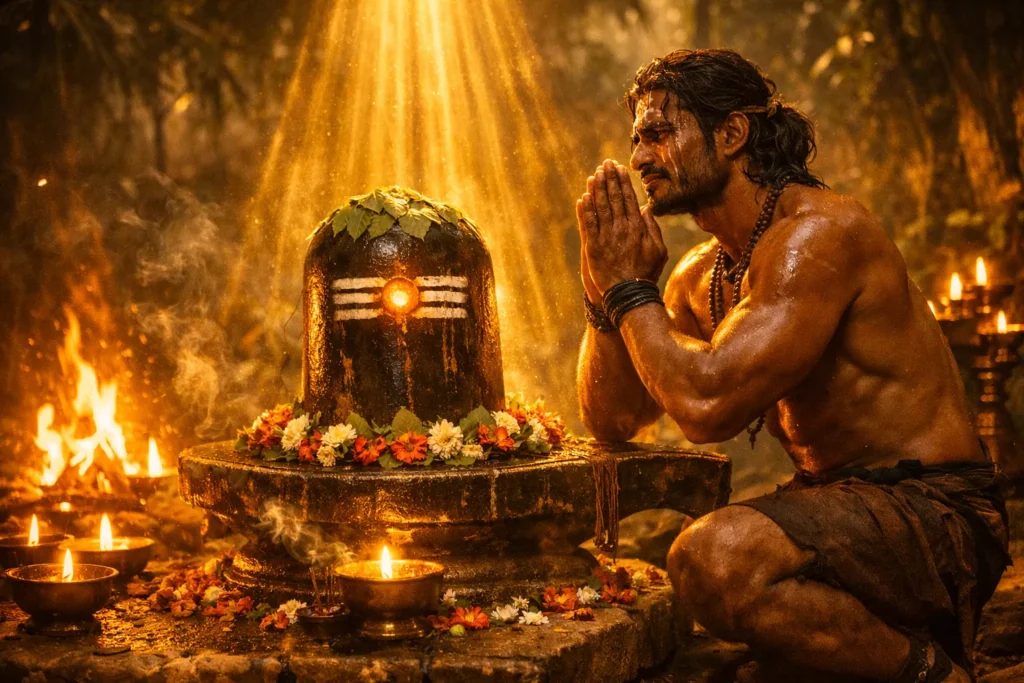
Kannappa was born into a hunting community in the forests around Shri Kalahasti — one of the five Pancha Bhuta Sthalams, the temple of Vayu, the air element, in what is now Andhra Pradesh. His name before his encounter with Shiva was Dinnudu — a hunter’s name, a forest name, a name with no religious significance whatsoever.
He encountered the Shiva lingam at Kalahasti entirely by accident — or rather, by the kind of accident that the tradition recognises as divine arrangement. He felt the immediate, overwhelming certainty of recognition: this is my God. This is my lord. I belong to this.
And he served — in the only ways he knew.
He brought water in his mouth from the forest stream to bathe the lingam. He tasted the water first to check its quality — as a hunter checks game — and spat it on the sacred stone. He hunted animals and offered the meat — the finest parts of his kill — to the deity. He used his feet to sweep away the flowers the priests had placed — not knowing they were offerings, only knowing that his God should not be surrounded by wilting things.
The priests were horrified. They reported the desecration to the temple authorities. They came the next morning to find the lingam bathed in spit-water, garlanded with meat, cleared of their careful flower offerings. And they found Kannappa doing it again.
💡 Key Concept: The Democratisation of Devotion
Kannappa’s story is the tradition’s most radical theological statement: that devotion, when genuine and total, transcends every ritual requirement, every caste boundary, every learned prescription. Kannappa did everything wrong by orthodox standards — wrong background, wrong offerings, wrong method, wrong everything. And Shiva declared him the greatest of all devotees. The point is specific and deliberate: God cares about the quality of the love, not the correctness of the form.
This is the living philosophical foundation of the bhakti approach to temple worship — and it is why, fourteen hundred years later, a farmer and a scholar and a foreign traveller can all stand before the same deity and each, in their own way, be fully received.
Then came the test.
Shiva caused the lingam’s right eye to bleed. Kannappa tried everything he knew to stop it — forest medicines, forest treatments. Nothing worked. And then — with the directness of a man who has only one solution to every problem — he took out his own eye and pressed it to the stone.
The bleeding stopped.
Then the left eye began to bleed.
Kannappa understood immediately. He placed his foot on the lingam — to mark the spot of the second eye, so that when he was blind he would know where to press the replacement. And raised his hand to remove his second eye.
At which point Shiva revealed himself. Stopped the hand. Embraced the hunter. And declared — in the presence of all his divine attendants — that Kannappa was the greatest of devotees.
The temple at Shri Kalahasti still tells this story. The lingam there shows, if you look carefully, the impression of a foot — Kannappa’s foot, pressing against the stone to mark the spot. Whether this is literal or symbolic matters less than what it means: the tradition has decided that this story is so important, so defining, that it must be preserved in the very stone of the temple.
Kannappa’s lesson is the simplest and the most demanding in the entire Nayanmar tradition: love completely. Let nothing — not ritual, not convention, not social expectation, not even the fear of blindness — come between you and your God.
VI. Five Lives — One Understanding
What do these five lives have in common?
On the surface, almost nothing. A child prodigy from a Brahmin family. A middle-aged man who survived torture and spent eighty years in gratitude. An aristocrat with a complicated love life. A minister who gave away a king’s treasury. A hunter who had never heard of the Agamas.
Different backgrounds. Different temperaments. Different relationships with the same God — one ecstatic, one grateful, one argumentative, one surrendered, one instinctive. Different hymns, different stories, different endings.
And yet — the tradition has placed them together. Has recognised in these five specific lives the full range of what devotion to Shiva can look like. Has understood that the tradition needs all five — the infant’s ecstasy and the old man’s gratitude and the aristocrat’s argument and the minister’s surrender and the hunter’s absolute simplicity — to be complete.
Because God, it turns out, is large enough to receive all of them. The child’s song and the old man’s service and the aristocrat’s complaint and the minister’s hymn and the hunter’s eye — Shiva receives them all with the same completeness, the same recognition, the same love.
This is what the Nayanmar tradition is saying, through these five lives: there is no single correct way to love God. There is only love — genuine, total, unconditional, and completely your own.
VII. These Five and the Temples
Each of these five lives is inseparable from specific temples on The Sacred Trails.
Sambandar’s home temple is Sirkazhi — the Brahmapureeswarar temple, one of the most ancient Padal Petra Sthalams on the Cauvery delta. His presence is felt in every temple where the Tevaram is sung — which is to say, in all 276.
Appar’s journey — from Jain monastery to Shaiva pilgrimage — can be traced through the temples of the Pallava country and the Cauvery delta. The temple at Thiruvathigai — Veerattaneswarar — is inseparably his.
Sundarar’s temples are spread across the Tamil country — particularly in the Kongu region and the Cauvery delta. The temple at Tiruvarur — Thyagarajar — is the one most deeply associated with his story and his most personal hymns.
Manickavasagar’s journey moves from Thiruperundurai — where he gave away the king’s treasury — to Chidambaram, where the Thiruvasagam ends and his physical form dissolves. Both temples carry his presence in their stones and in the air.
Kannappa’s temple is Shri Kalahasti — the Pancha Bhuta Sthalam of Vayu, the air element. Whether you approach it as a Hindu pilgrim or as a curious traveller, the lingam’s foot-impression and the story encoded in the temple’s atmosphere make it one of the most emotionally powerful sacred sites on any circuit of The Sacred Trails.
When The Sacred Trails visits these temples — in the temple blogs that follow the Sacred Foundations series — we will return to these five lives. Because you cannot stand in the Thiruvarur temple without Sundarar being present. You cannot hear the Tevaram at Sirkazhi without Sambandar being there. You cannot approach the Kalahasti lingam without feeling, in some way you may not be able to articulate, the weight of what Kannappa was willing to give.
The saints and their temples are not two different things. They are one reality — the stone and the song, the presence and the person, the place and the love that made it sacred.
VIII. Closing — The Bridge to What Comes Next
We have now lived, briefly, inside five Nayanmar lives. Five extraordinary human beings who loved the same God in five completely different ways — and who together created the devotional heartbeat of the Shaiva temple tradition that The Sacred Trails is here to explore.
The Sacred Foundations series now turns to the Vaishnava tradition — to the twelve Azhwars whose 4,000 Tamil verses in the Divya Prabandham gave the 108 Divya Desams their devotional identity.
Blog 8 introduces the Azhwars as a movement — who they were, what they created, and how their tradition relates to and complements the Nayanmar tradition we have just explored.
Blog 9 takes us into individual Azhwar lives — including Andal, whose bridal mysticism remains one of the most extraordinary expressions of devotional love in any tradition, and Thiruppaan Azhwar, the untouchable saint whose single hymn — the Amalanadhipiran — is considered the distilled essence of Vaishnava devotion.
After that, the Sacred Foundations series moves to its completion — through the remaining four Shanmatham paths and the two great temple overview blogs — before The Sacred Trails arrives, finally, at the entrance of the temples themselves.
Ready to enter. Ready to see. Ready, at last, to stand before the deity and understand — not just intellectually but in the body, in the breath, in the quality of the silence — what you are standing before.
Next in the Sacred Foundations Series :
4,000 Poems. 12 Saints. One Language. How Tamil Became the Voice of God — and how the Azhwars created the devotional world of the 108 Divya Desams.
Coming soon on thesacredtrails.com 🙏