
How a Spear, a Peacock, and the Love of the Tamil People Created One of the Most Vibrant Pilgrimage Traditions in the World

The Spear That Split the Ocean
The demon Surapadman was, by any measure, the most formidable enemy the gods had ever faced.
He had performed austerities of such staggering intensity — directed at Shiva himself — that Shiva had granted him a boon that made him nearly indestructible. He could not be killed by any weapon forged of ordinary matter. He had built his fortress in the middle of the ocean — a city of impossible wealth and impenetrable walls, populated by tens of millions of demon soldiers. He had imprisoned the sun and the moon, disrupted the cosmic seasons, enslaved the devatas, and driven Indra from his heaven. The universe was not merely threatened. It was held hostage.
The gods turned to Shiva. Shiva opened his third eye — the eye of cosmic fire that had once reduced Kama, the god of desire, to ash — and from that fire he drew six sparks of divine energy. Six points of light so intense that the sage Agastya, watching from a distance, shielded his eyes. The six sparks flew through the cosmos and came to rest in the sacred lake of Saravana — the lake of the reed forest, fed by the river Ganga flowing from Shiva’s matted locks.
From those six sparks, six infants were born — each one glowing with the light of Shiva’s third eye, each one lying on a lotus in the sacred lake, each one tended by the six Kritika stars in the form of celestial mothers. Parvati, hearing of the six children of Shiva’s divine fire, came to the lake. And in an act of overwhelming motherly love, she gathered all six into her arms simultaneously — and they merged into one. One child. Six faces. Twelve arms.
His name was Shanmukha — the Six-Faced One. Skanda in Sanskrit. Kumara — the eternal youth, the divine child. And in Tamil — Murugan. The Beautiful One. The Red One. Seyon — the one whose colour is the red of the rising sun, the red of the vel, the red of the hills where he makes his home.
Shiva placed in his hands the Vel — a divine spear of light, forged by Parvati herself, containing within it the full power of divine knowledge. Not a weapon of violence — a weapon of wisdom. The Vel that cuts through ignorance. The Vel that reveals the truth beneath every illusion.
Murugan took the Vel. And went to war.
What happened next at the shores of the cosmic ocean is one of the most dramatic passages in the entire Skanda Purana. Surapadman, in his final form, became a vast mango tree — ancient, immovable, rooted to the earth of his own demonic pride. Murugan hurled the Vel.
The tree split in two.
And from the two halves — transformed by the touch of Murugan’s divine weapon — emerged a peacock and a rooster. The peacock became Murugan’s vahana, his divine vehicle, the creature on whose back he rides across the universe. The rooster became the symbol on his battle flag. Surapadman — the great demon of cosmic ego — had been not merely defeated but transformed. Turned into the very vehicle of the god who defeated him.
This is the theology of Koumaram in a single image: the ego does not merely need to be destroyed. It needs to be transformed — into the vehicle of the divine. The peacock is the most beautiful creature in creation. And it was once a demon.
This is the story that the six great temples of Murugan — the Arupadai Veedu, the Six Abodes — exist to tell. And it is the story that the Tamil people have been telling, in song and pilgrimage and dance, for more than two thousand years.
I. Murugan — The God Who Belongs to Tamil Nadu
Every deity in the Hindu pantheon has a particular relationship with a particular land, a particular people, a particular landscape.
Murugan’s land is Tamil Nadu. His landscape is the hills — the kurinji landscape of the ancient Tamil Sangam poetry, where the mountain flowers bloom and the waterfalls cascade and the air is cool with rain. His people are the Tamil people — and the relationship between the Tamil world and Murugan is unlike any other relationship between a people and their deity in India. It is not merely devotion. It is identity. Murugan is not a god the Tamils worship. He is simply — Tamil.
The ancient Tamil Sangam literature — the earliest surviving Tamil poetry, composed between 300 BCE and 300 CE — already knows Murugan as Seyon, the Red One, the god of the kurinji hills. The Sangam poets assigned Murugan to the kurinji landscape in their classification of the five landscapes of Tamil poetry — each landscape with its own presiding deity, its own season, its own emotional register. Kurinji — the hills — is the landscape of lovers’ union, and Murugan is its god. Love and the hills and Murugan belong together, in the oldest stratum of Tamil literature, before Sanskrit or Brahminical influence had fully entered the Tamil world.
Then the Sanskrit stream arrived — and something remarkable happened. Rather than displacing the Tamil Murugan, the Sanskrit tradition recognised him. The Vedic deity Skanda — the son of Shiva, the commander of the divine army, the celibate warrior of the Mahabharata and the Puranas — was identified with Seyon. The Tamil hills-god and the Sanskrit warrior-deity were understood as one being, present in two traditions, approached by two languages, expressing two dimensions of the same infinite reality.
This synthesis is one of the most successful integrations in the history of Indian religion. The Tamil Murugan brought to the synthesis: his roots in the ancient hill-tradition, his intimate relationship with the Tamil landscape, his association with youth and beauty and love, and the intense personal devotion of a people who have worshipped him continuously for over two thousand years. The Sanskrit Skanda brought: his cosmic birth from Shiva’s fire, his role as the commander of the divine army, his philosophical depth as Kumara — the divine youth who represents the ever-fresh, ever-renewed quality of spiritual knowledge.
💡 Key Concept: Kumara — The Eternal Youth
Kumara — the Sanskrit name for Murugan — means the eternal youth, the divine child, the one who is always new.
This is not merely a description of physical youth. It is a philosophical statement about the nature of spiritual knowledge.
Knowledge that truly liberates is not ancient and accumulated — it is always fresh, always immediate, always experienced as if for the first time.
Murugan as Kumara is the embodiment of this quality: wisdom that never grows old, truth that never becomes stale, the divine that is always encountered as immediately present. This is why Murugan is simultaneously the warrior who defeats cosmic evil and the beautiful youth who sits on the hillside — the power that cuts through ignorance and the grace that makes the journey beautiful.
II. Koumaram — The Fifth Path of Shanmatham
In Adi Shankaracharya’s Shanmatham framework, Koumaram is the path of Murugan — Kumara, the divine son of Shiva, the commander of the celestial armies, the wielder of the Vel.
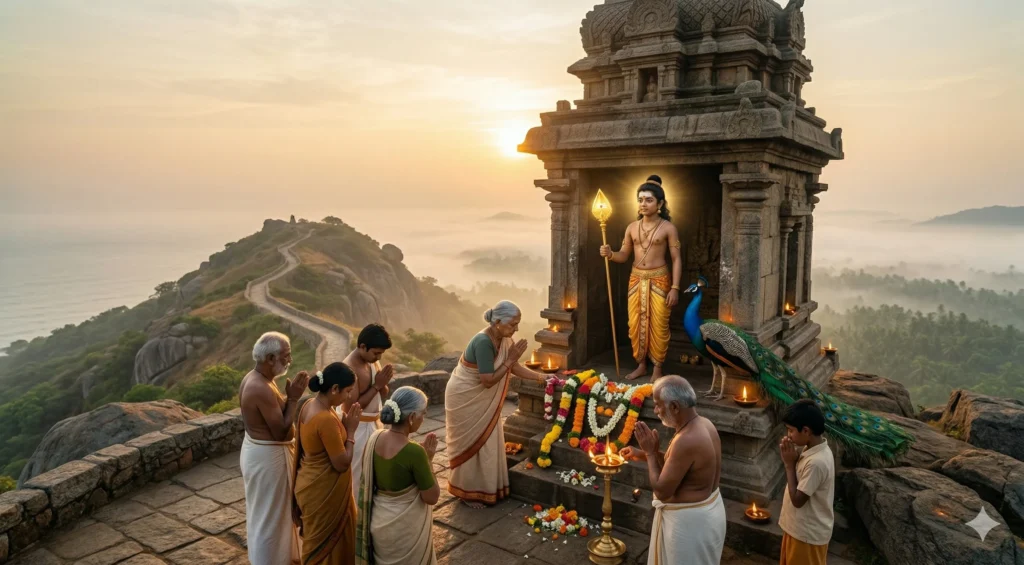
Like the other five paths, Koumaram worships its chosen deity as the supreme expression of Brahman — the ultimate reality taking the form of the divine youth who commands the cosmos and liberates the soul. Like the other five paths, it has its own texts, its own temples, its own ritual traditions, its own distinctive understanding of the divine.
But Koumaram has a quality that distinguishes it within the Shanmatham framework: it is the path most completely fused with a specific regional culture. While Shaivism, Vaishnavism, and Shaktism are pan-Indian traditions with deep roots across the subcontinent, Koumaram is — in its living devotional reality — primarily a Tamil tradition. The most important Koumaram temples are in Tamil Nadu. The most celebrated Koumaram scripture is in Tamil. The most beloved expression of Koumaram devotion — Arunagirinathar’s Thiruppugazh — is in Tamil. The tradition is not exclusive to Tamil Nadu, but it is most fully, most vividly, most personally alive there.
The philosophical understanding of Murugan in the Shaiva Siddhanta tradition — which, as we will explore in Blog 14, is the philosophical backbone of Tamil Shaivism — gives Koumaram a specific theological character. Murugan is Shiva’s son, which means he shares Shiva’s nature as the supreme reality. But as the son — as the one who was born for a specific purpose, who acts in the world, who is present in specific sacred places on the Tamil hills — he is Shiva’s grace in its most accessible, most youthful, most immediately present form.
The Vel that Murugan carries is, philosophically, Jnana Shakti — the power of divine knowledge. The same power that dissolves the bonds of Pasam in Meykandar’s framework. The same grace that Shiva sends through the guru to liberate the soul. In Murugan’s hands, that grace takes the form of a spear — because it cuts. It cuts through delusion the way a blade cuts through darkness. Not gradually, not philosophically — immediately, completely, with the clean precision of a weapon wielded by a perfect hand.
III. The Thirumurugarruppadai — The First Invitation
The oldest devoted literary work to Murugan in the Tamil language is the Thirumurugarruppadai — The Sacred Guide to Murugan — composed by the poet Nakkirar, one of the great poets of the Tamil Sangam tradition.
The word Arruppadai means a guide — specifically, a poem in which one traveller who has already received the blessings of a deity directs another traveller to the same source of grace. “I have been there. I have received what you are seeking. Let me show you the way.” The Arruppadai is one of the oldest poetic forms in Tamil literature, and the Thirumurugarruppadai is its most sacred expression.
Nakkirar’s poem describes Murugan as he is present at six specific sacred sites — six hills, six temples, six specific qualities of divine presence. This is the oldest textual reference to the six abodes of Murugan, and it established the framework that would shape Tamil Murugan devotion for the next two thousand years.
The Thirumurugarruppadai is included in the Pattuppattu — the Ten Idylls of classical Tamil literature — and is one of the foundational texts of the Tamil literary canon. But it is not merely a literary masterpiece. It is a pilgrimage guide — a map of the soul’s journey through six qualities of divine presence, written in a language of such sensory richness and devotional intensity that reading it is itself a form of pilgrimage.
📜 From the Thirumurugarruppadai — Nakkirar
நீரும் நிழலும் நிறைந்த குன்றத்து
Neerum nizhalum niraintha kunrathu
“On the hill filled with water and shade…” Nakkirar’s opening descriptions of Murugan’s abodes are among the most sensuously precise landscape poems in any language — the coolness of the hill water, the shade of the trees, the sound of the waterfalls, the smell of the kurinji flowers. He is saying: Murugan is not an abstraction. He lives in a specific place. And that place is beautiful. Come and see.
IV. The Six Abodes — Arupadai Veedu
The six abodes of Murugan — the Arupadai Veedu — are the six temples that the tradition has identified as the most sacred sites of Murugan’s presence on earth. Each is associated with a specific episode in Murugan’s mythology. Each presides over a specific landscape. Each offers a specific quality of the divine encounter with Murugan. Together they form the most beloved pilgrimage circuit in Tamil Nadu — and one of the most atmospherically varied sacred journeys in all of India.
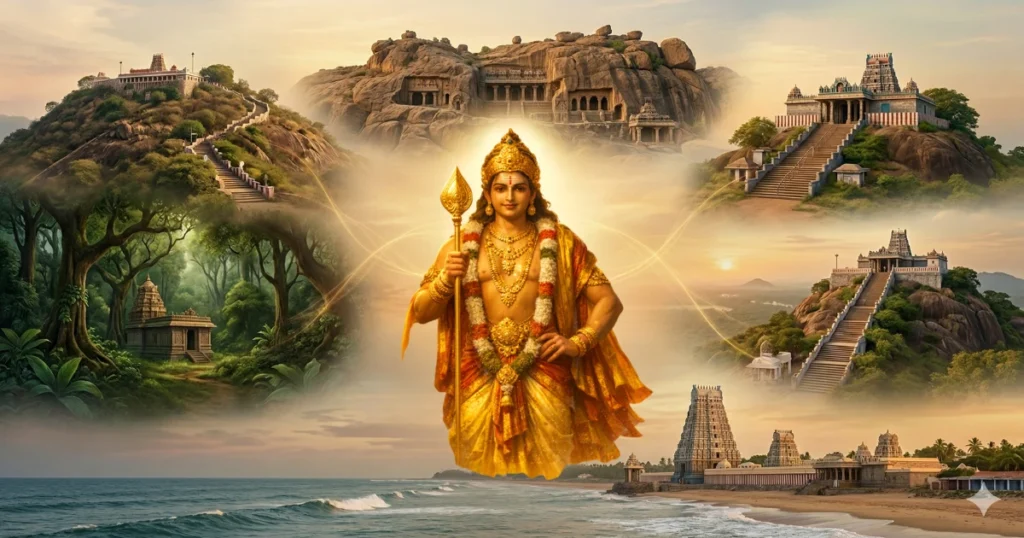
1. Thiruparankundram — The Oldest of All
Thiruparankundram is where it began.
Of the six abodes, Thiruparankundram is the oldest — not merely in terms of the temple’s antiquity (though it is among the most ancient temples in Tamil Nadu) but in terms of myth. This is where Murugan married Devasena — the celestial bride, Indra’s daughter, whose hand was the reward for his victory over Surapadman. The cosmic battle was won at Thiruchendur. The wedding was celebrated at Thiruparankundram. The beginning of the sacred family. The moment when the warrior became the husband.
The temple at Thiruparankundram is one of the most architecturally extraordinary sacred sites in Tamil Nadu. It is not a temple on a hill — it is a temple inside a hill. The innermost sanctum, the oldest shrines, the most sacred spaces are carved directly into the living rock of the granite hillside — an ancient cave temple of the Pandya period, its walls smoothed by centuries of lamp smoke and the touch of millions of devotees’ hands. The outer precincts expand down the hillside in the Dravidian style — gopurams and mandapams and sacred tanks — but the heart of the temple is underground, in the dark, in the rock.
Thiruparankundram is located just outside Madurai — close enough that a visit to the Meenakshi Amman Temple can include this abode on the same day. The rock-cut shrine, carved during the Pandya dynasty’s early phase, is one of the best examples of the ancient Tamil tradition of creating sacred space within the natural landscape rather than imposing a structure upon it. The hill itself is the temple. The rock is the deity’s own body.
2. Thiruchendur — Where the Sea Witnessed the Victory
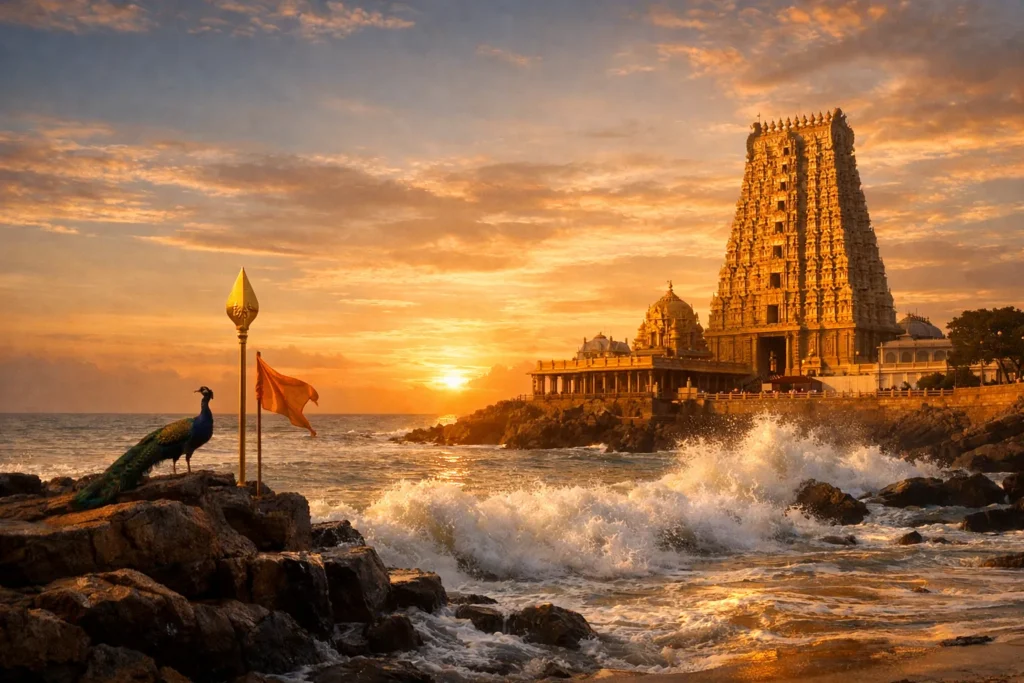
It was here — on the shore of the Bay of Bengal at the southeastern edge of Tamil Nadu — that Murugan launched his final assault on Surapadman’s ocean fortress. The sea itself was the battlefield. The waves carried the armies. The horizon was the limit of the cosmic war. And when Murugan hurled the Vel and split the mango tree and transformed the demon into his own vehicle — the ocean witnessed it. The sea was the first devotee at Thiruchendur.
Thiruchendur is the only one of the six abodes located not on a hill but directly on the sea — the waves of the Bay of Bengal breaking on the rocks below the temple walls. The setting is extraordinary and unlike any other temple in Tamil Nadu: the great Dravida gopurams rising from the rocky coastal headland, the sound of the sea constant and surrounding, the salt wind carrying the smell of the ocean into the innermost sanctum.
The presiding deity here is Senthilandavar — Murugan in his victorious form, holding the Vel, the peacock and rooster by his side, his expression carrying the specific quality of a warrior who has won not because he was the strongest but because he was the most righteous. The Vel is held high — not at rest as at Thiruthani, but raised in the moment of accomplished purpose.
The temple itself is one of the most ancient in Tamil Nadu — its origins traced by tradition to before the common era. The present structure reflects centuries of Pandya and Vijayanagara patronage, with the great outer walls and gopurams expanded repeatedly across the medieval period. The annual Skanda Sashti festival at Thiruchendur draws millions of pilgrims to the coastal town, and the Soorasamharam — the ritual re-enactment of Murugan’s victory over Surapadman, performed on the beach at sunset on the sixth day — is one of the most visually and emotionally overwhelming ritual events in Tamil Nadu.
3. Palani — The Hill of the Renunciant
Palani carries a story that is, at its heart, about what happens when even a god is asked to choose between attachment and liberation.
The sage Narada — the divine mischief-maker, the one who sets cosmic events in motion by asking the right question at the wrong moment — arrived at Kailash carrying a divine mango, the fruit of wisdom, the Jnana Pazham. He presented it to Shiva and Parvati: this mango, he said, cannot be divided. It must be given whole to whichever of your two sons — Murugan or Ganesha — proves himself most worthy.
Ganesha, with his characteristic genius, circumambulated his parents — walking around Shiva and Parvati three times. “You are my entire world,” he said. “To circumambulate you is to circumambulate all of creation.” The mango was his.
Murugan — who had been away on his peacock, had not heard the contest, had not been present for Ganesha’s solution — arrived to find the mango gone. He felt, for the first time, the sting of apparent injustice. The beloved child, overlooked. The warrior, passed over.
He left Kailash.
He flew on his peacock to the hill of Palani in what is now Dindigul district. And there he stood — on the summit of the rocky hill, alone, in the posture of a renunciant. No weapons. No army. No consort. No silk or gold or garlands. He wore a simple loincloth. He held a staff. His matted hair was piled high. He had renounced — not the world, but the desire for the world’s recognition.
Shiva and Parvati came to bring him home. Shiva said: “You yourself are the fruit of wisdom, my son. You need no mango.” And Murugan replied: “Then I am Pazham Nee — you are the fruit.” And he stayed on the hill.
The form of Murugan at Palani — Dandayudhapani, the one who holds the staff — is the most widely recognised image of Murugan in Tamil culture. Not the warrior with the Vel. Not the beautiful youth on the peacock. The renunciant on the hill, alone, complete in himself. This form — ascetic, stripped of ornament, carrying only the staff of the wandering monk — has a quality of austere beauty that is unique among all the Murugan images in Tamil Nadu.
The Palani temple sits atop a rocky hill rising 450 feet above the surrounding Kongu Nadu plains. The climb is by foot — up 693 carved stone steps — or by the rope car (palkodu) that carries those unable to climb. The inner sanctum houses the Dandayudhapani image made of navapashanam — an ancient compound of nine poisonous minerals alchemically transformed into a healing substance. The abhisheka — the ritual bathing of the deity with milk, honey, rose water, and other sacred substances — flows as prasad (panchamritam) to the thousands of pilgrims who arrive daily. Palani panchamritam is perhaps the most beloved prasad of any temple in Tamil Nadu.
4. Swamimalai — Where the Child Taught the Father
Every parent knows: there comes a moment when the child teaches the teacher.
At Swamimalai — whose name means the hill of the Lord — the tradition preserves one of the most philosophically rich and humanly touching stories in the Murugan cycle. Brahma, the creator of the universe, came to Murugan and asked the meaning of the pranava mantra — the sacred syllable Om, the primordial sound from which all creation emerges. Murugan listened to the question. And then he asked Brahma: “Do you know its meaning yourself?”
Brahma confessed: he did not know it fully. He knew the syllable. He did not know its depth.
And Murugan — the divine youth, the son of Shiva — imprisoned Brahma, went to his own father Shiva, and whispered the meaning of Om into Shiva’s ear. Shiva — astonished and delighted — asked his son: how does a child know what the creator himself does not know? And Murugan answered: because wisdom is not accumulated. It is received.
This story gives Murugan one of his most beloved Tamil epithets: Swaminatha — the lord who taught his own father. At Swamimalai, Murugan is worshipped in the form of the Swaminathaswami — the divine teacher, the guru who reveals the meaning of Om, the child who is wiser than the creator.
Swamimalai is located on the banks of the Cauvery river in Kumbakonam, in the heart of the Chola heartland. The temple sits on an artificial hill — sixty steps leading to the summit, each step representing a Tamil letter, the sixty steps together representing the sixty-four arts (kalai) that Murugan is said to master. The temple’s inner sanctum is ancient, built in the Dravidian style refined under Chola patronage, with a five-tiered rajagopuram that rises above the surrounding paddy fields and coconut groves of the delta.
For The Sacred Trails — Swamimalai is one of the temples we will visit early, given its proximity to the Cauvery delta circuit and its connection to the Chola heartland temples of Thanjavur, Kumbakonam, and Darasuram.
5. Pazhamudircholai — The Hill of the Eternal Fruits
Pazhamudircholai — the grove of eternal fruits — is the most intimate of the six abodes. Not a hilltop fortress or a coastal headland. A living forest on the slopes of the Azhagar hills near Madurai, where the trees are dense and the streams run cool and the air carries the fragrance of flowers that have been blooming, the tradition says, since before human memory.
This is Murugan in his most ancient Tamil form — Seyon, the god of the kurinji hills, the deity of the forest and the waterfall and the mountain bloom. No cosmic battle here, no philosophical debate, no renunciation. Here Murugan simply lives, in the forest that is his natural home, with the hill tribes who were his first devotees in the oldest Tamil tradition. The Veddas, the Kuravar, the tribal communities of the Azhagar hills — these were Murugan’s people before the Sanskrit tradition arrived, and Pazhamudircholai honours that primacy.
The temple at Pazhamudircholai is unusual among the six abodes in that it is located not at the summit of a hill but partway up the hillside, accessible through the forest. The path to the temple passes through a landscape of extraordinary botanical richness — the Azhagar hills are known for their endemic species, their waterfalls, and the specific quality of light that filters through the forest canopy in the mornings. The experience of approaching this temple is different from any of the others: it is a walk into the forest, an immersion in the natural world that was Murugan’s first temple.
Pazhamudircholai has a particular connection to the Tamil devotional literary tradition. Arunagirinathar — the 15th century saint-poet whose Thiruppugazh hymns transformed the Murugan devotional tradition — composed some of his most celebrated verses at this temple. The forest, the flowers, the sound of the streams — all of it enters his poetry, giving the Pazhamudircholai hymns a quality of natural ecstasy that is distinct from the urban or architectural poetry of the other abodes.
6. Thiruthani — The Hill of Rest
If Thiruchendur is where the story ended in glory, Thiruthani is where the story ended in peace.
After the defeat of Surapadman, after the cosmic battle was won and the divine order restored, Murugan came to Thiruthani. He came not in triumph but in stillness — the warrior laying down his weapons, the commander resting from his campaign, the divine youth finding his moment of peace. Thiruthani is the hill of rest. The abode after the victory.
But before the rest, there was one more story. And it is the most human of all Murugan’s stories.
Valli was a girl of the Veda Valli tribe — a hunter’s daughter, raised among the hills, her life shaped by the forest and the harvest and the rhythms of the earth. She was not celestial by birth. She was not a goddess by origin. She was, in every sense that the tradition holds sacred, one of us — a soul of the earth, loved by the god of the hills in the most ordinary and the most extraordinary way possible.
Murugan saw her. And the god who had commanded armies and defeated the greatest demon in creation was undone by a girl guarding a millet field.
What followed is told across Tamil literature with a tenderness that has no equivalent in Sanskrit devotional poetry. Murugan came to Valli in disguise — as an old man, as a hunter, as an ordinary suitor — and she refused him. He enlisted his brother Ganesha, who took the form of a wild elephant and charged toward Valli in the darkness of the forest. She fled in terror — directly into the arms of the old man standing nearby. The old man revealed himself. Valli, trembling, found herself looking at Murugan in his full divine form — radiant, laughing, utterly in love.
She did not resist. She had, the tradition says, loved him before she knew who he was — loved the persistence, the playfulness, the refusal to give up. The marriage was performed in the hills, among her people, in the Tamil manner. No celestial ceremony. No assembled gods. Just the god of the Tamil hills and the girl of the Tamil earth, together.
This is the theological heart of the Valli story: that Murugan did not bring Valli up to his level. He came down to hers. The god of the hills descended into the ordinary world — into the forest, the millet field, the hunter’s daughter’s daily life — because that is what love does. It crosses every distance. It takes whatever form is needed. It does not wait for the beloved to become worthy. It finds the beloved exactly where they are.
The temple at Thiruthani sits atop a granite hill rising steeply from the plains of the Arani river valley in Tiruvallur district — about 70 kilometres northwest of Chennai. The approach is by a flight of 365 steps — one for each day of the year — that climb the hill through a corridor of granite gopurams and pilgrims’ colonnades. The climb is physical, deliberate, earning. Every step up is a day of the year surrendered to the deity.
At the summit, Murugan stands — not with the Vel raised in battle but holding it at rest, his peacock beside him, his face carrying the serenity of absolute accomplishment. And at his side stand both his consorts — Devasena and Valli — together, equal, each representing a different dimension of the god’s love.
Devasena is the celestial bride — the daughter of Indra, promised to Murugan from the beginning of cosmic time, his divine consort by the dharma of heaven. She is duty, grace, the love that fulfils cosmic purpose. Valli is the earthly bride — the hunter’s daughter, chosen by the god’s own longing, his consort by the dharma of the heart. She is devotion, spontaneity, the love that crosses every boundary to find its beloved.
Together they stand at Thiruthani and together they complete him. The god who is simultaneously ancient and intimate, cosmic and personal, the warrior and the lover — is whole only when both are present. Thiruthani is the only abode among the six where both consorts are enshrined together, which gives this temple a quality of completeness — warrior and beloved, heaven and earth, duty and longing — that is distinct from every other hill.
Thiruthani holds a particular significance in the Murugan pilgrimage tradition as the first abode for many devotees beginning the circuit from Chennai — and as the last for those completing it. The hill is especially alive on Skanda Sashti — the six-day festival celebrating Murugan’s victory over Surapadman — when hundreds of thousands of pilgrims climb the 365 steps through the night, arriving at the summit at dawn to greet the god in the first light of the day after the victory.
🗺️ The Six Abodes — A Pilgrim’s Map
Thiruparankundram — Madurai outskirts. Rock-cut cave temple. The hill of the sacred wedding. Murugan with Devasena.
Pazhamudircholai — Azhagar hills, near Madurai. Forest temple. The ancient kurinji home. Murugan as Seyon.
Palani — Dindigul district. 693 steps. The hill of renunciation. Murugan as Dandayudhapani — the ascetic with the staff.
Thiruchendur — Bay of Bengal coast, Thoothukudi district. Sea-facing temple. The hill of victory. Murugan with Vel raised.
Swamimalai — Kumbakonam, Cauvery delta. 60 steps. The hill where the child taught the father. Murugan as guru.
Thiruthani — Tiruvallur district. 365 steps. The hill of rest after victory. Murugan with Valli and Devasena. The complete circuit of all six abodes is one of the most rewarding pilgrimage journeys in South India — covering the full arc of Murugan’s mythology from the forest to the sea, from the wedding to the renunciation, from the victory to the rest.
V. Arunagirinathar and the Thiruppugazh — The Voice That Found God Through Ruin
The greatest poet of the Murugan tradition was not a saint from birth. He was a man who nearly destroyed himself — and found Murugan at the very edge of destruction.
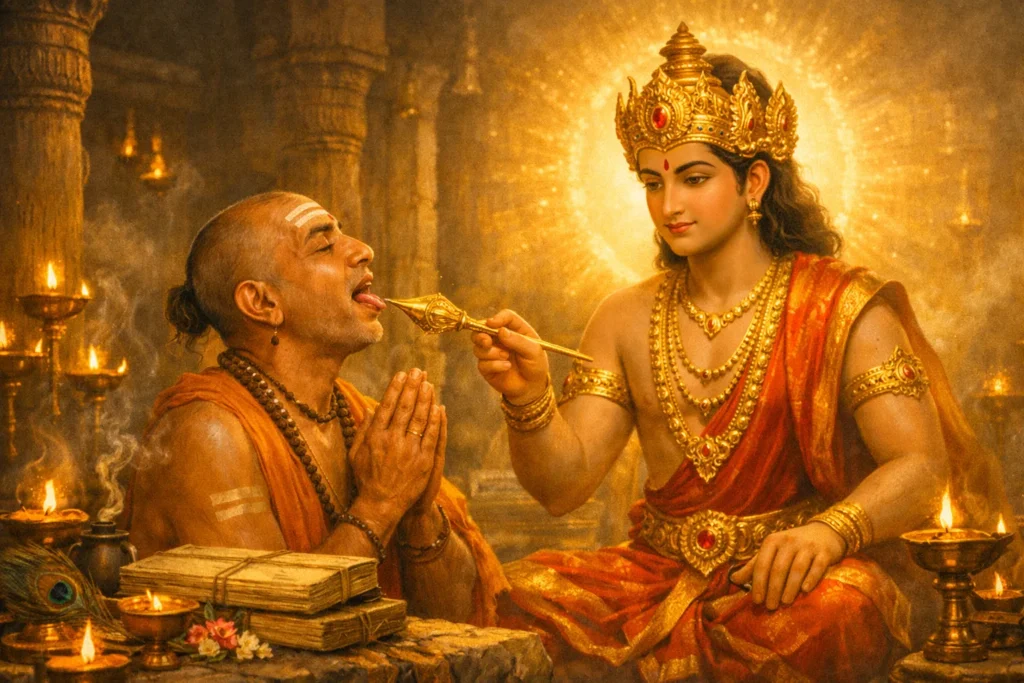
Arunagirinathar was born in Thiruvannamalai in the 15th century CE — in the shadow of the great Arunachaleswarar temple, at the foot of the sacred Arunachala hill. He was, by his own account in his hymns, a man given over completely to worldly pleasure — wine, women, the full catalogue of sensory indulgence. He lived this life until his body gave out. Diseased, penniless, abandoned, he climbed the temple tower of the Arunachaleshwarar temple intending to throw himself from its summit.
At the top of the tower — at the moment of the leap — Murugan appeared.
Not in a vision. Not in a dream. In the full, overwhelming, undeniable presence that the Tamil Bhakti tradition calls sakshatkaram — direct divine encounter. Murugan touched Arunagirinathar’s tongue with his Vel. And from that moment, the man who had been unable to say a single word of prayer found that he could not stop singing.
What poured out of him over the following decades was the Thiruppugazh — the Sacred Glory, the Holy Praise. More than sixteen thousand hymns, composed at temples across Tamil Nadu, each hymn addressed to Murugan at a specific sacred site, each composed in a specific musical metre of extraordinary complexity. The Thiruppugazh metres — some of them with syllable patterns so intricate that scholars have compared them to mathematical compositions — were not invented for literary effect. They were, Arunagirinathar said, the rhythms of Murugan’s presence as he received them — different rhythms at different temples, each rhythm carrying the specific quality of the divine encounter at that place.
📜 From the Thiruppugazh — Arunagirinathar
முத்தைத் தரு பத்தித் திருநகை
Muttait tharu pattit thirunagai
“The smile that gives pearls…”
The opening line of one of the most celebrated Thiruppugazh hymns — addressed to Murugan at Thiruchendur. The image of Murugan’s smile as a string of pearls captures in five Tamil words the entire Koumaram theology: beauty as grace, grace as liberation, liberation as the smile of the beloved god. Arunagirinathar’s hymns are still sung in Murugan temples across Tamil Nadu — and across the Tamil diaspora worldwide. They have been set to Carnatic music, adapted for Bharatanatyam dance, and memorised by generations of Tamil children as their first encounter with classical Tamil poetry.
VI. Beyond the Six — Other Temples of the Murugan Tradition
The Arupadai Veedu are the six principal abodes — but the Murugan tradition is far richer than six temples. His presence is not contained by any list of six. Just as the ancient Tamil traders carried their culture across the waters, Murugan’s grace crossed the sea — to find a home in the deep jungles of the south, in the mountain communities of Sri Lanka, in the Tamil diaspora scattered across the world.
Kataragama — The Abode Beyond the Sea
In Sri Lanka, at the remote jungle shrine of Kataragama — accessible, in the traditional pilgrimage, only by a walk of many days through the southern jungle — Murugan is worshipped as Kataragama Deviyo, the god of Kataragama. The Kataragama tradition is extraordinary for its multi-religious character: Buddhists, Hindus, and Muslims all worship at the same complex, each understanding the deity in their own terms. For the Tamil Shaiva tradition, Kataragama is one of the most powerful Murugan presences anywhere — remote, wild, demanding in its approach, and overwhelming in its presence.
Thiruvannamalai — Where Arunagirinathar Received the Vel
The Arunachaleswarar temple complex at Thiruvannamalai contains a significant Murugan shrine where, by tradition, Arunagirinathar received his divine initiation. The hill of Arunachala — sacred to Shiva as the fire lingam, the column of infinite light — is also the hill where Murugan’s grace reached a broken man and transformed him into a poet. For Sacred Trails visitors, Thiruvannamalai offers the unique experience of Shiva and Murugan present in the same landscape — the father and the son, the cosmic fire and the grace it generates.
Sirkazhi — Thirugnana Sambandar’s Murugan
Sirkazhi — the birthplace of Thirugnana Sambandar — has a Murugan temple where the child-saint composed some of his earliest hymns. The connection between Sirkazhi and Murugan runs deep: the same sacred geography that produced the greatest Nayanmar also produced a profound local Murugan tradition, and the two are inseparable in the Cauvery delta’s sacred landscape.
Marudamalai — The Hill of the Marudha Tree
On the outskirts of Coimbatore, Marudamalai rises from the foothills of the Nilgiris with a Murugan temple of great antiquity and local importance. The presiding deity is Murugan in his benevolent, gracious aspect — and the temple’s setting, with the Western Ghats rising behind and the Coimbatore plains spreading below, gives it a quality of natural grandeur that complements the more ancient and famous sites of the tradition.
VII. Thaipusam — The Festival of the Vel
No account of the Murugan tradition is complete without Thaipusam — the festival that, more than any other event in the Hindu calendar, expresses the depth and intensity of Murugan devotion.
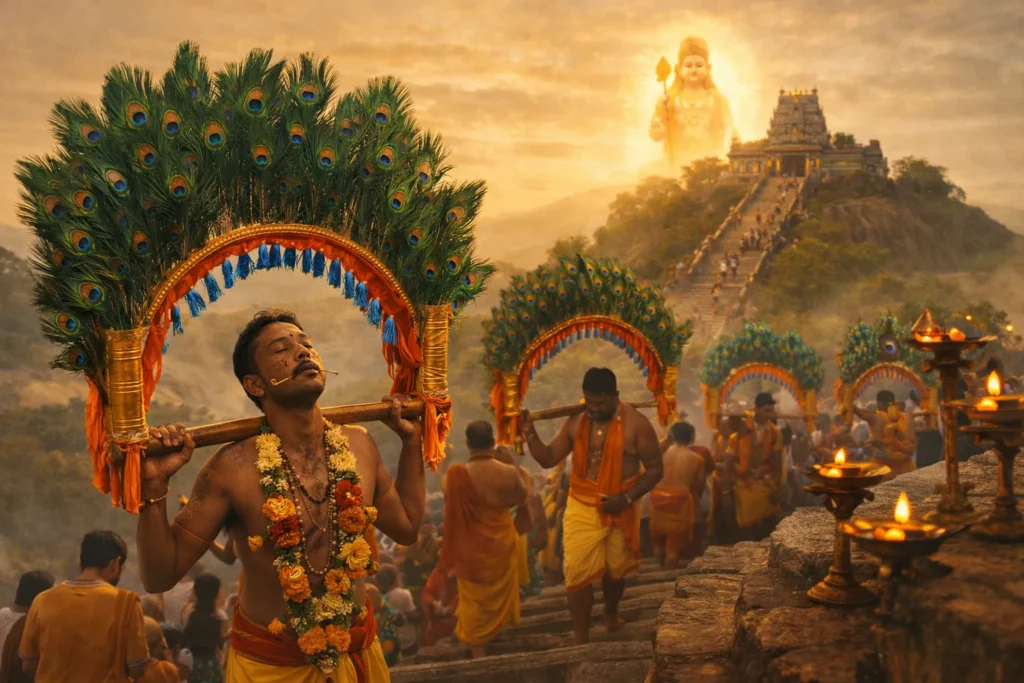
Thaipusam falls on the full moon day of the Tamil month of Thai (January-February) — the day, tradition says, when Parvati presented Murugan with the Vel. It is observed across Tamil Nadu, Sri Lanka, Malaysia, Singapore, South Africa, and wherever Tamil communities have carried their tradition in the diaspora.
At Palani — the most important Thaipusam centre in Tamil Nadu — the festival draws millions of pilgrims over several days. Devotees carry the kavadi — a physical burden, ranging from simple pots of milk to elaborately constructed wooden frames decorated with peacock feathers and flowers — as an act of devotional penance and surrender. The kavadi is carried up the 693 steps of Palani hill in fulfilment of a vow, in gratitude for a blessing received, in the specific Murugan tradition of carrying a weight as an offering of the body itself.
The most intense expression of kavadi devotion involves vel piercings — the devotee allowing small spears to pierce the cheeks, tongue, or skin in a state of devotional trance, feeling no pain, experiencing only the overwhelming presence of Murugan’s grace. This practice — understood within the tradition as the Vel of divine knowledge cutting through the body’s illusion of separateness — is one of the most challenging and misunderstood aspects of the Murugan tradition for outside observers.
The tradition’s understanding is precise: the absence of pain during vel piercing is not a physical trick or a matter of psychological conditioning. It is the direct consequence of Murugan’s grace — the deity’s own Vel, the weapon of divine knowledge, meeting the devotee’s surrender so completely that the ordinary rules of physical sensation are temporarily suspended. It is, in the tradition’s understanding, Murugan touching each devotee directly.
VIII. The Tamil God — A Bridge to What Comes Next
We have now walked through five of Shanmatham’s six paths. Shaivam — the path of Shiva and the Nayanmars, whose devotional fire sanctified 276 temples across Tamil Nadu. Vaishnavism — the path of Vishnu and the Azhwars, whose longing love sanctified 108 Divya Desams. Saktham — the path of the Divine Mother, whose body became the subcontinent. Ganapathyam — the path of the deity who stands at every entrance and governs every beginning. And now Koumaram — the path of the Tamil God, whose six abodes from the forest to the sea trace the full arc of a divine life lived completely in this land.
What strikes any traveller who visits the Arupadai Veedu with open eyes is how completely each temple expresses a different dimension of the same divine — the warrior and the renunciant, the husband and the forest wanderer, the teacher and the victorious commander. Six faces of one reality. Six landscapes of one presence.
The journey that began in the cosmic fire of Shiva’s third eye has found its grounding in the red earth of Tamil Nadu. Those six sparks of divine energy, which once flew through the cosmos, have come to rest in these six abodes—each one a lighthouse of grace for the seeker. The Shanmukha — the Six-Faced One — present at six sacred hills, each face turned toward a different horizon, each horizon offering a different quality of the divine encounter.
Murugan is called Karpaha Vriksham — the wish-fulfilling tree — in the Tamil devotional tradition. He is also called Arumugam — the Six-Faced One. He is Kumara — the eternal youth. He is Skanda — the one who has leapt beyond. He is Seyon — the Red One of the hills. He is Dandayudhapani — the ascetic with the staff. He is Swaminatha — the one who taught his own father.
He is, above all, Tamil.
And the landscape he inhabits — the hills, the forests, the sea coasts, the river valleys of Tamil Nadu — is the landscape The Sacred Trails will walk through, temple by temple, story by story, from the paddy fields of the Cauvery delta to the granite summits of the ancient hills.
One path remains.
In Blog 13, we meet Sowram — the path of Surya, the Sun God, the oldest deity in the Vedic tradition and the one whose light makes every pilgrimage possible. He is the god who was there before the temples, before the rivers, before the hills — the light that the Rig Veda’s earliest hymns were addressed to, still receiving worship in some of India’s most ancient and atmospheric sacred sites.
Next in the Sacred Foundations Series:
The God Who Was There First. Sowram — the path of Surya, the solar tradition, and the temples of light that open the final chapter of the Sacred Foundations.
Coming soon on thesacredtrails.com 🙏