
How the Sun Became a Deity, a Philosophy, a Medicine, and the Light That Every Other God Walks Toward

Before the Temples. Before the Rivers. Before the Hills.
Every morning, the sun rises.
This is the most ordinary fact in human experience — so ordinary that most of us have stopped noticing it. But for the earliest human beings who looked up at the sky and tried to make sense of existence, the rising of the sun was not ordinary at all. It was the most extraordinary thing that happened every single day. The darkness — which was real, which was dangerous, which carried within it every fear the human mind has ever generated — ended. Light returned. The world was visible again. Life continued.
Long before any temple was built, any river named sacred, or any hill associated with a god. Before the Vedas were composed or the Puranas compiled or the great philosophical schools had even begun to ask their questions — before all of that, human beings looked at the rising sun and felt something that had no name yet but would eventually be called: worship.
The Rig Veda — one of the oldest surviving religious text in any language, composed roughly between 2000 and 1500 BCE (with earlier oral origins) — opens its most celebrated hymns to the sun. The Gayatri Mantra, recited by hundreds of millions of Hindus every morning for three thousand years, is addressed to Savitri — the solar deity, the divine light that illuminates all things including the mind itself. The Aditya Hridayam — the Heart of the Sun, the hymn that Agastya teaches Rama on the battlefield of Lanka when the great hero is exhausted and losing hope — is one of the most powerful devotional texts in the Sanskrit tradition.
And yet, of the six paths of Shanmatham, Sowram — the path of Surya, the Sun God — is perhaps the least discussed, the least elaborated in popular devotional culture, the most easily overlooked.
This is a loss. Because Sowram is not merely the sixth path completing a theological taxonomy. It is the path that contains within it the oldest human religious impulse — the impulse that preceded every deity, every ritual, every philosophical system. The impulse to look at the light and say: thank you. You came back. You are real. You are divine.
Every other deity in the Hindu pantheon can be approached in darkness — in the lamp-lit inner sanctum, in the cave temple, in the midnight ritual. Surya alone demands that you come outside. That you face the horizon. That you stand in the open light and let it fall on your face.
This is Sowram. The path of the open sky — where the divine is not enclosed, but encountered directly.
I. Surya — The Many-Named Light
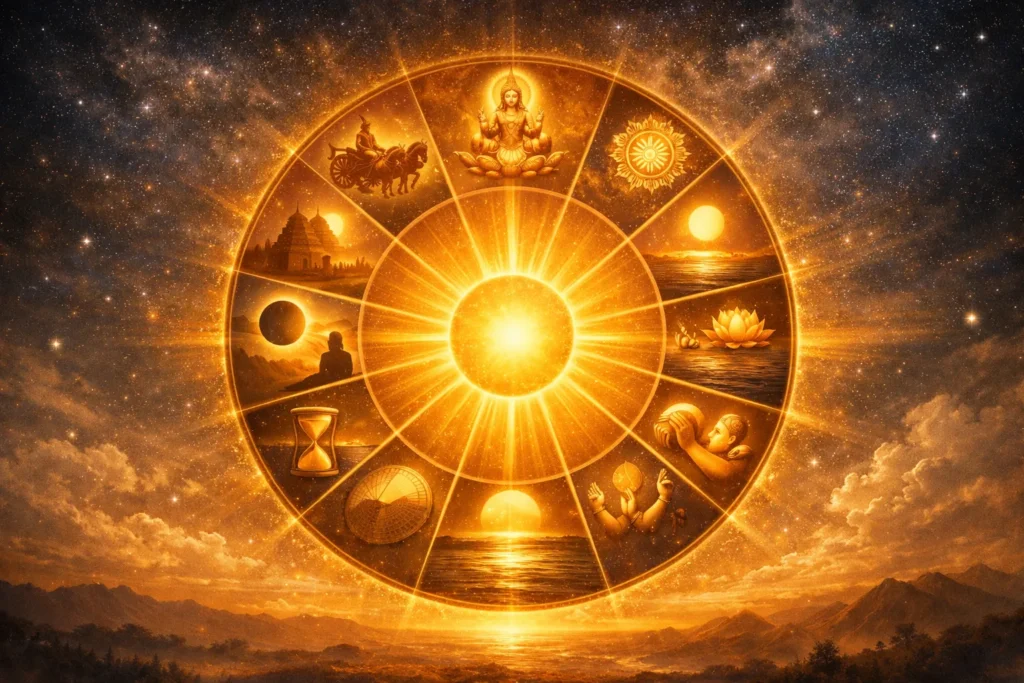
The Sanskrit tradition has twelve principal names for the sun — the Dwadasha Adityas, the twelve Adityas — each representing a different quality of solar energy as it manifests across the twelve months of the year. Each name is a complete theological statement:
💡 The Twelve Names of Surya — Dwadasha Adityas
Vivasvan — the brilliant one, the presiding sun deity, the source of all solar energy
Aryaman — the noble one, the lord of hospitality and ancestral rites
Tvashtr — the divine craftsman, the one who shapes all forms in creation
Savitr — the vivifier, the one who animates all living things before sunrise
Bhaga — the bestower, the one who distributes fortune and prosperity
Dhatr — the sustainer, the one who upholds the order of the created world
Mitra — the friend, the one who sustains relationships and keeps all promises
Varuna — the cosmic guardian, the one who oversees the moral law of the universe
Amsha — the generous portion, the one who gives each being its share of the divine
Pushan — the nourisher, the one who feeds all life and guides all journeys
Indra — the sovereign of heaven, the thunderbolt wielder present in the solar cycle
Vishnu — present here as Vamana, the dwarf avatar, the infinite within the finite
Each name is recited in the Surya Namaskar — the twelve-posture salutation to the sun — one name per posture, each posture a different physical expression of the quality of light that name represents. Together, these twelve names form a complete map of solar presence across time.
The twelve names together form a complete portrait of the solar principle. But the tradition did not stop there.
Beyond the twelve Adityas, Surya carries other names and epithets that reveal the depth of the tradition’s understanding of what the sun represents.
Dinakara — the maker of day.
Bhutasya Jatah — the father of all beings.
Tapanam — the one who generates heat and therefore all transformation.
Savitri — the great vivifier, whose energy animates every living cell.
And most philosophically significant: Pratyaksha Brahman — the Brahman that can be directly seen, the infinite made immediately perceivable without the mediation of image, scripture, or ritual.
This last name is the theological heart of Sowram. Every other deity in the Hindu pantheon requires an image — a murti in a temple, a yantra in a ritual, a visualisation in meditation — to be approached. Surya requires nothing but open eyes and a clear horizon. He is the one deity whose darshan — whose direct sacred vision — is available to every human being, every morning, without any prerequisite of learning, purity, or initiation.
The Vedic tradition recognised this early. The Rig Veda’s Mandala 1, hymn 115 — one of the oldest hymns in any language — addresses the sun directly: “The bright face of the gods has risen, the eye of Mitra, Varuna, and Agni. He has filled heaven, earth, and the air. Surya — the soul of all that moves and stands.” Three thousand five hundred years ago, the Vedic seers were saying: the sun is not a thing in the sky. The sun is the soul of the world.
II. The Stories That Made the Sun Sacred
Samjna and the Unbearable Light — The Origin of the Solar Dynasty
The mythology of Surya begins with a marriage that could not survive its own intensity.
Vishvakarma — the divine architect, the craftsman of the gods, the builder of celestial palaces and divine weapons — had a daughter named Samjna. She was given in marriage to Surya, the sun god, in what should have been the most magnificent union in all of creation.
It was magnificent. It was also unbearable.
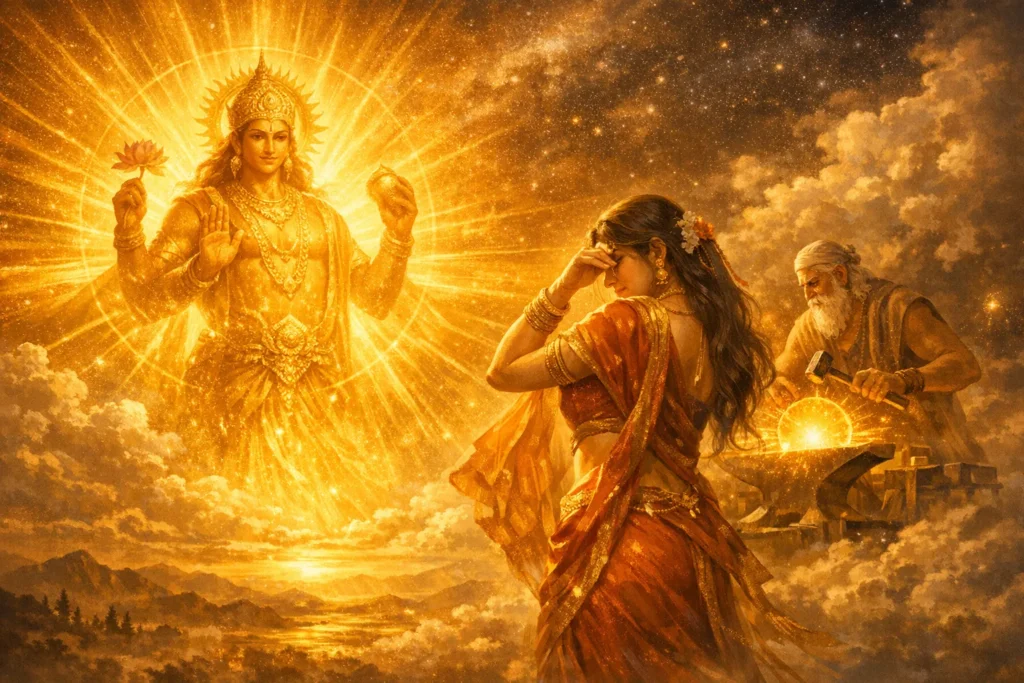
Surya’s radiance — the full, unfiltered light of the cosmic sun — was too much for even a divine being to endure in close proximity. Samjna could not live beside him. His light scorched her. His heat was not warmth but consuming fire. She bore him three children — Vaivasvata Manu (the progenitor of the present human race), Yama (the lord of death), and Yami (the first woman) — and then, unable to continue, she left. She created a shadow-duplicate of herself — Chhaya, the shadow — placed Chhaya in her place beside Surya, and fled to the forests of the north, where she lived in the form of a mare, in penance and in hiding.
Chhaya bore Surya additional children — including Shani, the god of Saturn and karmic justice, whose slow, exacting nature reflects his origin in shadow rather than light. But Surya eventually discovered the deception — the shadow’s love was different from the original’s, and a father knows the difference. He found Samjna. He understood what had happened. And then — in an act of divine accommodation that is itself a theological statement — he went to Vishvakarma.
“Reduce me,” he said. “Take away enough of my light that my wife can bear to be near me.”
Vishvakarma placed Surya on his lathe and shaved away portions of his radiance — the excess light that fell away became, in different traditions, Vishnu’s Sudarshana Chakra, Shiva’s Trishul, Murugan’s Vel, and other divine weapons. The sun was reduced — but not diminished. The essential light remained. And Samjna returned.
From their reunion was born Ashwini Kumar — the twin divine physicians who carry their mother’s horse-form in their name, who are the doctors of the gods, who represent the healing power of solar energy. And from this lineage — the Solar Dynasty, the Suryavamsha — descended the greatest kings in the Puranas, including Rama himself. The entire Ramayana is, in a genealogical sense, the story of the Sun’s descendants.
Karna — The Son the Sun Could Not Protect
Of all Surya’s children in the great epics, none carries the weight of the solar tradition more completely than Karna — the tragic hero of the Mahabharata, the greatest warrior of his age, the man who was born royal and lived as an outcast and died with more grace than any of the kings who survived him.
Kunti — the princess who would become the mother of the Pandavas — had been given, as a young girl, a boon by the sage Durvasa: a mantra with which she could summon any deity and receive a child. Not fully understanding what she had been given, she tested it on the sun. Surya appeared. And Karna was born — radiant, already armoured with divine kavach (armour) and kundala (earrings) that were fused to his body at birth, gifts from his solar father that made him invulnerable.
Kunti, unmarried and terrified of the social consequences, placed the infant in a basket and set him adrift on the river. Karna was found and raised by a charioteer — growing up in a station far below his nature, his divine lineage unknown even to himself, his extraordinary gifts a source of mystery and resentment from those who could not explain how a charioteer’s son could outshoot every prince in the land.
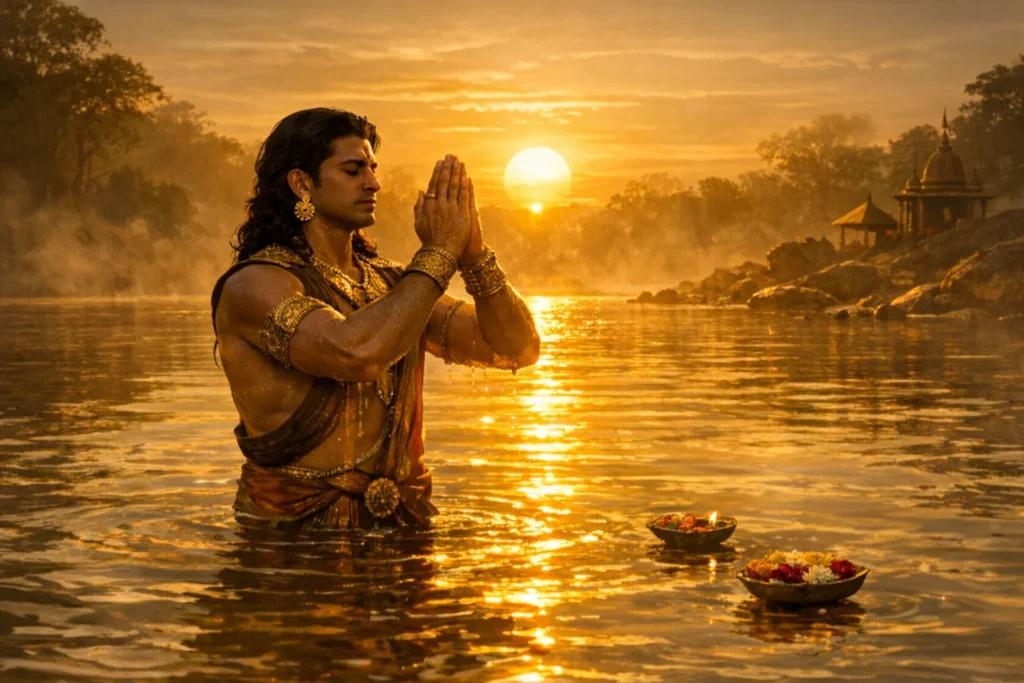
Surya watched — as the tradition holds, the laws of karma are not superseded even by a god’s love. But when Indra — knowing that Karna’s armour made him invincible, and wanting to protect his son Arjuna — came to Karna disguised as a beggar asking for his kavach and kundala, Surya appeared to Karna in a dream and warned him: “Do not give what Indra asks. He is your enemy. He is coming to rob you of your divine protection.”
Karna listened to the warning. And then gave the armour anyway.
Because Karna was a man who could not refuse a request from a Brahmin — even a disguised one, even a hostile one. His dharma of generosity was more fundamental to his identity than his instinct for survival. Surya’s warning was heard and overruled — by his own son’s nobility.
Karna died in battle, abandoned by fortune, his divine gifts given away, his true lineage revealed too late to change anything. And Surya — who had watched all of this from the sky, who had warned and been overruled and could only watch — shone on. This is the solar tradition’s deepest teaching, carried in the story of its most beloved child: the light shines on everyone equally. It does not protect its favourites from consequence. It illuminates — and lets each soul make its own choices in the clarity of that illumination.
The Aditya Hridayam — The Sun on the Battlefield
The most celebrated moment of Surya worship in the entire Sanskrit epic tradition occurs on the battlefield of Lanka, in the Ramayana, at the moment of Rama’s greatest crisis.
Rama had been fighting Ravana — the ten-headed demon king, the abductor of Sita, the most formidable enemy the world had known — and Ravana would not fall. For every head Rama cut off, another grew back. For every blow that should have ended the battle, Ravana rose again. Rama was exhausted. His divine weapons had been expended. His army was depleted. And Ravana stood undefeated before him.
It was at this moment that the sage Agastya — who appears at critical moments throughout the Sanskrit tradition as the one who knows what is needed — descended from the heavens and approached Rama. “Listen,” he said. “I will tell you the eternal secret by which all enemies are defeated. The Aditya Hridayam — the Heart of the Sun.”
What Agastya taught Rama was not a new weapon. Not a tactical strategy. Not a divine intervention. It was a hymn — an inner alignment, not an external weapon — a recitation of the names and qualities of the sun, an act of conscious alignment with the solar energy that is the source of all strength, all vitality, all victory. Three times Rama recited the hymn. And then he faced Ravana.
Ravana fell.
📜 From the Aditya Hridayam
आदित्यहृदयं पुण्यं सर्वशत्रुविनाशनम्
जयावहं जपेन्नित्यं अक्षय्यं परमं शिवम्
Aditya hridayam punyam sarva shatru vinashanam
Jayavaham japenityam akshayam paramam shivam
“The Heart of the Sun — sacred, destroyer of all enemies,
bringer of victory — recite it daily; it is eternal, supreme, auspicious.” Valmiki Ramayana, Yuddha Kanda — The Aditya Hridayam contains 31 verses recited by Agastya to Rama on the battlefield. It is recited to this day by millions of Hindus every morning as part of the daily solar worship. The tradition holds that it generates the same quality of solar energy in the devotee that it generated in Rama — the clarity, the vitality, the unconquerable inner light that no external enemy can extinguish.
III. The Gayatri Mantra — The Most Ancient Living Prayer
There is a prayer that has been recited every morning, without interruption, for at least three thousand years.
It is twenty-four syllables long. It was composed by the sage Vishwamitra — the warrior who became a Brahmin through the sheer force of his austerities, the sage who created a new universe when he needed one, the teacher who taught Rama the Bala and Atibala mantras and walked beside him through the great adventure of the Ramayana.
The Gayatri Mantra appears in the Rig Veda — Book 3, Hymn 62, Verse 10 — making it one of the oldest continuously recited prayers in human history. It is addressed to Savitri — the solar deity, the divine light — and it asks for one thing only:
📜 The Gayatri Mantra
ॐ भूर्भुवः स्वः
तत् सवितुर्वरेण्यं
भर्गो देवस्य धीमहि
धियो यो नः प्रचोदयात्
Om bhur bhuvah svah
Tat savitur varenyam
Bhargo devasya dhimahi
Dhiyo yo nah prachodayat
“Om. We meditate on the divine radiance of Savitri — the supreme light that illuminates the three worlds (earth, atmosphere, heaven). May that divine light illuminate our minds.”
The prayer does not ask for health, wealth, victory, or any external gift. It asks for one thing: illuminated intelligence — the mind that can see clearly, think truly, and perceive the divine reality that underlies the ordinary world. This is the purest expression of Sowram philosophy: the sun is not merely a source of physical light. It is the model for what the human mind can become — radiant, all-illuminating, warming without burning, present without being possessive, sustaining all life without demanding anything in return.
The Gayatri Mantra is traditionally recited at three junctions of the day — sunrise (Pratah Sandhya), noon (Madhyahna Sandhya), and sunset (Sayam Sandhya) — marking the three moments when the quality of solar light changes most dramatically. These three recitations constitute the Sandhyavandanam — the salutation to the junctions — which remains the foundational daily practice of the Brahminical tradition and is observed by millions of Hindus across India and the diaspora every day.
The Surya Namaskar — the twelve-posture physical salutation to the sun — combines the twelve names of the Adityas with twelve specific body postures, creating a practice that is simultaneously devotional, philosophical, and physical. Each posture opens a different part of the body to the solar energy; each name aligns a different quality of the mind with a different quality of light. The Surya Namaskar is the most complete integration of body, breath, and prayer in the entire Hindu ritual tradition — and it is addressed, without exception, to the sun.
IV. Sowram — The Sixth Path of Shanmatham
In Adi Shankaracharya’s Shanmatham framework, Sowram is the sixth and final path — the way of Surya, the sun, worshipped as the supreme expression of Brahman in the most immediately visible form available to human perception.
Sowram has a specific philosophical character within the Shanmatham framework that distinguishes it from the other five paths. Where Shaivam and Vaishnavism have vast devotional literatures, complex theological schools, and pilgrimage traditions of extraordinary richness, Sowram is the most austerely Vedic of the six paths. Its roots are in the oldest stratum of the tradition — the hymns of the Rig Veda, the Sandhyavandanam practice, the Gayatri Mantra — and its philosophical expression is the most direct equation of the chosen deity with the ultimate reality.
Surya as Pratyaksha Brahman — directly visible Brahman — is a statement that requires no temple, no image, no intermediary. The theological sophistication of Sowram is not in its ritual complexity but in its radical simplicity: the infinite is visible. Every morning. On every horizon. To every human being who has eyes to see.
💡 Key Concept: Sowram and the Integration of All Paths
One of the most significant aspects of the Sowram tradition is how completely it integrates all the other five paths of Shanmatham — Shaivam, Vaishnavism, Saktham, Ganapathyam, and Koumaram — within the single form of the sun.
In the Saura Upanishad and the Aditya Purana, Surya is described as simultaneously embodying the three great cosmic functions and the full range of divine manifestation:
The sun at dawn — red, fierce, rising — is Brahma, the creator.
The sun at noon — white, pure, overhead — is Vishnu, the preserver.
The sun at dusk — dark, descending, setting — is Shiva, the dissolver.
The sun as light — the radiance that enables all seeing — is Shakti.
The sun as the single eye of the sky — gazing at everything — is Surya himself.
Each of the five paths sees its own deity reflected in the sun — Shaivam sees Shiva in the setting sun, Vaishnavism sees Vishnu at noon, Saktham sees the Goddess in the radiance itself. The solar tradition does not compete with the other five paths. It contains them.
Shankaracharya’s inclusion of Sowram as the sixth path was therefore not merely the addition of one more deity to a list. It was the recognition that the solar tradition holds within it the seed of the entire synthesis — the one form in whom all five paths can simultaneously find their own deity. The sun is the visible proof of Shanmatham’s central claim: that all paths lead to the same light.
V. The Sacred Temples — Where Surya Is Most Powerfully Present
Unlike the other five paths of Shanmatham, dedicated Surya temples are relatively rare — the solar tradition expresses itself most fully in daily practice (the Sandhyavandanam, the Surya Namaskar, the Gayatri recitation) rather than in pilgrimage. But the Surya temples that do exist are among the most architecturally extraordinary and historically significant sacred sites in India.
Konark — The Chariot of the Sun
Konark is not merely a temple. It is one of the most ambitious architectural statements in human history — a stone chariot of cosmic proportions, pulled by seven horses, carrying the sun god across the sky of Odisha.
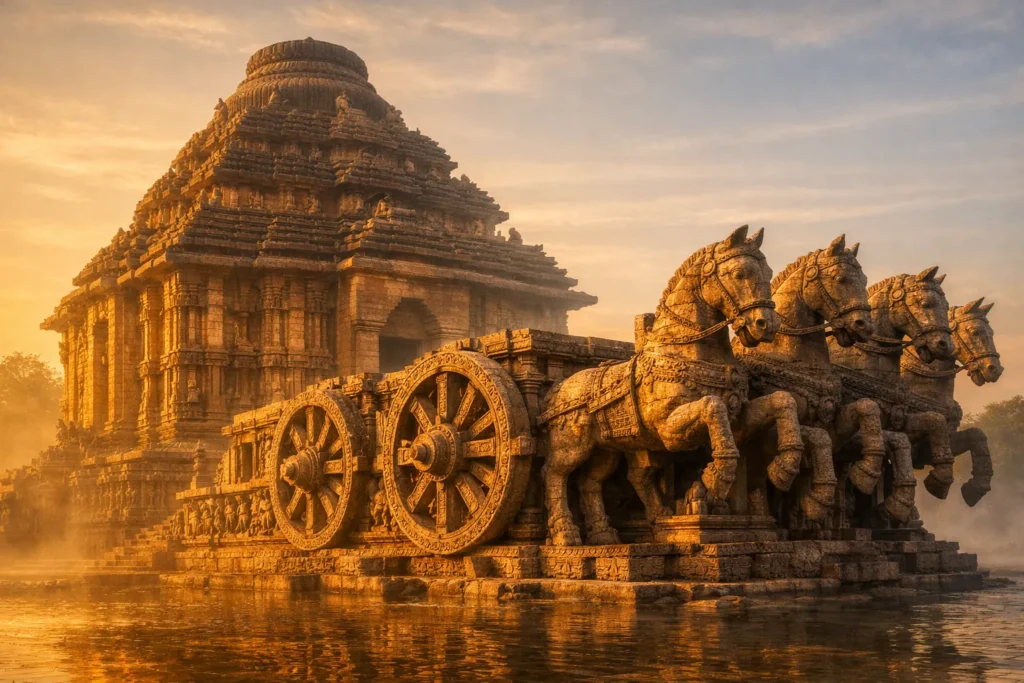
Built by the Ganga dynasty king Narasimhadeva I in 1250 CE — the Konark Sun Temple was conceived as the chariot of Surya himself: a twelve-wheeled stone vehicle pulled by seven horses, the twelve wheels representing the twelve months of the year, the seven horses representing the seven days of the week. Every surface of the temple is covered with carved figures — celestial musicians, dancers, erotic couples, divine beings, animals, scenes from daily life — in a sculptural programme of such density and skill that it has been compared to a stone encyclopedia of medieval Indian civilization.
The temple is oriented with absolute precision to the east, so that the first rays of the rising sun fall directly on the main deity. The Nata Mandir — the dance hall, where temple dancers performed before the deity — stands before the main tower like a stage set before an audience, the audience being the god himself. The erotic sculptures of Konark — which have attracted so much Western attention — are understood in the tradition not as decoration but as a theological statement about the creative energy of the solar principle: the same energy that warms the earth and drives the seasons also drives the impulse of life to create more life.
The main shikhara of Konark collapsed centuries ago — the fallen tower, the missing peak — giving the temple a quality of magnificent incompleteness that is itself deeply moving. What remains is still one of the greatest architectural achievements of medieval India and a UNESCO World Heritage Site. The wheels of the chariot — thirteen feet in diameter, carved with extraordinary precision — have become one of the most recognisable symbols in Indian iconography, appearing on the national flag of India as the Ashoka Chakra, the wheel of dharma.
Modhera — The Temple Aligned With the Solstice
The Sun Temple at Modhera in Gujarat — built by the Solanki dynasty king Bhimadeva I in 1026 CE — is the most precisely astronomically aligned of all India’s Surya temples.
On the equinoxes — the two days of the year when day and night are of equal length — the rising sun falls directly through the entrance of the temple and illuminates the central image of Surya in the innermost sanctum with perfect precision. On the summer solstice, the sun stands directly overhead at noon and casts no shadow within the entire temple complex. These alignments were not accidental — they were the architectural expression of the Sowram understanding that the temple is not a building that contains the deity but a precision instrument for receiving the deity’s direct presence.
The Modhera temple sits beside an extraordinary stepped tank — the Surya Kund — whose steps descend in terraced tiers to the water below, each tier lined with small shrines to various deities. The reflection of the temple in the Surya Kund at sunrise is one of the most photographed sacred vistas in Gujarat. The temple itself, though no longer used for active worship (it is protected as a historical monument), retains a quality of serene, mathematical perfection that the centuries have not diminished.
Suryanar Kovil — The Tamil Navagraha Sun Temple
In the Cauvery delta — in the direct path of The Sacred Trails’ South India circuit — the village of Suryanar Kovil near Kumbakonam houses the only temple in Tamil Nadu where Surya is the presiding deity rather than one of the navagraha (nine planet) subsidiary shrines.
The Suryanar Kovil is one of the nine Navagraha temples of Tamil Nadu — a unique grouping of nine temples scattered across the Cauvery delta, each presided over by one of the nine celestial bodies of Vedic astrology. Most of these nine temples have other deities as their primary presiding deity, with the relevant graha deity in a subsidiary shrine. Suryanar Kovil is different: here, Surya himself is the main deity, with his two consorts Usha (dawn) and Pratyusha (twilight) — the light of the morning and the light of the evening — on either side.
The temple has a specific quality of light that is unlike any other temple in the Cauvery delta. Because it is dedicated to the sun, its architecture and orientation are designed to maximise natural illumination — the inner sanctum receives direct sunlight at specific times of the day in a way that most Tamil temples, with their dark inner sanctums lit only by oil lamps, do not. Standing before the Suryanar image when the morning light falls on it is an experience that needs no theological explanation.
Suryanar Kovil is particularly significant for those seeking relief from afflictions associated with the sun’s position in their horoscope — it is one of the most visited temples in the delta for astrological remedies, and the connection between solar worship and the Vedic astrological tradition is one of the most living expressions of Sowram in contemporary Tamil practice.
Arasavalli — The Sun Temple of Andhra
On the Andhra coast near Srikakulam — where the Bay of Bengal meets the Andhra shoreline — the Suryanarayana temple at Arasavalli is the most celebrated Surya temple in South India after Suryanar Kovil.
The Arasavalli temple was built by the Kalinga kings in the 7th century CE and expanded under later dynasties. Like Modhera, it is precisely oriented: twice a year — in January and March — the rays of the rising sun fall directly on the feet of the presiding deity, moving slowly up the image as the sun rises until it illuminates the full form of Suryanarayana. This astronomical alignment, maintained across thirteen centuries of the temple’s existence, is one of the most compelling demonstrations of the Vedic tradition’s understanding of sacred architecture as a science of light.
The presiding deity at Arasavalli is Suryanarayana — Surya in his synthesis with Narayana/Vishnu, reflecting the Sowram tradition’s integration with Vaishnavism that we noted in the callout above. He stands holding lotus flowers in both hands, flanked by his two consorts, the seven horses of his chariot visible below. The temple is one of the five important pilgrimage sites of the Srikakulam region and draws pilgrims specifically for the Ratha Saptami festival — the seventh day of the waxing moon in the month of Magha (January-February), considered the most auspicious day for solar worship in the entire calendar.
Uttararka and Lolarka — The Ancient Sun Shrines of Varanasi
In Varanasi — the city of Shiva, the city of liberation — two of the twelve Adityas have their primary sacred sites: Uttararka (the northern sun) and Lolarka (the trembling sun, the sun that vibrates with life energy).
The Lolarka Kund — a deep, ancient stepped tank in the southern quarter of Varanasi — is one of the oldest surviving sacred sites in the city. The Lolarka deity worshipped here is associated specifically with the granting of children — the solar energy in its aspect of the divine father, the creative generative light that brings life into the world. The Lolarka Shashthi festival, observed on the sixth day of the waxing moon in the month of Bhadra (August-September), draws thousands of devotees seeking the blessings of parenthood.
These Varanasi sun shrines are among the most ancient Surya worship sites in North India — predating the great Konark and Modhera temples by many centuries — and they represent the most intimate, most personally devotional expression of the solar tradition: not the grand architectural statement of a royal patron but the small, worn, ancient shrine where ordinary people have been bringing their deepest hopes to the sun for thousands of years.
VI. Chhath Puja — The Most Ancient Solar Festival
If Thaipusam is the festival that most completely expresses the devotional intensity of Koumaram, Chhath Puja is its equivalent for Sowram — the festival that strips solar worship to its most primal, most physically demanding, most emotionally overwhelming form.
Chhath Puja is observed in Bihar, Jharkhand, Uttar Pradesh, and the Terai of Nepal — and increasingly across India and the global Indian diaspora — on the sixth day of the waxing moon in the month of Kartika (October-November). It is one of the oldest festivals in the Hindu calendar, its origins traced in the tradition to the age of the Mahabharata — to Karna himself, who is said to have stood in the waters of the Ganga every day and worshipped his father Surya with offerings of water and light.
The four-day festival has no priests, no temple, no intermediary of any kind. The devotees — primarily women, though men participate equally — fast without water for thirty-six hours, stand waist-deep in rivers and ponds at dawn and dusk, and offer arghya (water offerings) to the sun with their bare hands. The offerings include sugarcane, seasonal fruits, thekua (a specific Chhath sweet), and lit diyas. The entire ritual is conducted in the open air, at the water’s edge, under the open sky.
The most extraordinary moment of Chhath is the offering to the setting sun — the Sandhya Arghya — which is made while standing in the water as the sun descends to the horizon. This is unusual in the entire tradition of solar worship: most Hindu solar practices focus on the rising sun, the return of light, the dawn as the image of hope and renewal. Chhath honours the setting sun with equal devotion — the sun that is departing, that is descending into darkness, that will have to find its way back through the night.
The theology of this is precise and moving. The light that departs is also divine. The darkness that follows the sunset is not the absence of the divine but the divine in a different form. And the offering made to the departing sun is the act of a devotee who does not worship the light only when it is convenient and overhead — but who stands in the water, in the cooling air, and says goodbye to the sun with as much love as the welcome at dawn.
VII. Surya in South Indian Temple Tradition — The Eternal Witness
In every major South Indian temple — Shaiva or Vaishnava — there is a Surya shrine. Like the Ganesha shrine at the entrance, the Surya shrine in a South Indian temple occupies a specific, theologically significant position.
Surya is the Navagraha — the presiding deity of the solar body in the Vedic astrological system that governs the placement of the nine planetary deities in every major South Indian temple. The Navagraha shrines — nine deities in a specific geometric arrangement, each governing a different planetary influence — are found in almost every significant temple in Tamil Nadu and are visited by devotees seeking astrological remedies, blessings for specific life circumstances, and the balancing of the planetary influences that the Vedic tradition understands as shaping the conditions of human life.
Surya is at the centre of the Navagraha arrangement in some traditions, and in a specific directional position in others. In Tamil Nadu temples, the Navagraha shrine is typically found in its own small precinct within the temple complex, and devotees circumambulate the nine deities in a specific order — beginning with the sun and proceeding through the other eight — as a complete act of alignment with the cosmic forces that the tradition understands as governing earthly existence.
The temple Surya in South India is almost always depicted in the same specific iconographic form: standing, holding two lotus flowers (one in each hand), wearing a high crown, flanked by his two consorts Usha and Pratyusha, and two guards (pratihara) Danda and Pingala, with the seven horses of his chariot and his charioteer Aruna (the dawn, personified as a legless but immensely skilled driver) visible at his feet.
VIII. The Light That Makes the Journey Possible — A Bridge to What Comes Next
We have now walked all six paths of Shanmatham.
Shaivam — the path of Shiva, of the Nayanmars, of 276 temples singing in the Tamil morning. Vaishnavism — the path of Vishnu, of the Azhwars, of 108 Divya Desams glowing with the light of 4,000 verses. Saktham — the path of the Divine Mother, of the fifty-one Shakti Peethas where the earth itself is her body. Ganapathyam — the path of Ganesha, who stands at every threshold and asks: are you ready? Koumaram — the path of Murugan, of the six hills, of the Tamil God whose beauty and whose spear are the same divine gift. And Sowram — the path of Surya, the oldest path, the most direct path, the path that was walked before any of the others had names.
The Sacred Foundations series has been building toward a single moment: the moment when we step through the temple door. We have met the philosophers who built the frameworks — Shankaracharya, Ramanuja, Madhva. We have met the poet-saints who filled those frameworks with fire — the Nayanmars, the Azhwars, Arunagirinathar. We have met the deities themselves — Shiva and Vishnu and the Goddess, Ganesha and Murugan and the Sun. We have walked the land in our minds — from the Cauvery delta to the sea at Thiruchendur, from the Rock Fort at Trichy to the summit of Palani, from the coastal Surya temple at Arasavalli to the chariot at Konark.
Now the preparation is complete.
The temples are waiting.
They have been waiting for a thousand years — some of them for two thousand. They have been receiving pilgrims every morning since before our great-grandparents’ great-grandparents were born. The priests are performing the same rituals that were performed when the temples were new. The Tevaram is being sung in the same stone chambers where the Nayanmars first heard it echo. The oil lamps are lit. The flowers are fresh. The bell is ringing.
In Blog 14, we pause one final time before entering — because someone in a small delta town has twelve sentences that will change how we hear everything inside. Meykandar and Shaiva Siddhanta: the philosophical ground beneath every Tamil Shaiva temple, the tradition that says the love of the Nayanmars was not a stepping stone to something higher — it was the destination. And then the door opens.
Next in the Sacred Foundations Series:
Wait. Before We Enter the Temples. Meykandar, the Sivagnana Botham, and the Tamil philosophical tradition that gave the Shaiva temple world its intellectual spine.
Coming soon on thesacredtrails.com 🙏