
One of the Most Ambitious Intellectual Project in Human History — and Why It Still Matters

There is a library that has no walls.
No shelves. No catalogue. No building. For most of its existence — spanning at least three thousand five hundred years, possibly considerably more — it had no physical form at all.
It existed entirely inside human beings. Passed from mouth to ear, from teacher to student, from one generation to the next, in an unbroken chain of transmission so precise, so disciplined, and so obsessively maintained that scholars who have studied it call it one of the greatest feats of collective human memory in the history of civilization.
This library contains, by conservative estimate, over one hundred thousand verses across its complete corpus. Composed in multiple distinct literary forms. Arranged according to a classification system of extraordinary sophistication. Covering subjects that range from the most practical — how to light a ritual fire, how to build an altar, how to measure time — to the most abstract: the nature of consciousness, the structure of reality, the relationship between the individual self and the infinite ground of being.
It is called the Vedas.
What you are about to encounter is not a collection of ancient religious texts. It is humanity’s first — and perhaps most ambitious — attempt to write down the source code of reality itself.
Before we enter the first temple.
Before we meet the saints who sang its praises.
Before we understand why a priest performs the same ritual every morning at the same hour in the same sequence — we need to understand what the Vedas are, what they contain, and why they matter not just to the tradition we are tracing but to anyone who has ever asked a serious question about the nature of existence.
This is Blog 3. And it begins with a sound.
I. In the Beginning Was the Word — But Not Any Word
AUM (OM).
One syllable. Three letters in the Roman alphabet, two in the Sanskrit original. Pronounced not as a word but as a vibration — beginning in the back of the throat, moving forward through the mouth, ending with the lips sealed and the sound continuing in the hum of the closed consonant. The entire human vocal apparatus engaged, from open to closed, from back to front.
The tradition holds that this syllable is not a human invention. It is a discovery. That in the deepest silence, when the mind achieves a stillness so complete that ordinary thoughts cease and the subtle background noise of existence itself becomes audible, what one hears is OM. That it is the primordial sound — Nada Brahman — the universe’s own self-expression in the medium of vibration.
This is not metaphor. Or rather — it is metaphor in the way that all language about ultimate reality must be, but it points to something the tradition takes with complete philosophical seriousness: the universe is, at its most fundamental level, vibrational.
Sound is not merely something that happens in the universe. Sound — vibration, frequency, pattern — is the universe’s primary language. And the Vedas are that language, heard by human beings who had achieved sufficient stillness to receive it.
The Sanskrit word for the Vedas — Shruti — means literally that which is heard. Not that which was composed. Not that which was invented or imagined or cleverly constructed. That which was heard — received, perceived, transmitted — by human beings of extraordinary inner development, called Rishis, who had trained themselves to listen in the deepest possible way to the deepest possible frequency of reality.
This claim — that the Vedas are not human compositions but divine revelations — is the foundational claim of the entire Hindu tradition. Everything else rests on it. And understanding it properly requires us to set aside both naive credulity and reflexive skepticism, and ask instead: what might it actually mean for a human being to hear the source code of reality?
💡 Key Concept: Shruti vs Smriti
The Vedic tradition makes a crucial distinction between two categories of sacred literature. Shruti — literally “that which is heard” — refers to the Vedas themselves: texts understood to be direct revelations of cosmic truth, received by the Rishis in states of deep meditative insight. They are considered eternal and authorless — not created by any human or divine being but simply perceived, in the way that a scientist perceives a law of nature.
Smriti — literally “that which is remembered” — refers to all other sacred literature: the epics (Ramayana, Mahabharata), the Puranas, the law codes, the philosophical commentaries. These are understood to be human compositions inspired by Shruti but not identical with it.
The distinction matters enormously: Shruti is the constitution. Smriti is the legislation that elaborates it.
II. What are the Vedas? – Four Books That Are Not Books
The Vedas are divided into four collections, each with its own character, function, and genius.
Understanding this structure is essential — not as a piece of academic classification but as a key to understanding why the tradition works the way it does, and why the temple ritual is structured the way it is.
The Rigveda is the oldest and most revered. It contains 10,552 verses arranged in ten books called Mandalas — circles, wheels of knowledge. These verses are hymns — addressed to the deities of the Vedic pantheon, yes, but also explorations of the most fundamental philosophical questions imaginable.
The Nasadiya Sukta (which we encountered in Blog 1), the Purusha Sukta, the great hymns to Varuna — these are Rigvedic verses. The Rigveda is the philosophical heart of the tradition: the place where ancient India asked its deepest questions and recorded its most profound insights.
The Samaveda is the Rigveda set to music. Approximately 1,800 of its 1,875 verses are drawn directly from the Rigveda — but transformed by the application of specific musical notations, rhythms, and melodic patterns that turn recitation into song.
The Samaveda is the source of Indian classical music: the tradition holds that all musical knowledge flows from it. It is also the basis of the musical element of temple ritual — the specific melodies in which mantras are chanted.
The Yajurveda is the ritual handbook. Where the Rigveda asks philosophical questions and the Samaveda sets them to music, the Yajurveda provides the precise technical instructions for performing the Vedic sacrifice — the yajna. It specifies what is to be said, what is to be done, in what sequence, at what moment, with what intention.
The Yajurveda is the operational manual of the tradition, and the ancestor of the Agama texts that still govern Hindu temple ritual today.
The Atharvaveda is the most human of the four — and the most controversial in its reception history, having been excluded from the canonical “three Vedas” by some early traditions. It contains hymns for healing, for protection, for the resolution of everyday human problems: disease, enemies, love, prosperity. It is the Veda closest to ordinary life — and it reveals something important: the tradition understood that cosmic law (Rta) expressed itself not only in grand philosophical speculation and elaborate ritual but in the texture of daily human experience.
📜 From the Rigveda
एकं सद्विप्रा बहुधा वदन्ति अग्निं यमं मातरिश्वानमाहुः
Ekam sat vipra bahudha vadanti agnim yamam matarishvanam ahuh
“Truth is one; the wise call it by many names — they call it Agni, Yama, Matarishvan.”
Rigveda 1.164.46 — Perhaps the most famous verse in the entire Rigveda, and one of the most extraordinary statements in world religious literature. Three thousand years before the modern discourse on religious pluralism, the Rigveda articulated the principle that underlies it: the ultimate reality is one, and the diversity of names and forms through which human beings approach it are not competing falsehoods but different perspectives on a single truth. This verse is the philosophical foundation of Hindu tolerance — and of the tradition’s capacity to hold apparent contradictions without requiring resolution.
III. The Impossible Achievement — How the Vedas Were Preserved
Consider what is being claimed.
A corpus of over one hundred thousand verses — including the four Samhitas, the Brahmanas, the Aranyakas, and the Upanishads — composed in a highly evolved, highly inflected language with precise tonal values, intricate metres, and layers of meaning that reward lifetimes of study — was preserved without writing, with perfect accuracy, for a period that conservative scholars estimate at between one thousand and three thousand years.
In any other tradition, this claim would be dismissed as impossible. In the case of the Vedas, it is not only plausible but demonstrable — because we can compare the versions of the Vedic texts that were eventually written down (beginning approximately in the first millennium CE) with oral recitations recorded in different parts of the subcontinent, separated by centuries and thousands of kilometres, and find them virtually identical. Letter for letter. Syllable for syllable. Tone for tone.
How was this achieved? The answer reveals something extraordinary about the Vedic understanding of knowledge — and about the relationship between sound, memory, and meaning.
The tradition developed not one but multiple methods of Vedic recitation, each designed as a check on the others.
The simplest method — Samhita patha — recites the text in its natural flow.
A second method — Pada patha — recites each word separately, stripped of the phonetic modifications that occur when words combine in Sanskrit.
A third method — Krama patha — recites words in overlapping pairs: 1-2, 2-3, 3-4.
More complex methods — Jata patha, Ghana patha — recite words in increasingly elaborate patterns, back and forth, in combinations that would immediately reveal any error because the mathematical relationships between the words would break down.
“The Vedas should be learned from a teacher who knows them, not from books. The text must be received through the ear, transmitted through the mouth, and preserved in the mind. Writing is a concession to weakness, not a method of preservation.”
— Traditional Vedic teaching principle
The oral tradition is not a primitive precursor to the written tradition. It is a deliberate, sophisticated choice, based on the understanding that living transmission — from one human being to another, across the bridge of sound — preserves not only the words but the meaning, the energy, and the presence that no written text can fully encode.
The achievement is almost incomprehensible to the modern mind, trained as it is to outsource memory to external devices. We do not remember phone numbers because our phones remember them for us. We do not remember directions because our navigation systems remember them. We do not remember facts because our search engines retrieve them on demand.
The Vedic student was trained in the opposite direction: to make the mind itself the most reliable storage and retrieval system possible. To develop a memory so precise, so deep, so structurally integrated that the text became not something one knew but something one was.
And the tradition held that this was not merely a practical necessity. It was a spiritual one. Because the Vedas are not primarily a text. They are a sound. And a sound must be heard to be real.
IV. What the Vedas Actually Contain — The Four Layers
Here is where most introductions to the Vedas go wrong.
They present the Vedas as a single unified thing — “the Hindu scriptures” — and then either celebrate them as timeless wisdom or dismiss them as primitive superstition, without ever actually engaging with the extraordinary diversity and sophistication of what they contain.
The Vedas are not a single thing. Each of the four Vedas is itself divided into four distinct layers of text, each with its own genre, purpose, and philosophical register. Understanding these layers is the key to understanding how the tradition thinks — and how it evolved from the cosmic hymns of the Rigveda to the philosophical depths of the Upanishads.
The Samhitas are the core hymns — the verses we have been discussing. They are the oldest layer, the most poetic, and the most directly concerned with the relationship between human beings and the cosmic order (Rta) we explored in Blog 2.
The Brahmanas are prose commentaries on the Samhitas — detailed explanations of the ritual context and meaning of each hymn, and precise instructions for the Vedic sacrifices. They are, in a sense, the tradition’s first attempt to systematise and explain itself — to move from inspired poetry to analytical prose.
The Aranyakas — literally the “forest texts” — represent a transitional layer, composed for and by renunciants who had withdrawn from the world of active ritual into the forest. They begin the process of internalising the sacrifice: moving from the outer fire of the yajna to the inner fire of contemplation.
The Upanishads are the culmination — the philosophical summits of the Vedic tradition, the texts in which the insights of the Samhitas are developed into the most sophisticated metaphysical system the ancient world produced.
The Upanishads are where the tradition makes its most audacious claim — Tat Tvam Asi: “That thou art.” The individual self (Atman) and the universal consciousness (Brahman) are not merely similar, not merely related — they are identical. And liberation (Moksha) consists in the experiential realisation of this identity.
The Vedas begin with fire and end with consciousness. They begin with the world and end with the self. They begin with many gods and end with one truth. The journey from the Samhitas to the Upanishads is the journey from the surface of reality to its centre.
V. The Rishis — The Ones Who Listened
They had no laboratories.
No telescopes, no particle accelerators, no fMRI machines, no double-blind studies. What they had was something the modern world has largely forgotten how to value: extraordinary inner stillness. The capacity to turn the instrument of consciousness itself — the one instrument that is present in every experiment, the one variable that modern science systematically refuses to examine — toward its own source.
The Rishis were not priests, though they performed priestly functions. They were not philosophers, though they produced philosophy of the highest order. They were not scientists, though their methods were, in their own domain, rigorously empirical. They were, most precisely, explorers — of the inner universe, the territory that lies on the other side of ordinary waking consciousness, in the spaces between thoughts, in the silence beneath all sound.
And what they found there — what they heard, in the most literal sense the tradition means when it calls the Vedas Shruti — was a coherent, structured, infinitely deep account of the nature of reality. Not a story about reality. Not a theory about reality. A direct perception of it, expressed in the only medium adequate to such perception: sound, rhythm, vibration, poetry.
📜 From the Rigveda
ऋतं च सत्यं चाभीद्धात्तपसोऽध्यजायत
Ritam cha satyam cha abhiddhat tapaso adhya jayata
“From the blazing heat of tapas (inner discipline), truth and cosmic order were born.”
Rigveda 10.190.1 — Tapas — the disciplined heat of inner practice — is the method. Rta and Satya — cosmic order and truth — are the result. The Rishis did not stumble upon cosmic truth. They earned it, through the most demanding inner discipline imaginable. The Vedas are the record of what that discipline revealed.
The great Rishis whose names are attached to specific Vedic hymns — Vishwamitra, Vasishtha, Bharadwaja, Atri, Gautama — are not authors in the modern sense. They are perceivers. The tradition is precise about this: they saw the mantras (mantra-drashta — seers of mantras), they did not compose them.
The distinction matters as much as the distinction between a scientist who discovers a law of nature and one who invents a useful fiction. The Rishis were, in the tradition’s understanding, scientists of consciousness — and the Vedas are their published findings.
VI. From Veda to Temple — The Unbroken Thread
You are standing, once again, at the entrance of a South Indian temple.
The gopuram rises before you — tier upon tier of carved stone figures, thousands of them, each one a specific deity or celestial being, arranged in a precise hierarchy that reflects the Vedic understanding of the cosmos. The priest inside is performing the morning puja — lighting lamps, chanting mantras, offering flowers and food and incense in a precise sequence that has been performed every morning, in this temple, for perhaps a thousand years.
Where does the sequence come from? From the Agama Shastras — the manuals of temple ritual and architecture that govern every aspect of temple construction and worship. And where do the Agama Shastras come from? From the Vedic tradition — specifically from the Yajurveda and the Brahmana literature that elaborated it into a complete system of ritual knowledge.
The mantras the priest is chanting are Vedic mantras — sounds first heard by Rishis thousands of years ago and transmitted without interruption, through the oral tradition, to the lips of this priest in this temple on this morning.
The structure of the puja — the sequence of offering, the logic of hospitality to the divine guest, the timing aligned with the movements of the sun — is Vedic. The iconography of the deity in the inner sanctum — the specific form, the specific attributes, the specific mudras (hand gestures) — derives from the Vedic understanding of the cosmic forces that deity embodies.
The temple is, in the most literal and precise sense, a Vedic structure. Not a building inspired by Vedic ideas. A three-dimensional expression of Vedic knowledge — the Vedas made stone, made ritual, made image, made sound.
When you enter a temple on The Sacred Trails, you are entering the Vedas. You are stepping inside the source code of reality, as ancient India understood it — and as it has been maintained, preserved, transmitted, and embodied, without interruption, from the first Rishi who sat in the deepest silence and heard the universe speak, to this morning, this priest, this lamp, this mantra, this moment.
The Vedas did not end when the last Rishi fell silent. They became temples. They became rituals. They became the morning bell. They became the lamp that is lit before dawn in ten thousand sanctuaries across a subcontinent — and they are still, right now, being heard by anyone with sufficient stillness to listen.
VII. Why This Matters — The Source Code Question
There is a reason the metaphor of “source code” resonates so deeply with the modern, tech-fluent mind.
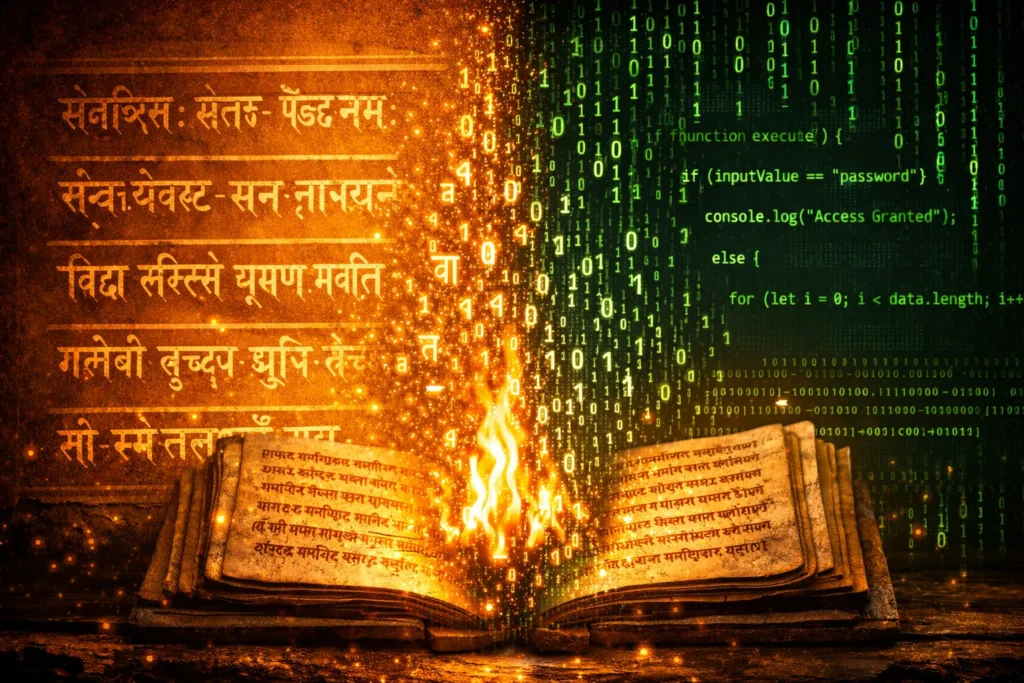
Source code is the set of instructions that underlies a program — not the interface that users see but the logic that generates the interface. You can use a piece of software without understanding its source code. But if you want to understand why it works the way it does — if you want to modify it, extend it, fix it when it breaks — you need to go deeper. You need to go to the source.
The Vedas are the tradition’s claim to have done exactly that — to have gone below the interface of ordinary experience, below the level at which most human beings operate, to the underlying instructions that generate the experience of reality. And to have transmitted those instructions — in the most faithful medium available, the living human voice — across an unimaginable span of time.
Whether one accepts the tradition’s metaphysical claims or not, the achievement is staggering.
A civilisation decided that the most important thing it could do was understand and transmit the deep structure of reality. It devoted its most gifted minds, its most rigorous methods, its most careful institutional structures to this project.
And it succeeded — across thousands of years, across the rise and fall of empires, across invasions and famines and floods — in keeping the transmission alive.
The temples on The Sacred Trails are the visible expression of that invisible transmission. Every stone is a word of the source code, made permanent. Every ritual is a line of code, still running. Every mantra is a variable, still holding its value, passed intact through two hundred generations of human minds.
VIII. Closing — The Bridge to What Comes Next
We have now established the three foundational pillars of everything that follows on The Sacred Trails:
The nature of consciousness — Purusha and Brahman — explored in Blog 1. The nature of order — Rta and Dharma — explored in Blog 2. And now the nature of knowledge itself — the Vedas as Shruti, as cosmic revelation, as the source code that underlies the entire tradition.
In the next blog, we will meet three men who read the same source code and arrived at completely different conclusions.
Shankara, Ramanuja, and Madhva — the three great philosopher-saints of the Vedantic tradition — each built a complete metaphysical system on the foundation of the Vedas, each system internally consistent and philosophically brilliant, each incompatible with the other two.
Their debate — still alive, still unresolved — is one of the greatest intellectual dramas in human history.
And it matters for The Sacred Trails because the temples we are here to explore were built, funded, consecrated, and managed by communities defined by their allegiance to one or another of these philosophical schools.
To understand a temple is to understand the philosophy that built it. And to understand the philosophy is to understand the three men who read the same ancient text and heard three different things. Which is itself a kind of Vedic teaching: Ekam sat vipra bahudha vadanti. Truth is one. The wise call it by many names.
Next in the Sacred Foundations Series :
Three Men. One Source Code. Three Different Universes. How Shankara, Ramanuja, and Madhva read the same Vedas and built three incompatible philosophies — and why the temples of South India cannot be understood without knowing which one built them.
Coming soon on thesacredtrails.com 🙏