
All for Love of Shiva

Sometime in the sixth century CE, in a small temple town on the Cauvery delta, a child was left alone on the temple steps.
His father — a devout Shaiva Brahmin — had gone to bathe in the temple tank, leaving the infant in the care of the deity. The child began to cry. And from within the inner sanctum, from the presence of Shiva and his consort Parvati, a golden cup of divine milk appeared. The infant drank. And then — still an infant, still on the temple steps, still in the first months of his life — he sang.
The song he sang is the first hymn of the Tevaram. It begins: Thodudaya Seviyan — “The one with matted locks and the bull.” Fourteen hundred years later, it is still sung every morning in Shaiva temples across Tamil Nadu. Without interruption.
This is where the tradition of devotional temple worship as we know it — the singing, the weeping, the ecstasy, the intimate personal relationship between the devotee and the deity — begins. Not in a philosophical treatise. Not in a royal proclamation. On a temple steps. With a crying infant. And a golden cup of divine milk.
In Blog 5, we met the institution builder — Adi Shankaracharya, who gave the fragmented religious world of 8th century India its philosophical framework and its institutional structure. He built the frame. Now we meet the painters — the extraordinary human beings who filled that frame with colour, with warmth, with tears, and with song. They are the Nayanmars. And what they created changed everything.
I. What the Temples Were Missing
The temples existed before the Nayanmars.
South India’s great temple-building tradition stretches back centuries before the first Nayanmar was born. The Agama Shastras — the ancient manuals of sacred architecture and ritual — had already given the tradition its precise, cosmologically grounded blueprint. Stone temples were rising along the Cauvery. Priests were performing the daily puja in the prescribed sequence. The cosmic wheel was turning.
But something was missing. Something that no Agamic text could provide and no philosophical commentary could generate.
The Vedic ritual was rigorous, precise, and profound. For those trained in Sanskrit — for the priests and scholars who understood the cosmic significance of each gesture, each mantra, each offering — it was fully accessible in all its depth. For everyone else — for the farmer on the Cauvery delta, the weaver in the temple town, the fisherwoman on the coast — it was a spectacle of extraordinary atmosphere whose deeper meaning remained locked behind a language and a learning tradition they had no key to enter.
The Nayanmars gave them the key.
Not in Sanskrit. In Tamil — the language of the soil, the river, the monsoon, the paddy field. Not in the measured, formal register of philosophical discourse but in the immediate, urgent, heart-to-heart language of love. Not as instruction but as testimony — this is what I felt, standing before this deity, in this temple, on this morning. Come and feel it too.
This is what the temples were missing: not ritual, not theology, not architecture — but the human voice, raised in the mother tongue, saying to every person regardless of learning or birth: God is here. God is real. God is accessible to you. Right now. In this place.
A note to the reader: you need neither Sanskrit nor Tamil to access what the Nayanmars created. What they unlocked was not a language — it was a quality of presence. The atmosphere of a temple sanctified by fourteen hundred years of devotional song is felt before it is understood. The Sacred Trails will give you the context, the stories, and the meaning. The temple itself will do the rest.
II. The Sixty-Three — A Cross-Section of Humanity
The Nayanmars number sixty-three in the traditional count.
This precision matters. The tradition knows exactly who they were — their names, their birthplaces, their social backgrounds, their stories, their hymns. The Periya Puranam — the Great Purana, written by the poet Sekkizhar in the 12th century CE — tells all sixty-three stories in extraordinary detail, creating a portrait of the Nayanmar tradition that is simultaneously a sacred biography, a theological statement, and a social manifesto.
Because the sixty-three Nayanmars were not a gathering of learned Brahmin scholars. They were a cross-section of Tamil society so complete that it reads like a deliberate theological argument:
Thirugnana Sambandar — the Brahmin infant we met on the temple steps. He began composing hymns before he could walk and died, tradition says, as a young man, leading hundreds of his followers in a mass ascension into divine light at the temple of Sirkazhi. His hymns are the most numerous in the Tevaram — 384 decades of verses, composed with a musical and poetic sophistication that remains astonishing given the tradition’s claim that he was composing from infancy.
Thirunavukkarasar — Appar — whose name means Father, the name given to him by Thirugnana Sambandar in recognition of his spiritual seniority despite his younger counterpart’s greater fame. Appar was born into a Shaiva family, converted to Jainism in middle age, and reconverted to Shaivism after a miraculous healing that he attributed to Shiva’s grace. He spent the rest of his long life — he lived to be over eighty — composing hymns of extraordinary emotional depth from the perspective of a man who had been lost, found, and could never stop being grateful.
Sundarar — the aristocrat, the beloved, the one who argued with God. Born into a family of hereditary temple functionaries, Sundarar had the kind of personal vanity and social confidence that comes with privilege — and a relationship with Shiva that was, uniquely in the Nayanmar tradition, explicitly that of a friend rather than a devotee. He called Shiva his friend (thozhan), demanded favours, complained when they were not delivered, and composed in the process some of the most humanly honest devotional poetry in any language. It is Sundarar who composed the Tiruthonda Thogai — the list of all sixty-three Nayanmars — which became the canonical enumeration of the tradition.
Manickavasagar — the minister who became a mystic. Born into a high ministerial family, he served as prime minister to the Pandya king — until a divine encounter at the Shiva temple at Thiruperundurai transformed him completely. Entrusted with royal funds to purchase horses for the army, he spent the entire treasury building a temple instead — because Shiva had appeared to him and he could do nothing else. The king imprisoned him. Shiva sent divine horses. And Manickavasagar spent the rest of his life composing the Thiruvasagam — the eighth volume of the Tirumurai, and perhaps the most emotionally intense devotional poetry in Tamil literature.
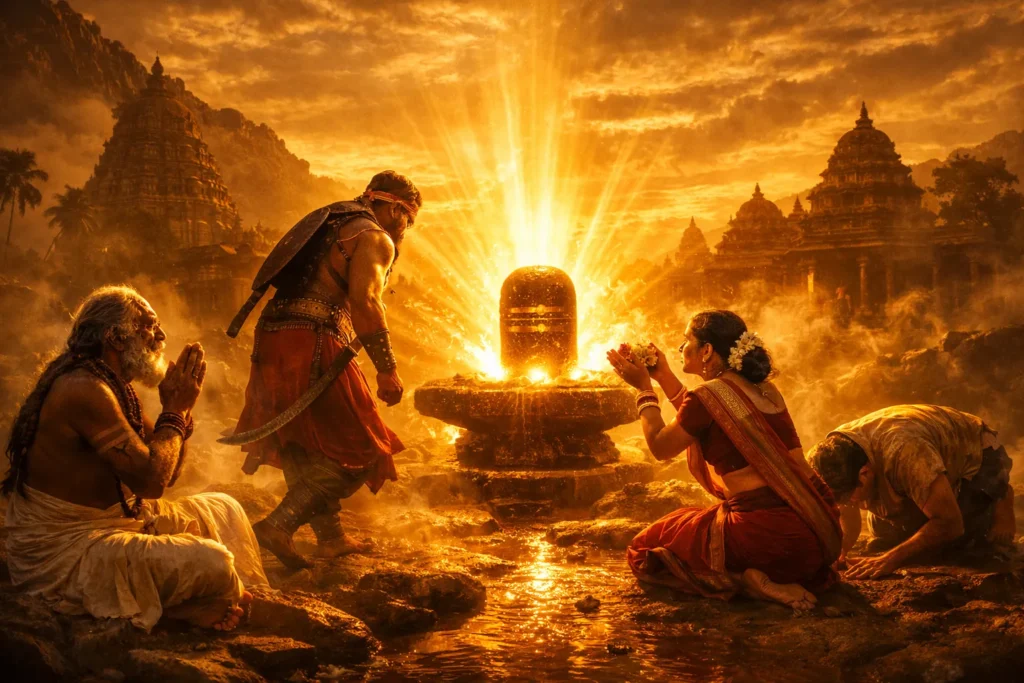
Kannappa Nayanar — the hunter. This is the tradition’s most radical story, and we must tell it fully. Kannappa was a hunter — from a community that lived by killing, that had no contact with temple ritual, no Sanskrit education, no ritual purity by any orthodox standard. He encountered a Shiva lingam in the forest and recognised the deity with the immediate, instinctive certainty of a hunter reading a track. And he began to worship — in the only ways he knew.
He brought water in his mouth to bathe the lingam (considered ritually impure). He brought meat from his hunt as an offering (completely outside any prescribed ritual). He removed thorns from the lingam with his teeth and hands (certainly not in any Agama text). When the deity tested him — causing the lingam’s eye to bleed — Kannappa did not hesitate. He gouged out his own eye and pressed it against the stone. When the other eye began to bleed, he placed his foot on the lingam to mark the spot — so that when he had removed his second eye and was blind, he would know where to apply the replacement. Shiva stopped his hand. And declared Kannappa the greatest of all devotees.
And beyond these five — the infant, the monk, the aristocrat, the minister and the hunter — the sixty-three include stories that stretch the imagination and expand the definition of what devotion can look like. Karaikkal Ammaiyar — a merchant’s wife who asked Shiva to transform her into an emaciated, terrifying form so she could dwell permanently in the cremation grounds and witness his cosmic dance — represents the tradition’s radical inclusivity of women and its willingness to follow love wherever it leads, however strange the destination. A king who swept the temple floor with his own hair. A man who tested his own son’s devotion and found it perfect.
Sixty-three lives. Sixty-three completely different expressions of the same overwhelming fact: God is accessible to anyone, in any form of love that is genuine and total. Blog 7 takes us into five of these lives in full — the four Samayacharyars and Kannappa — where their stories will be told with the depth and detail they deserve.
III. The Tirumurai — Poetry as Sacred Technology
The hymns they composed form part of the Tirumurai — the twelve-volume treasury of Tamil Shaiva devotional literature.
The word Tirumurai means Sacred Collection — and it is exactly that: a complete library of Tamil Shaiva devotional poetry, assembled over several centuries, covering the full range of the tradition’s emotional and philosophical register.
The first seven volumes — the Tevaram — are the hymns of the three principal Nayanmars: Thirugnana Sambandar, Thirunavukkarasar, and Sundarar. Together they contain approximately 800 hymns addressed to Shiva as he is present at specific temples across Tamil Nadu — creating simultaneously a devotional masterwork and a sacred geography of the Tamil country.
But the Tirumurai does not end with the Tevaram. The eighth volume — and in many ways the most emotionally intense of all — is the Thiruvasagam of Manickavasagar. Where the Tevaram hymns have the quality of songs composed for the temple — musical, structured, liturgically precise — the Thiruvasagam has the quality of a private conversation between a soul and its God. It is raw, urgent, intimate:
📜 From the Thiruvasagam — Manickavasagar
யாரே கொடியவர் ஆனாலும் தாம்கொடுமை செய்தாலும் செய்யா திருப்பர் சிவபெருமான்
Yaare kodiyavar aanaalum thaam koduma Seythaalum seyyaa thiruppar Sivaperumaaan
“However cruel they may be, however much wrong they do — Shiva himself does no wrong.”
Thiruvasagam — This single verse captures the essential quality of Manickavasagar’s devotion: an absolute, unconditional trust in the goodness of God that survives every apparent contradiction. The Thiruvasagam was composed at the great temple of Chidambaram — and is inseparable from that temple’s sacred atmosphere. Tradition holds that when the Chidambaram priests refused to sing Manickavasagar’s Tamil hymns (insisting on Sanskrit only), Shiva himself commanded their inclusion. They have been sung there ever since.
“திருவாசகத்திற்கு உருகாதார் ஒரு வாசகத்திற்கும் உருகார்”
“Those who are not moved by the Thiruvasagam will not be moved by any word in any tongue.”
— Ancient Tamil saying
The remaining four volumes of the Tirumurai — volumes 9 through 12 — include the hymns of later saints, philosophical poems, and devotional narratives that extend the tradition into the medieval period. Together, the twelve volumes constitute the complete sonic landscape of Tamil Shaiva devotion — a landscape that is still, fourteen hundred years after its creation, the living voice of the morning ritual in every Shaiva temple on The Sacred Trails.
The musical dimension of the Tirumurai is inseparable from its devotional power. The hymns were composed in specific ragas — melodic frameworks of the ancient Tamil musical system — and were always meant to be sung, not merely read.
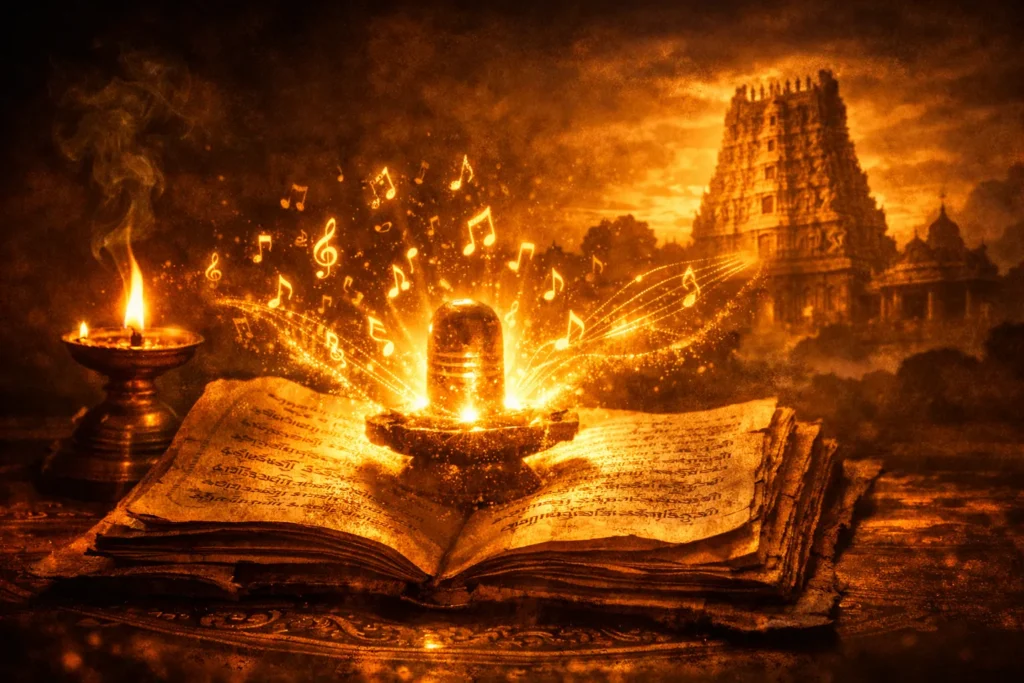
The Chola king Rajaraja I (985–1014 CE) had the Tevaram texts recovered, organised, and set to music — mandating their daily recitation in the great temples of his empire. This mandate has never been rescinded. In the major Shaiva temples of Tamil Nadu today — Chidambaram, Thiruvarur, Madurai, Rameswaram — the Tevaram and Thiruvasagam are sung every morning, every evening, at every major ritual occasion. Exactly as they were a thousand years ago.
IV. The Padal Petra Sthalams — Temples Sanctified by Song
Not every Shaiva temple in Tamil Nadu is a Padal Petra Sthalam.
Padal Petra Sthalam means “temple that has been sung” — specifically, a temple at which one or more of the three principal Nayanmars composed a Tevaram hymn. There are 276 such temples. And their sanctification by the Nayanmars’ hymns is not merely a historical distinction — it is an ongoing spiritual reality that shapes how the tradition understands these places.
When a Nayanmar stood before the deity at a specific temple and was moved to compose a hymn, they were doing something more than making poetry. They were perceiving and recording the specific quality of divine presence at that location — the particular way in which Shiva manifests in that place, with that name, in that form, in relationship with that local landscape and community. The hymn encodes that perception. And when the hymn is sung in the temple — morning after morning, for fourteen hundred years — the perception is renewed, the presence is re-confirmed, the field of sacred atmosphere is maintained and deepened.
This is why visiting a Padal Petra Sthalam feels different from visiting an ordinary historical monument. You are not visiting a record of something that happened in the past. You are entering a living field of presence — a place where a great soul’s perception of the divine has permanently altered the spiritual atmosphere, and where that alteration is actively maintained by the daily singing of the hymns that captured it.
💡 Key Concept: Sacred Temple Groupings
Within the 276 Padal Petra Sthalams, several important sub-groupings reflect specific theological or geographical significance.
The Pancha Bhuta Sthalams — the five temples of the five elements — are among the most theologically significant: Chidambaram (space/akasha), Thiruvanaikaval (water/jala), Thiruvannamalai (fire/agni), Kalahasti (air/vayu), and Kanchipuram (earth/prithvi).
The Sapta Vidanga Sthalams — the seven temples of the Cauvery delta where Shiva is worshipped in the form of the Vidanga — are among the most ancient and atmospherically powerful. Readers will encounter these groupings repeatedly on The Sacred Trails — knowing them now will deepen every temple visit that follows.
The 276 Padal Petra Sthalams are distributed across Tamil Nadu and into parts of neighbouring states — with the greatest concentration along the Cauvery delta, where the density of ancient Shaiva temples is extraordinary. Many of them have been receiving daily worship — the same hymns, the same rituals, in the same stone chambers — for over a thousand years. Some are grand, famous, visited by thousands of pilgrims daily. Others are small, quiet, tucked into village lanes, attended by a single priest and a handful of local devotees. All of them are sung. All of them are alive.
These are the temples at the heart of The Sacred Trails’ Shaiva circuit. And understanding the Nayanmar tradition — who these saints were, what they felt, what they sang, and why — is the essential preparation for entering them.
V. The Nayanmars and the Tradition of Walking
The Nayanmars walked.
This is not incidental. The peripatetic nature of the Nayanmar tradition — the fact that these saints were pilgrims, wanderers, people who moved through the sacred landscape of Tamil Nadu from temple to temple, often barefoot, always on the road — is central to both what they created and what they experienced.
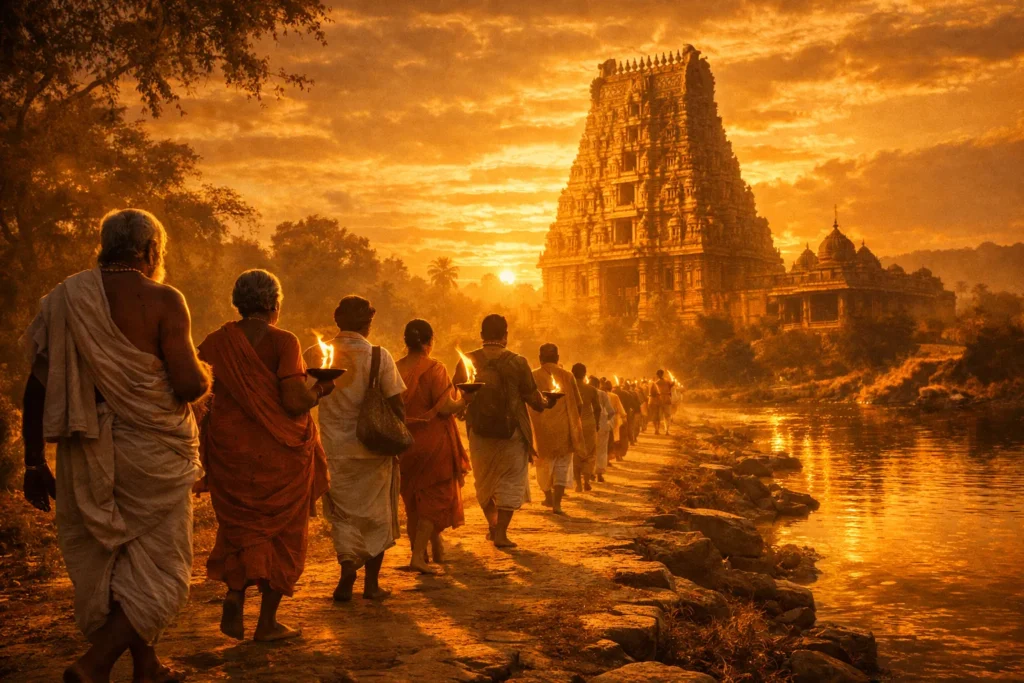
Walking to a temple is not the same as driving to one. The body knows it differently. The approach is gradual, physical, demanding — and that gradualness creates a quality of arrival that instant transportation cannot replicate. When the Nayanmars arrived at a temple after days or weeks of walking — when they came around a bend in the road or crested a hill and saw the gopuram rising above the palms in the morning light — the experience of arrival was inseparable from the experience of divine presence.
The Tevaram hymns carry this quality. They describe the approach to the temple — the sight of the tower, the sound of the bells, the smell of the incense — with a sensory specificity that is unmistakably the language of someone who has walked there. Who has earned the arrival. Who knows what it costs to get here and therefore knows what it means to have arrived.
When The Sacred Trails maps its temple circuits — when it traces the routes between the Padal Petra Sthalams of the Cauvery delta, or the pilgrimage path between the Pancha Bhuta Sthalams — it is following in the footsteps of the Nayanmars. Not metaphorically. Some of the paths they walked are still walkable. Some of the landscapes they described are still recognisable. The gopurams they saw are still rising. The bells they heard are still ringing. The deity they loved is still there — receiving, morning after morning, the hymns they composed, sung by priests who learned them from priests who learned them from priests, in an unbroken chain of transmission that reaches back to the Cauvery delta, fourteen hundred years ago, and a crying infant on a temple step.
VI. What the Nayanmars Changed — Forever
Before the Nayanmars, the temple was a place of ritual.
Precise, powerful, cosmologically significant ritual — as we explored in the earlier blogs. But ritual that was, in its full depth, accessible only to those with the training to understand it.
After the Nayanmars, the temple was also a place of song. Of poetry. Of the immediate, heart-to-heart communication between the human soul and the divine that requires no intermediary, no Sanskrit, no ritual purity — only the willingness to feel.
This transformation is permanent and total. It is visible in every Shaiva temple in Tamil Nadu today. The priest who performs the morning puja does not merely conduct the Agamic ritual — he also sings the Tirumurai hymns. The two dimensions of temple worship — the ritual precision of the Agamic tradition and the devotional intensity of the bhakti tradition — are now inseparable. Each makes the other complete.
The ritual gives the devotion its structure and cosmic significance. The devotion gives the ritual its emotional reality and human warmth. Together, they create the extraordinary atmosphere of a living South Indian Shaiva temple — an atmosphere in which the most rigorous cosmic philosophy and the most tender personal love exist simultaneously, in a space of stone and fire and song that has been maintained, without interruption, for over a thousand years.
This is the Nayanmar legacy. Not a historical achievement to be studied — a living reality to be entered.
VII. Closing — The Bridge to What Comes Next
We have now met the Nayanmars as a movement — who they were, what they sang, what they created, and why it still matters in every Shaiva temple on The Sacred Trails.
But sixty-three is too many lives to fully honour in a single blog. And five of those lives are so extraordinary — so specific in their stories, so inseparable from the specific temples we will visit — that they deserve a blog of their own.
In Blog 7, we go deeper. We meet five Nayanmars in full detail. Five lives. Five completely different paths. One God. And the temples that are inseparable from their stories — temples that you will never be able to visit again without hearing, underneath the bells and the chanting, the echo of these specific human beings and their specific, irreducible, world-changing love.
After the Nayanmars, our journey continues to the Vaishnava tradition — to the Azhwars, whose 4,000 Tamil verses in the Divya Prabandham created an equally extraordinary devotional world around the 108 Divya Desams.
Together — the Nayanmars and the Azhwars — they complete the human face of the Sacred Foundations. The face that looks not toward the abstract infinite but toward the beloved God, present and near, in every lamp-lit inner sanctum on The Sacred Trails.
Next in the Sacred Foundations Series :
Meet the Saints Who Sang India’s Most Sacred Temples Into Existence. Five lives — four Samayacharyars and the hunter who gave his eyes — that changed a civilisation.
Coming soon on thesacredtrails.com 🙏