
How Adi Shankaracharya Looked at a Fragmented Civilisation — and Built Something That Held It Together

Imagine a civilisation at war with itself.
Not the war of armies — though there was plenty of that too. The war of ideas. Of competing loyalties. Of communities that worshipped different deities, followed different rituals, read different texts, and regarded each other with the particular contempt that neighbours reserve for neighbours who are almost — but not quite — like themselves.
This was India in the seventh and eighth centuries CE.
Six distinct religious traditions competed for the hearts and minds of a subcontinent. The Shaivas worshipped Shiva. The Vaishnavas worshipped Vishnu. The Shaktas worshipped the Divine Mother. The Ganapatyas worshipped Ganesha. The Kaumaras worshipped Murugan. The Sauras worshipped Surya, the sun. Each tradition had its own temples, its own priests, its own texts, its own theology — and its own conviction that the others were, at best, misguided, and at worst, heretical.
Into this fragmented world walked a young man from Kerala.
He was, by most accounts, barely in his twenties. He had already, by this point, walked the length of the subcontinent, debated and defeated the leading philosophers of every school, and written commentaries that would be studied for the next twelve centuries.
His name was Adi Shankaracharya. And what he did next was one of the most audacious acts of intellectual and institutional statesmanship in the history of any civilisation.
He offered a framework that allowed all six to coexist under a shared philosophical vision.
This is not the story of a philosopher. We met the philosopher in Blog 4. This is the story of a builder — a man who took the most fractious religious landscape imaginable and constructed, from it, something that has held together for twelve hundred years.
I. Adi Shankaracharya – The Problem He Inherited
To understand what Shankara built, you need to understand what he found.
The centuries preceding Shankara’s birth had been a period of extraordinary religious ferment in India. Buddhism (founded in the 5th century BCE) and Jainism (founded in the 6th century BCE) had challenged the Vedic tradition at its foundations, rejecting the authority of the Vedas, the caste system, and the elaborate ritual apparatus of the Brahminical tradition. For nearly a thousand years, Buddhism in particular had been the dominant intellectual and spiritual force across large parts of the subcontinent, patronised by emperors, funded by merchants, and sustained by the extraordinary institution of the Buddhist monastery.
By Shankara’s time, the tide was turning. Buddhism was in decline in India — partly through internal fragmentation, partly through the revival of the Vedic tradition, partly through political changes. But the Vedic tradition that Buddhism had challenged was itself fragmented — the six competing schools we described above, each with its own institutional base, each suspicious of the others.
The result was a landscape of extraordinary spiritual richness but dangerous institutional weakness. A tradition that could not agree on what it believed, or who belonged to it, or how to organise itself, was a tradition vulnerable to collapse.
Shankara saw this. And he acted.
II. The Solution — Shanmatham
The word Shanmatham means “the six religions” or “the six paths.”
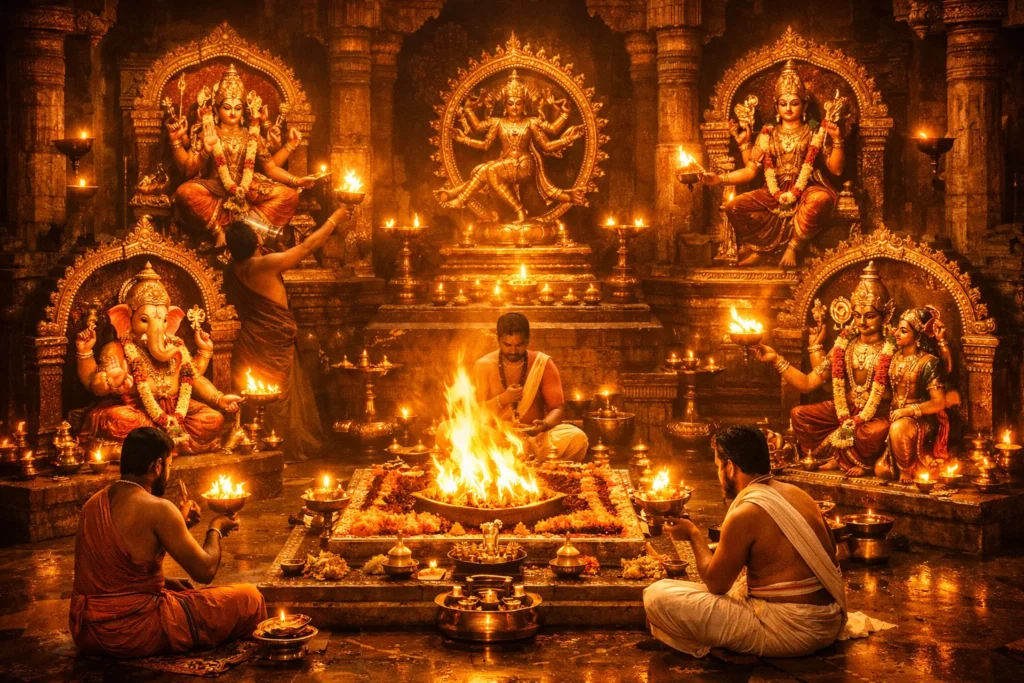
What Adi Shankaracharya proposed — and what he institutionalised through a combination of philosophical argument, personal authority, and extraordinary organisational genius — was a framework for understanding all six competing traditions not as rivals but as aspects of a single truth.
His argument was elegant in its simplicity: all six traditions are worshipping the same ultimate reality — Brahman — through different forms and names. Shiva, Vishnu, the Divine Mother, Ganesha, Murugan, Surya — these are not different gods competing for supremacy. They are different faces of the one infinite consciousness, each face suited to the temperament, the cultural background, and the spiritual development of a different category of worshipper.
💡 Key Concept: Ishta Devata — The Chosen Deity
Central to Shankara’s Shanmatham framework is the concept of the Ishta Devata — the chosen deity. The tradition holds that every individual has a natural affinity for one particular form of the divine — one face of Brahman that speaks most directly to their temperament, their history, their inner nature.
The Shaiva worships Shiva not because Shiva is superior to Vishnu but because Shiva is the form through which that particular soul most readily apprehends the infinite. The Vaishnava worships Vishnu for the same reason. Both are approaching the same summit — by different paths suited to their nature. Shanmatham is the framework that makes this diversity not a problem but a feature.
This was not merely a philosophical position. It was a political and institutional masterstroke.
By establishing that all six traditions were equally valid paths to the same ultimate reality, Shankara gave the fragmented Vedic world a common roof under which to shelter — without requiring any tradition to abandon its distinctive practices, its deities, or its identity.
The Shaiva could remain a Shaiva. The Vaishnava could remain a Vaishnava. But both could now recognise themselves as part of a single, larger tradition — the Sanatana Dharma, the eternal order — with a common philosophical foundation in Advaita Vedanta and a common institutional framework in the four mathas that Shankara established.
III. The Four Mathas — An Institution Built to Last
Shankara was not merely a philosopher. He was an institution builder of the first order.
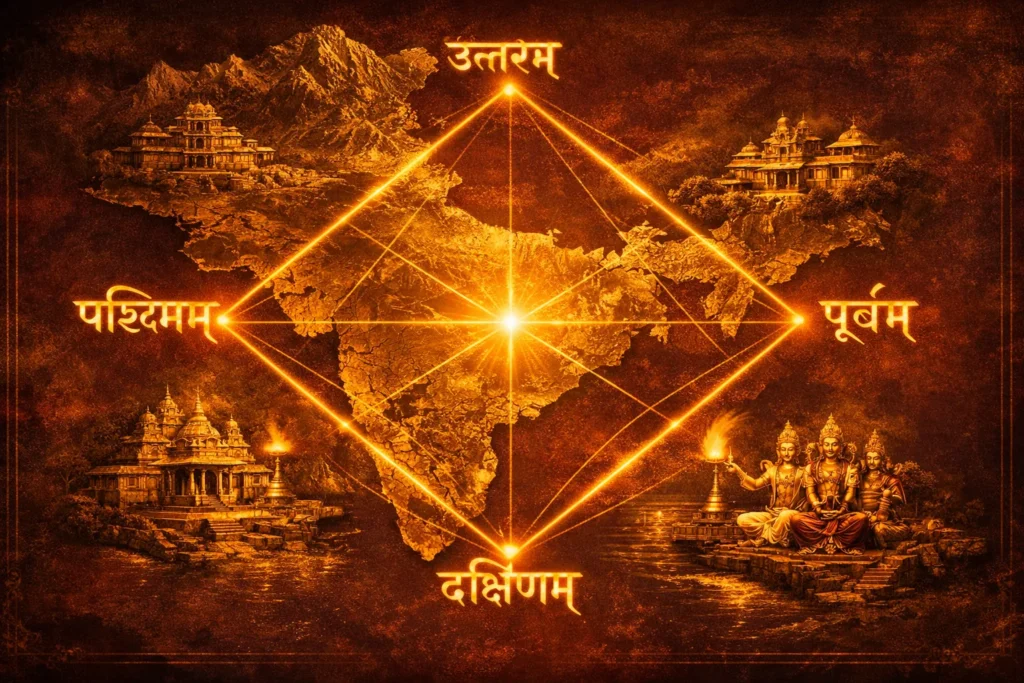
The four mathas — monastic centres — that he established at the four geographic corners of India are among the oldest continuously functioning institutions in the world. They are still operating today, twelve hundred years after their founding, still governed by the system Shankara designed, still maintaining the tradition he established.
| Matha | Location | Direction | Veda | Mahavakya |
| Sringeri | Karnataka | South | Yajurveda | Aham Brahmasmi |
| Dwarka | Gujarat | West | Samaveda | Tat Tvam Asi |
| Puri | Odisha | East | Rigveda | Prajnanam Brahma |
| Badrinath | Uttarakhand | North | Atharvaveda | Ayam Atma Brahma |
Each matha was assigned one of the four Vedas to preserve and transmit. Each was given one of the four great Mahavakyas — the “great sayings” of the Upanishads that encapsulate the Advaitic understanding of the relationship between Atman and Brahman. Each was placed at a geographic extreme of the subcontinent — ensuring that the tradition would have an institutional presence from the Himalayas to the southern coast, from the eastern shore to the western sea.
📜 The Four Mahavakyas
Aham Brahmasmi — “I am Brahman” (Brihadaranyaka Upanishad)
Tat Tvam Asi — “That thou art” (Chandogya Upanishad)
Prajnanam Brahma — “Consciousness is Brahman” (Aitareya Upanishad)
Ayam Atma Brahma — “This Self is Brahman” (Mandukya Upanishad)
These four statements — one from each of the four Vedas — are the pillars of Advaita Vedanta. Each says the same thing in a different register: the individual self and the ultimate reality are not two different things. Shankara assigned one to each matha as its philosophical cornerstone — ensuring that the complete Advaitic understanding was preserved and transmitted from four different directions simultaneously.
The head of each matha carries the title Shankaracharya — literally “teacher in the line of Shankara” — and is considered the living representative of Shankara’s lineage and authority. The current Shankaracharyas of the four mathas are among the most respected religious authorities in India today.
The genius of this institutional design becomes clear when you consider its durability. Kingdoms have risen and fallen. Empires have come and gone. Languages have changed, borders have shifted, entire civilisations have been transformed beyond recognition. The four mathas have remained — quietly, consistently, without interruption — maintaining the tradition, training the next generation of scholars and monastics, and providing the institutional backbone of the Vedic tradition through twelve centuries of Indian history.
IV. The Smarta Tradition — Shankara’s Living Legacy
The Shanmatham framework gave rise to a distinct community within the broader Hindu world: the Smartas.
The Smartas — from Smriti, the body of traditional texts — are Hindus who follow the Shanmatham approach: worshipping all six deities as equal manifestations of Brahman, performing the Panchayatana puja (worship of five deities simultaneously), and holding Advaita Vedanta as their philosophical foundation.
The Panchayatana puja — one of Shankara’s most practical and enduring contributions — involves the simultaneous worship of five deities: Shiva, Vishnu, Devi (the Divine Mother), Ganesha, and Surya. The sixth tradition — Kaumara, the worship of Murugan — is incorporated through regional practice.
By worshipping all five simultaneously, the Smarta practitioner embodies the Shanmatham principle in daily ritual: all forms are one reality, approached through many doors.
💡 Key Concept: Panchayatana Puja
The Panchayatana puja is performed by placing five sacred images or symbols — representing Shiva, Vishnu, Devi, Ganesha, and Surya — around a central altar. The deity of one’s Ishta Devata (chosen deity) is placed at the centre; the other four surround it. The ritual worship addresses all five simultaneously, with the understanding that all five are expressions of the same Brahman. It is a daily practice of Shanmatham — the unity of all paths, enacted in ritual form every morning in millions of homes across India.
The Smarta tradition is particularly strong in South India — especially in Tamil Nadu and Karnataka — where Brahmin communities following Shankara’s framework have been the custodians of the Vedic tradition for over a millennium. Many of the great temples on The Sacred Trails were built, administered, or profoundly influenced by Smarta communities — making Shankara’s institutional legacy not merely a philosophical abstraction but a living presence in the stones and rituals we are here to explore.
V. The Philosopher Who Became a Saint
There is something almost impossible about Shankara’s life when you look at it clearly.
He was born into a Brahmin family in Kaladi, Kerala. His father died when he was young. He showed such extraordinary intellectual gifts from childhood that the tradition records him as having mastered the four Vedas by the age of eight. He renounced the world — took sannyasa, the monastic vow — as a young teenager, over his mother’s objections, and spent the rest of his short life in a continuous movement across the subcontinent that combined philosophical debate, textual composition, institutional founding, and devotional practice in proportions that seem humanly impossible.
He debated Mandana Mishra — the greatest Mimamsa philosopher of his age — in a contest so legendary that the tradition records it lasting weeks, with Mandana’s wife Ubhaya Bharati serving as judge. He won. He debated scholars of every school across every region of India. He won consistently — not through sophistry or rhetorical tricks but through the sheer power and clarity of his philosophical understanding.
And yet — and this is what makes Shankara truly extraordinary — he was simultaneously one of the great devotional poets of the tradition. The man who argued most rigorously that the personal God was ultimately a form of the attributeless Brahman wrote some of the most achingly beautiful hymns to personal deities in Sanskrit literature. His Soundarya Lahari — the “Wave of Beauty,” addressed to the Divine Mother — is a masterpiece of devotional poetry. His hymns to Shiva, to Vishnu, to Ganesha, are still sung in temples and homes across India today.
This is the paradox of Shankara: the philosopher of radical non-dualism who could not stop writing love poems to God. The man who argued that the personal deity was ultimately Maya who nevertheless devoted his life to serving that deity with extraordinary passion and tenderness.
Perhaps this is not a paradox at all. Perhaps it is simply what wisdom looks like from the inside — the capacity to hold the philosophical truth (all is Brahman) and the devotional truth (God is real and worthy of love) simultaneously, without contradiction, without tension, as two aspects of a single, inexhaustible reality.
VI. Shankara in the Temple
Every great Shaiva temple on The Sacred Trails bears Shankara’s fingerprints.
Not always visibly. Not always in ways that a casual visitor would recognise. But in the philosophical framework that governs the ritual, in the Smarta communities that have maintained these temples for centuries, in the Advaitic understanding of what the temple is and what happens within it — Shankara is present.
When the priest performs the morning puja in a Shaiva temple, the theology behind each gesture is Advaitic: the deity being worshipped is a form of Brahman, and the worship itself is an act of recognising — in concentrated, ritual form — the identity of the worshipper’s own deepest nature with the infinite reality represented by the deity.
When a devotee circumambulates the temple — walking clockwise around the outer walls in the pradakshina — the Advaitic understanding is that the worshipper is orbiting not a statue but a living focal point of the infinite — a place where Brahman’s presence is concentrated and accessible in a way that everyday life does not afford.
And when the temple’s architecture rises in tiers toward the sky — the gopuram climbing through successive layers of carved divinity toward the golden finial at its summit — the Advaitic cosmology is encoded in stone: the movement from the gross to the subtle, from the many to the one, from the outer world of multiplicity to the inner sanctum of undifferentiated presence.
Shankara didn’t build these temples. But he gave the tradition the philosophical vocabulary to understand what they are — and why they matter.
VII. Why This Matters Now
Shanmatham is twelve hundred years old. And it is, arguably, more relevant now than it has ever been.
We live in a world of competing fundamentalisms — religious, political, ideological — each convinced of its own exclusive access to truth and correspondingly dismissive of every other claim. The capacity to hold multiple perspectives simultaneously, to recognise the partial truth in positions apparently opposed to one’s own, to maintain conviction without requiring the destruction of competing convictions — this is one of the rarest and most urgently needed capacities of our time.
Shankara built an institution around exactly this capacity. He looked at six traditions convinced of their own superiority and said: you are all right, and you are all approaching the same truth, and your diversity is not a problem to be solved but a richness to be celebrated. And then he built the institutional structures — the mathas, the Smarta community, the Panchayatana puja — to make this philosophical position a living practice rather than a mere aspiration.
The result has lasted twelve hundred years. It has survived invasions, colonialism, modernisation, and the extraordinary pressures of the twenty-first century. The four mathas still stand. The Shankaracharyas still teach. The Panchayatana puja is still performed every morning in millions of homes.
Whatever one thinks of the specific philosophical positions involved, this is an achievement worth understanding — and worth learning from.
VIII. Closing — The Bridge to What Comes Next
We have now met the philosopher (Blog 4) and the institution builder (Blog 5). We have seen how the Vedantic tradition moved from cosmic speculation to human community — from the abstract identity of Atman and Brahman to the concrete reality of mathas, communities, and daily ritual practice.
But here is the question that Shanmatham — for all its philosophical elegance and institutional genius — could not fully answer:
How do you make the infinite lovable?
Shankara had established that all six paths led to the same summit. He had built the institutional structures to maintain those paths across centuries. He had given the tradition a common philosophical foundation in Advaita Vedanta and a common ritual practice in the Panchayatana puja.
What he had not — could not, by the nature of his philosophical position — fully provide was the emotional bridge. The path from the head to the heart. The way of approaching the formless absolute not through rigorous philosophical reasoning but through the immediate, overwhelming, completely unconditional force of love.
That bridge was being built simultaneously — in the Tamil country, along the banks of the Cauvery, in the gopuram-shadowed towns of the river delta — by people who were not philosophers at all. Who had no interest in Advaita or Vishishtadvaita or Dvaita. Who could not have written a Sanskrit commentary to save their lives.
What they could do was sing.
And they were not alone.
Across the Tamil country — simultaneously, or nearly so, as if the same wind was blowing through both traditions at once — two extraordinary devotional movements were transforming the landscape of South Indian worship.
In the Shaiva world, the Nayanmars — sixty-three saints from every walk of life — were composing the hymns that would eventually be compiled into the Tirumurai, the great twelve-volume treasury of Tamil Shaiva devotional literature. The first seven volumes — the Tevaram — were the hymns of three principal saints: Thirugnana Sambandar, Thirunavukkarasar, and Sundarar. The eighth volume — the Thiruvasagam — was the burning, intimate outpouring of Manickavasagar, whose hymns of longing, surrender, and divine encounter remain among the most emotionally powerful devotional poems in any language. Together, the Tirumurai gave the Shaiva tradition something no philosophical system could provide: a living, sung, felt experience of the divine.
In the Vaishnava world, the Azhwars — twelve saints, equally diverse in background and equally passionate in devotion — were composing the Divya Prabandham: 4,000 Tamil verses in praise of Vishnu as he is present at 108 specific temples called the Divya Desams. Their devotion was different in its object — Vishnu rather than Shiva, the personal God of love and grace rather than the cosmic dancer of destruction and creation — but identical in its essential quality: immediate, personal, overwhelming, and completely beyond the reach of philosophical categories.
Together, the Nayanmars and the Azhwars represent the bhakti revolution — the great devotional transformation that swept through South Indian religious life between the 6th and 10th centuries CE, and that permanently changed what a temple is, what worship means, and what the relationship between a human being and the divine can feel like.
It is important to be precise about what each tradition contributed within the Shanmatham framework. Shankara’s genius was in providing a philosophical roof large enough to shelter all six paths — but the Nayanmars sang specifically within the Shaiva tradition, and the Azhwars within the Vaishnava. Their devotional revolutions deepened and humanised their respective traditions — giving the Shaiva path its emotional heartbeat through the Tirumurai, and the Vaishnava path its through the Divya Prabandham.
Shanmatham provided the framework that held both — and the devotional movements filled that framework with the warmth, the tears, the songs, and the aching personal love that philosophy alone could never generate.
Where Shankara built the frame. The saints painted the picture — each in their own tradition’s colours, each with their own language of devotion, and together creating the extraordinary palette of South Indian temple worship that we are here to explore.
We begin with the Nayanmars — the Shaiva saints whose Tirumurai hymns still echo in the stone corridors of the Padal Petra Sthalams every morning before dawn. Blog 6 tells their story — who they were, where they walked, what they felt, and why a Brahmin infant, a reformed Jain monk, a vain aristocrat, a forest hunter, and a woman who became a ghost all loved the same God with the same completeness. Blog 7 goes deeper — into five specific Nayanmar lives whose stories are inseparable from the temples on our Sacred Circuits.
Then in Blog 8, we turn to the Azhwars — the twelve Vaishnava saints whose 4,000 Tamil verses in the Divya Prabandham sanctified 108 Divya Desams and gave the Vaishnava tradition its own extraordinary devotional heartbeat. Blog 9 takes us into individual Azhwar lives — including Andal, the girl who refused to marry anyone but God, and Thiruppaan Azhwar, the saint who never spoke.
After that — Blogs 10 through 13 — we complete the Shanmatham picture, exploring the remaining four paths: Saktham, Koumaram, Ganapathyam, and Sowram — each with its own sacred geography, its own saints, its own temples on The Sacred Trails.
And then — finally, after thirteen blogs of foundation-laying — we arrive at the temples themselves. And The Sacred Trails begins its temple-by-temple journey through the most sacred landscape in the world.
Next in the Sacred Foundations Series :
They Were a Poet, a King, a Hunter and a Woman. The story of the Nayanmars — the sixty-three Shaiva saints whose Tirumurai hymns sang India’s most sacred temples into existence.
Coming soon on thesacredtrails.com 🙏