
A 150-Year Historical Investigation into the Correlation Between Rahu’s Transit, Global Financial Crises, and Political Change in India
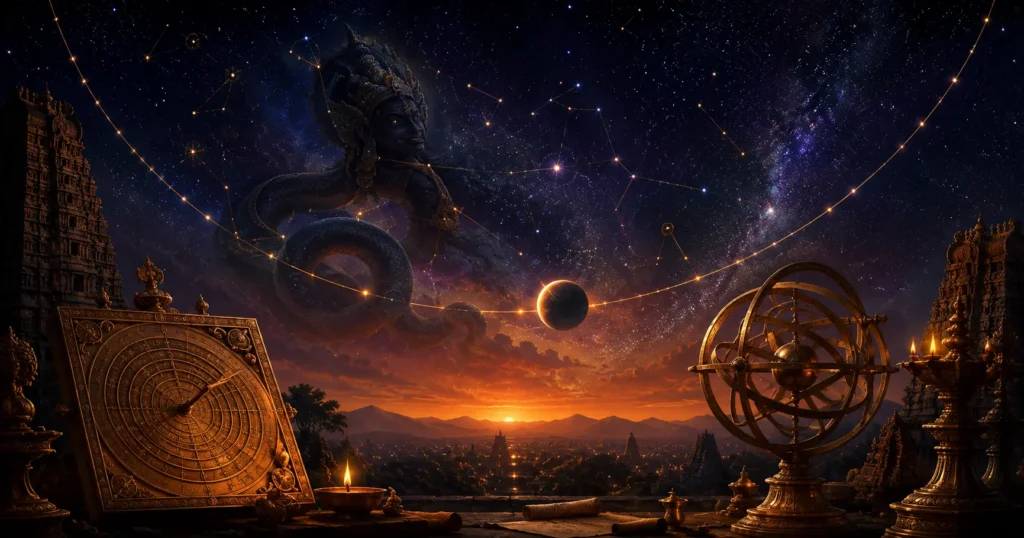
“History rarely repeats itself in exactly the same way. Yet, time and again, it seems to move in recognizable rhythms. Economists describe these rhythms as business cycles. Historians call them turning points. Astrologers have, for thousands of years, described them as planetary cycles.”
Every civilization has attempted to answer one enduring question:
Does history move randomly, or does it follow recurring patterns?
Economists have proposed business cycles, debt cycles, and market cycles. Political scientists have identified recurring phases of institutional growth and decline. Historians frequently observe that periods of prosperity are often followed by correction, reform, conflict, or renewal. Across cultures, one common theme emerges: societies appear to evolve through recognizable cycles rather than along a straight path.
Vedic astrology approaches this question from a different perspective.
Within the branch known as Mundane Astrology—the study of nations, governments, economies, and collective events—planetary movements are viewed as symbolic indicators of periods during which significant societal developments may unfold. Rather than focusing on individuals, mundane astrology examines broader patterns affecting civilizations, institutions, financial systems, and political structures.
Among the many planetary combinations studied by practitioners of Vedic astrology, one recurring observation has attracted particular attention: Rahu’s transit through Dhanishta (Avittam) Nakshatra.
Over approximately the last 150 years, Rahu has entered Dhanishta only eight times before its forthcoming transit in 2026–2027. Each passage lasts for roughly eight months, yet several of these periods appear to coincide with moments of remarkable transformation in global finance and, in India’s post-Independence history, significant political developments.
Is this merely coincidence?
Does it represent a recurring historical rhythm?
Or is it an example of the selective pattern recognition that often accompanies retrospective analysis?
This article does not seek to answer these questions with certainty. Instead, it presents the historical record and invites readers to examine the evidence for themselves.
The Purpose of This Study
This is not an attempt to prove that planetary transits cause economic crises or political upheavals.
Such a claim would extend beyond what historical evidence can establish.
Instead, the objective is considerably more modest—and, perhaps, more valuable.
This study seeks to investigate whether Rahu’s transit through Dhanishta has repeatedly coincided with periods marked by:
- Financial instability or systemic economic restructuring,
- Monetary reforms and banking crises,
- Major political realignments in India,
- Institutional change and shifts in governance.
If recurring correlations exist across multiple cycles spanning more than a century, they deserve documentation and thoughtful examination, regardless of one’s views on astrology.
The emphasis throughout this article is therefore on historical observation rather than deterministic prediction.
Why Study Rahu?
Among the nine planetary influences (Navagrahas) recognized in Vedic astrology, Rahu occupies a unique position.
Unlike the visible planets, Rahu is not a physical celestial body. It is the ascending lunar node—the point where the Moon’s orbit intersects the apparent path of the Sun. Although astronomically invisible, Rahu has held profound symbolic significance in Indian astrological tradition for millennia.
Classical texts associate Rahu with themes such as:
- Expansion beyond conventional limits,
- Innovation and disruption,
- Foreign influences,
- Speculation and excessive optimism,
- Sudden reversals,
- Illusion and uncertainty,
- Technological advancement,
- Collective transformation.
In mundane astrology, Rahu is often examined during periods when societies experience rapid change, financial speculation, political uncertainty, or institutional disruption.
Importantly, Rahu should not be understood as inherently “benefic” or “malefic.” Its symbolism is more nuanced. Rahu tends to amplify existing trends, accelerate change, blur established boundaries, and expose structural weaknesses that may have accumulated over time.
For this reason, many mundane astrologers pay particular attention to Rahu’s movement through specific Nakshatras that are closely associated with governance, wealth, institutions, or societal organization.
One such Nakshatra is Dhanishta.
Why Dhanishta?
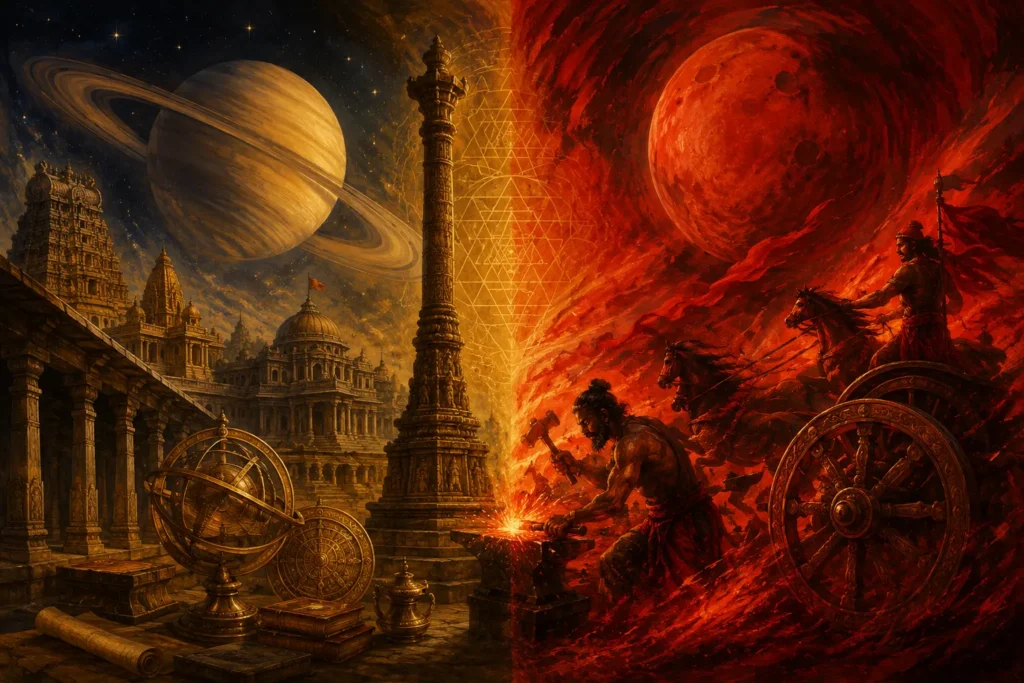
The Sanskrit word Dhanishta is commonly translated as the wealthiest, the most prosperous, or the star of abundance. In Tamil tradition, it is known as Avittam.
Its symbolism extends well beyond material wealth.
Classical descriptions associate Dhanishta with:
- Prosperity,
- Resources,
- Rhythm,
- Social order,
- Leadership,
- Institutions,
- Community organization,
- Reputation and achievement.
Astronomically, Dhanishta spans the transition between Capricorn (Makara) and Aquarius (Kumbha)—two zodiacal signs ruled by Saturn (Shani).
This is significant.
Saturn represents:
- Institutions,
- Governments,
- Administrative systems,
- Law,
- Accountability,
- Infrastructure,
- Public responsibility,
- Long-term economic structures.
The Nakshatra itself is ruled by Mars (Mangala), traditionally associated with action, conflict, decisive change, engineering, military affairs, and implementation.
Thus, Dhanishta represents an unusual combination:
- Saturn provides structure.
- Mars provides action.
- Rahu introduces disruption and acceleration.
From the perspective of mundane astrology, this creates a symbolic framework in which existing institutional structures may be tested, challenged, reformed, or transformed.
Whether history consistently reflects this symbolism is precisely the question explored in this study.
A Rare Planetary Cycle
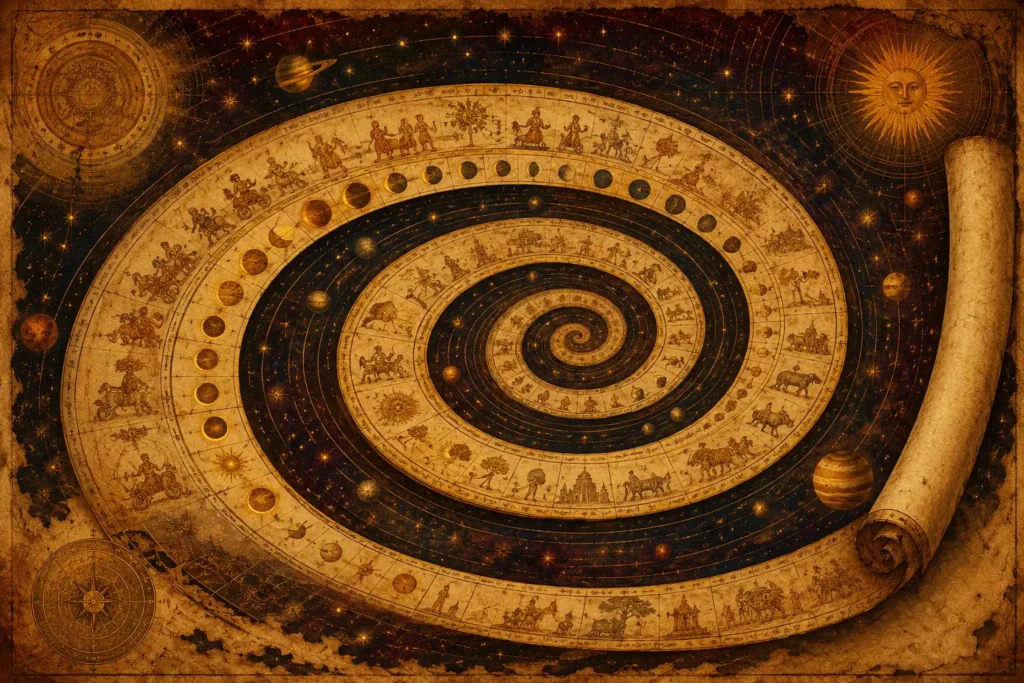
Rahu completes one full revolution through the zodiac approximately every 18.6 years, moving in a retrograde direction.
Consequently, Rahu enters Dhanishta only once during each cycle, remaining there for roughly eight months before continuing into the previous Nakshatra.
Between 1877 and 2027, the transit has occurred during the following periods:
| Occurrence | Entry | Exit |
| 1877–78 | 14 October 1877 | 23 June 1878 |
| 1896-97 | 21 May 1896 | 27 January 1897 |
| 1914–15 | 27 December 1914 | 5 September 1915 |
| 1933–34 | 3 August 1933 | 11 April 1934 |
| 1952 | 9 March 1952 | 16 November 1952 |
| 1970–71 | 14 October 1970 | 23 June 1971 |
| 1989–90 | 21 May 1989 | 28 January 1990 |
| 2007–08 | 26 December 2007 | 3 September 2008 |
| 2026–27 (forthcoming) | 2 August 2026 | 11 April 2027 |
Each of these periods serves as a reference point for the historical investigation that follows.
Rather than beginning with astrological interpretation, we will first examine what the historical record reveals.
Only after reviewing the evidence will we return to the question posed at the outset:
Is there a recurring pattern—or merely an intriguing coincidence?
That question forms the foundation for the chapters ahead.
Coming in Part II
When Markets Trembled: Rahu in Dhanishta and 150 Years of Global Financial History
We begin in 1877, during the aftermath of the Long Depression, and trace each subsequent transit through the Panic of 1896, World War I, the Great Depression, post-war monetary restructuring, the breakdown of Bretton Woods, the Savings & Loan crisis, and the Global Financial Crisis of 2008—asking whether these periods reveal a consistent historical rhythm or simply remarkable coincidence.