
The Universe Did Not Create the Goddess. The Goddess Created the Universe

She Was Already Dead. Shiva Refused to Let Go.
The wedding had been magnificent.
Sati — the daughter of Daksha, the lord of creatures, the most powerful of Brahma’s sons — had chosen Shiva as her husband. Not by arrangement. Not by her father’s blessing. By her own fierce, unshakeable will. She had walked to the swayamvara, the ceremony of self-choice, looked past every assembled king and god, and placed her garland around the neck of the great ascetic who sat at the edge of the world, covered in ash, his matted locks piled high, his eyes half-closed in meditation. The gods were astonished. Daksha was furious. Shiva was, for perhaps the first time in his existence, moved.
They were happy. This is the part the great myths do not linger on, but it is true: they were happy. Sati — who would later be reborn as Parvati — lived with Shiva in the high Himalayas, and for a time the universe itself breathed easier. The destroyer and the goddess of devotion, together. Stillness and power, united.
Then came the great yagna.
Daksha — still carrying his rage, still unable to forgive his daughter for choosing the wild ascetic over every respectable suitor — organised a massive yajna, a sacred fire ritual. He invited every god, every sage, every divine being in creation. Every one except two: his daughter Sati, and his son-in-law Shiva.
The insult was deliberate. Cosmic. Public.
Sati heard about the ceremony from the divine chariots passing overhead, from the celestial music drifting through the mountains. She wanted to go. Shiva forbade it — not from weakness, but from knowledge. He knew what Daksha’s omission meant. He knew what awaited her if she walked into that hall uninvited, as the daughter her father had disowned.
“He will insult you,” Shiva said. “He will insult me through you. Do not go.”
Sati went.
What happened next is one of the most devastating passages in the Puranas. Daksha, surrounded by the assembled gods, looked at his daughter — who had come uninvited, who had defied convention, who had married against his will — and spoke. Every word he said was designed to wound. He called Shiva a mad beggar. A wanderer of cremation grounds. A wearer of skulls. Unworthy of sacrifice. Unworthy of worship. Unworthy of his daughter.
Sati stood in the hall of the great yagna. She had come hoping — what? That her father would see her. That the love between a father and a daughter might survive even this. That the god she loved could be acknowledged, even here.
He did not see her. He saw only his own wounded pride.
What Sati did next, no text fully explains — because it requires no explanation. It is the act of a soul for whom dignity is indistinguishable from devotion. She could not bear to live in a body born of a man who had spoken those words about the one she loved. She could not carry the flesh and blood of Daksha’s line and remain who she was.
She walked to the sacred fire.
And she entered it.
When the news reached Shiva, the universe stopped.
What followed is described in the Puranas with a restraint that is more devastating than any elaboration. Shiva came to Daksha’s yajna. He destroyed it — the hall, the sacrificial vessels, the cosmic order of the ceremony. He killed Daksha (who was later restored). And then he did something that shook the three worlds to their foundations.
He lifted Sati’s body from the fire. And he began to walk.
He walked across the universe, carrying the body of the woman he loved. Refusing to release her. Refusing to perform the final rites. Refusing to let the grief become real by completing the act that would make it permanent. The gods watched in horror. Brahma and Vishnu knew: as long as Shiva carried the body, he could not return to his cosmic function. The universe was being undone by a god’s grief.
It was Vishnu who finally acted. Using his Sudarshana Chakra — his spinning discus of divine light — he followed Shiva across the cosmos. And piece by piece, with infinite gentleness and infinite sorrow, he cut Sati’s body loose from Shiva’s arms.
Wherever a piece fell to earth, the earth itself was transformed.
The place where Sati’s womb fell became Kamakhya in Assam — the most primal of all Shakti Peethas, where the creative power of the universe is worshipped in its rawest form. The place where her right toe fell became Kalighat in Kolkata — the temple that gave a city its name. The place where her tongue fell became the temple at Jwalamukhi. The place where her navel fell, some say, became Kanchi.
Fifty-one pieces. Fifty-one places. The body of the goddess, scattered across the subcontinent. Her body became geography. Her presence became permanent.
This is what a Shakti Peetha is: not a place where the Goddess is worshipped. A place where the Goddess is present. Where the earth itself has been consecrated by her body. Where the boundary between the human and the divine does not merely thin — it dissolves entirely.
Shiva, released from the weight of the body, did not disappear. He sat down on the earth. And he began, they say, to weep. And then — because he is also the great meditator — he turned his grief inward. And what emerged from that turning was the deepest stillness in creation. The stillness that is not the absence of feeling but feeling so complete it becomes transparent. Pure consciousness, beyond both joy and sorrow. Shiva, without Shakti, became stone. And it was only when Sati was reborn — as Parvati, the daughter of the mountains — that the universe breathed again.
I. The Goddess Before the Gods
Every civilisation that has ever existed has worshipped the feminine divine.
This is not a romantic generalisation. It is an archaeological fact. The oldest surviving religious artefacts in human history — figurines found across Europe, the Middle East, and the Indian subcontinent, dating back thirty thousand years and more — are overwhelmingly female. The great mother goddess — the source of life, the power of fertility, the force that brings forth, sustains, and ultimately receives back all that lives — is the oldest human intuition about the divine.
In India, this intuition has never died. It has evolved — absorbed into the Vedic tradition, developed by the great philosophical schools, expressed through extraordinary temple architecture and devotional poetry that spans three thousand years — but the essential recognition has remained constant: that the ultimate reality has a feminine face. That the infinite, when it turns toward the human being in its most intimate and most immediately felt form, presents itself as mother.
The Sanskrit tradition has many names for this feminine divine. Devi — simply, the Goddess. Shakti — power, the primal energy that underlies all manifestation. Amma — mother. Durga — the one who is difficult to approach, who destroys what needs to be destroyed. Kali — the dark one, time itself, the power of transformation. Lakshmi — the goddess of abundance, grace, and beauty. Saraswati — the goddess of knowledge, music, and learning. Parvati — the daughter of the mountain, the second birth of Sati, the consort of Shiva, the tender mother of Ganesha and Murugan.
These are not different goddesses competing for the same theological space. They are, in the Shakta understanding, different faces of a single infinite reality — the Devi in her many forms, each form suited to a different aspect of human experience, a different moment of the soul’s journey.
💡 Key Concept: Shakti — Power as the Fundamental Reality
In the Shakta philosophical tradition, Shakti — the divine feminine power — is not an attribute of Brahman. She IS Brahman, in its dynamic, creative, manifest aspect.
The distinction the tradition makes is between Brahman as pure, static, attributeless consciousness (associated with the masculine principle, Shiva) and Brahman as dynamic, creative, manifesting power (Shakti, the feminine principle).
Neither is complete without the other. Shiva without Shakti is a corpse — inert, unmanifest, unable to act. Shakti without Shiva is chaos — undirected power without the ground of pure awareness. Together they are the complete reality — the infinite in its fullness, the universe in its living wholeness.
II. Saktham — The Sixth Path of Shanmatham
In Adi Shankaracharya’s Shanmatham framework — the six-path system we explored in Blog 5 — Saktham is the path of the Divine Mother.
Like the other five paths, Saktham worships its chosen deity — the Devi in her many forms — as the supreme manifestation of Brahman. Like the other five paths, it has its own temples, its own sacred texts, its own ritual traditions, its own philosophical schools. And like the other five paths, it has its own distinctive understanding of what the universe is, and what the human soul’s relationship to it looks like.
But Saktham has a quality that distinguishes it from the other paths in a way that goes beyond mere theological difference. The other paths — Shaivism, Vaishnavism, Ganapathyam, Koumaram, Sowram — worship deities who are, in some essential sense, other. Even in the most devotional Vaishnava understanding — where Vishnu is the beloved and the soul is the bride — there is a distinction between worshipper and worshipped. Even in the most Advaitic Shaiva understanding — where the devotee’s deepest nature is identical to Shiva — the realisation of that identity is the goal, not the starting point.
In the deepest Shakta understanding, there is no other. The Goddess is not someone you approach. She is the ground you are standing on. She is the awareness with which you are reading these words. She is the love that arises when you see a child. She is the grief that arises when you lose someone. She is the hunger and the satisfaction, the longing and the fulfilment.
The Shakta path is the path of recognising what was always already true: that you have never been separate from the mother. That the universe is not a place you inhabit — it is a being who is holding you. And that the practice of Saktham is not a journey toward the Goddess but the growing recognition of having always been within her.
III. The Devi Mahatmyam — The Scripture of the Great Goddess
The central text of the Shakta tradition is the Devi Mahatmyam — the Glory of the Great Goddess.
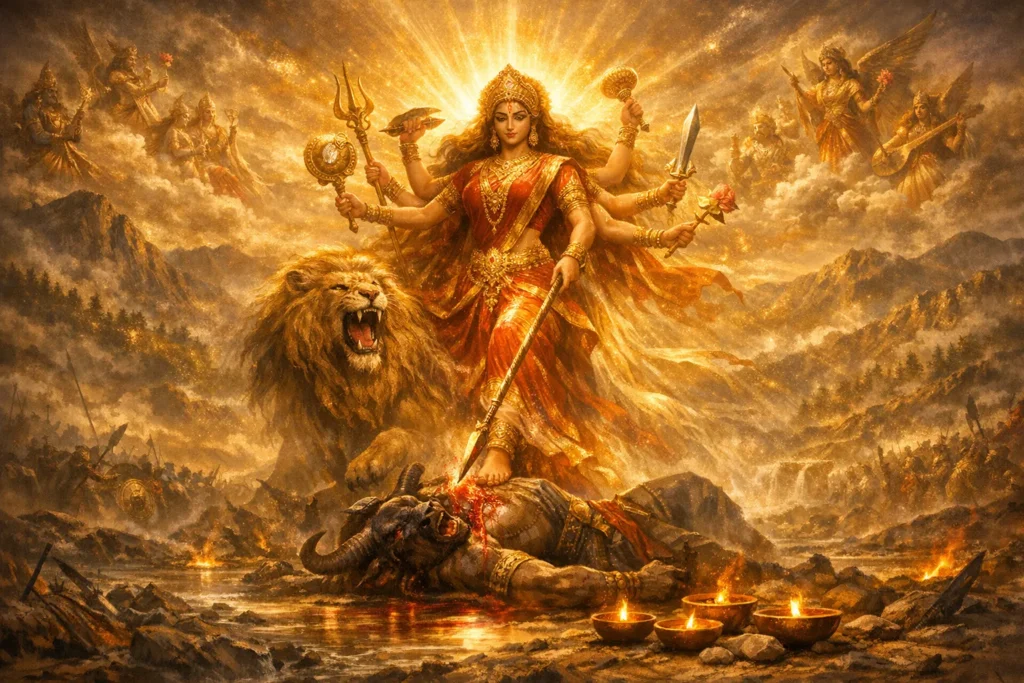
Also known as the Durga Saptashati (the Seven Hundred Verses of Durga) or the Chandi, it forms part of the Markandeya Purana and is understood by the tradition not merely as a sacred text but as a living presence — the Goddess herself in the form of sound. Its 700 verses, recited in their entirety, are understood to invoke the Goddess’s direct presence and protection.
The Devi Mahatmyam tells three stories — each depicting the Goddess destroying a different form of cosmic evil, each representing a different aspect of her power. In the first, she destroys Madhu and Kaitabha — demons of delusion who have overwhelmed Brahma. In the second, she destroys Mahishasura — the buffalo demon, the force of ego that mistakes itself for the ultimate. In the third and most elaborate, she destroys Shumbha and Nishumbha, including the extraordinary episode in which she absorbs all her own emanations back into herself to fight the final battle entirely alone.
These are not just stories — they are maps of inner battles.
📜 From the Devi Mahatmyam
या देवी सर्वभूतेषु शक्तिरूपेण संस्थिता।
नमस्तस्यै नमस्तस्यै नमस्तस्यै नमो नमः॥
Yaa Devi sarvabhuteshu shaktiroopena samsthita
Namastasyai namastasyai namastasyai namo namah
“To the Goddess who dwells in all beings as power — salutation to her, salutation to her, salutation to her, again and again.” This verse — repeated in the Devi Mahatmyam with different attributes (as consciousness, as sleep, as hunger, as peace, as beauty, as compassion) — is its philosophical heart. The Goddess is not in the temple alone. She is in every being, as every experience, as every quality of existence.
The Devi Mahatmyam is recited during Navaratri — the nine-night festival of the Goddess observed across India. During these nine nights, the Goddess is worshipped in nine forms — the Navadurga — each representing a different facet of her power. The festival culminates on Vijayadasami — the tenth day, the day of victory — celebrating her final defeat of Mahishasura and the restoration of cosmic order.
IV. The Shakti Peethas — Where the Goddess Is the Earth Itself
The Sati story is not merely myth. It is the origin story of an entire sacred geography.
When Vishnu’s Sudarshana Chakra cut Sati’s body into fifty-one pieces — releasing Shiva from his grief, saving the universe from cosmic standstill — those pieces did not simply fall to earth. They became the earth. They transformed the very ground on which they landed, saturating it permanently with the Goddess’s presence. These are the Shakti Peethas: not temples built to invite the divine, but places where the divine is irrevocably, permanently, inescapably present.
The tradition counts different numbers — 18, 51, or 108 depending on the text — but the most widely accepted number is 51, corresponding to the 51 letters of the Sanskrit alphabet. Each Peetha is associated with a specific part of Sati’s body, a specific form of the Goddess, and a specific form of Shiva who stands as her eternal companion and guardian at each site.
💡 Key Concept: Sacred Geography and the Body of the Goddess
The Shakti Peethas span the entire Indian subcontinent — from Kamakhya in Assam in the northeast to Kanyakumari at the southernmost tip, from Hinglaj in Balochistan (now Pakistan) in the west to Kalighat in Kolkata and beyond into Bangladesh and Tripura in the east.
This geographical spread is itself a theological statement: the Goddess’s body — Sati’s dismembered form — has become the land itself. In the Shakta understanding, India is experienced as the body of the Goddess. To travel across India is to travel across her form. Every pilgrimage is a circumambulation of the divine mother.
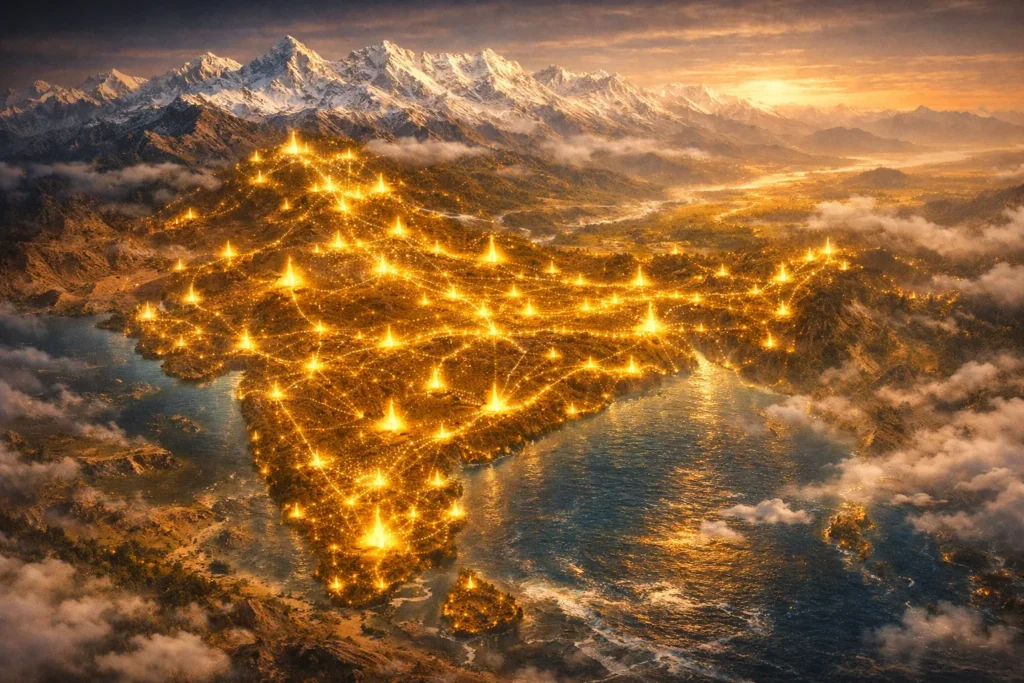
Among the most significant Shakti Peethas:
Kamakhya — Assam
Where Sati’s womb is said to have fallen. The most powerful of all Shakti Peethas, associated with the Goddess in her most primal creative aspect. The temple does not contain an image — only a natural rock formation in the shape of a yoni, kept perpetually moist by an underground spring. The Ambubachi Mela, celebrated annually when the spring flows red, draws hundreds of thousands of pilgrims and is one of the most extraordinary festivals in the Hindu world. Kamakhya is the supreme centre of Tantric practice in India, where the creative power of the universe is worshipped without metaphor, without softening, as the fundamental force of existence.
Kalighat — Kolkata
Where Sati’s right toe is said to have fallen. The presiding deity is Kali — the most philosophically demanding form of the Goddess, the power of time and transformation, the one who destroys to liberate. Her image here is fierce and magnificent: dark, garlanded with skulls, tongue extended, standing on Shiva’s chest. Kalighat has been the spiritual heart of Kolkata for centuries. The city’s very name is drawn from the temple — Kali’s Ghat, the landing place of Kali. To stand before the image at Kalighat is to stand before a tradition that does not flinch from the full reality of existence.
Kanyakumari — Tamil Nadu’s Southern Tip
Where Sati’s back is said to have fallen— though traditions vary on the exact body part associated with this site. The presiding deity is the Virgin Goddess — the Devi in her aspect of pure, unconditional power, unmarried, belonging to no one, complete in herself. The temple at Kanyakumari, where the Arabian Sea, the Bay of Bengal, and the Indian Ocean meet at the very edge of the subcontinent, is one of the most atmospherically overwhelming sacred sites in India. She stands here in her eternal penance — waiting for Shiva, who was delayed on his wedding night and never arrived — and her unfulfilled longing has become itself an act of power. The Goddess who waits is not diminished. She is complete.
Kasi Vishalakshi — Varanasi
Where Sati’s earrings — or by some accounts her face itself — are said to have fallen. Varanasi, one of the oldest continuously inhabited cities on earth, the city of Shiva, the city where Hindus come to die in the hope of liberation, is also a Shakti Peetha. The presiding goddess is Vishalakshi — the Wide-Eyed One, the goddess with eyes so expansive they hold the entire universe within their gaze.
Her temple sits in the ancient lanes of Varanasi, close to the great Kasi Vishwanath Shiva temple, and the pairing is theologically precise: Shiva is present in Varanasi as the lord of liberation, and Vishalakshi is present as the compassionate mother who ensures no soul who dies in Kasi is turned away. Together they offer the full gift: the Goddess holds you in her gaze, and Shiva whispers liberation into your ear.
For The Sacred Trails, a future visit to Varanasi will devote full attention to Vishalakshi — to sitting in the lanes of Kasi before dawn, watching the ghats come alive, and then climbing to her shrine where the fierce and the tender meet.
V. Kanchi Kamakshi — The Goddess Who Makes All Desires Possible
There is a city in Tamil Nadu that has been called the city of the thousand temples. Kanchipuram — ancient, layered, golden with temple gold even in its dust — is one of the seven sacred cities of Hinduism, one of the four Shankaracharya maths, one of the greatest centres of Sanskrit learning and Dravidian temple architecture in the world.
And at its centre, the reason all of it exists: Kamakshi.
Kamakshi — the one whose eyes are love, or the one who fulfils all desires — is understood in the Shakta tradition as one of the three supreme Shakti goddesses of South India, alongside Meenakshi in Madurai and Vishalakshi in Varanasi. Together they form the Tri-Pura Shakti — three forms of the supreme goddess, presiding over three sacred cities, each offering a different face of the divine feminine.
The Temple
The Kamakshi Amman Temple at Kanchipuram is one of the oldest and most architecturally magnificent temples in South India. Its origins are traced by tradition to the distant past — some accounts link it to the sage Durvasa, others to the divine architect Maya.
What is historically certain is that it was patronised by the Pallava kings, expanded by the Chola dynasty, and reached its present magnificent form under the Vijayanagara empire.
The great reformer Adi Shankaracharya — who was born in Kerala, lived much of his philosophical life in the North, and established his maths across the four cardinal directions — chose Kanchipuram as the site of his primary math. He installed the Sri Chakra before the goddess, transforming the temple’s worship to the Sri Vidya tradition, and is said to have attained mahasamadhi (conscious death) here.
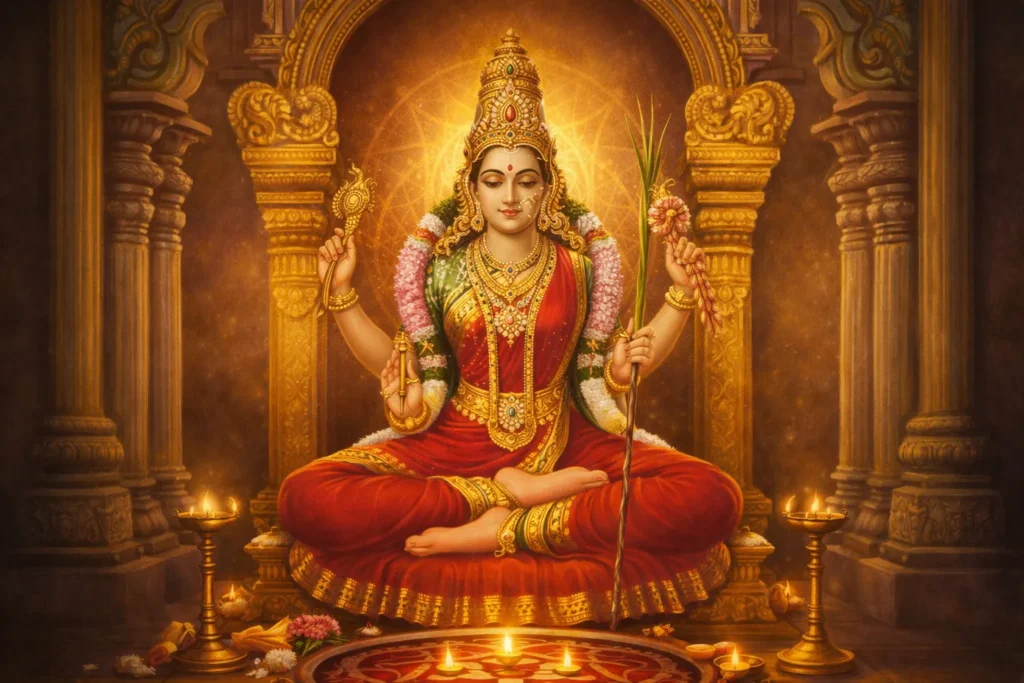
The presiding deity, Kamakshi, is unique in all of South Indian temple tradition for one specific reason: she is the only major goddess in the region who sits. Every other great goddess in South India stands — asserting her power, her readiness, her dynamism.
Unlike the fierce standing forms of Durga and Kali, Kamakshi sits in padmasana — the lotus posture of meditation — with a sugarcane bow in one hand and a noose of flowers in the other. The sugarcane bow shoots arrows of flowers: desire itself as the instrument of liberation. The noose draws the devotee toward her. She is not preparing for battle. She is seated in the stillness of absolute power, because absolute power requires no exertion.
To stand before Kamakshi is to understand something the Shakta tradition has always taught: that desire and liberation are not opposites. Desire, rightly understood, is itself the path. The Goddess of desire is also the Goddess of liberation — because she is the one who holds both.
The Philosophy
Kamakshi is worshipped in the Sri Vidya tradition — perhaps the most sophisticated of all Shakta philosophical schools, which understands the Goddess not as a deity who exists somewhere but as the fundamental reality of consciousness itself, expressed in the geometric form of the Sri Chakra. The Sri Chakra — the yantra installed before Kamakshi by Shankaracharya — is a diagram of the universe: nine interlocking triangles, radiating from a central point, representing the complete dynamic of creation, preservation, and dissolution. To meditate on the Sri Chakra is to meditate on the structure of reality itself.
The Kanchipuram Shankaracharya Math, adjacent to the temple, remains one of the most influential religious institutions in South India to this day. The lineage of Shankaracharyas at Kanchipuram has included some of the greatest scholars and saints of the modern era, and their relationship with the Kamakshi temple — as guardians of her worship, interpreters of her philosophy — is one of the great living examples of the continuity of Indian sacred tradition.
VI. Madurai Meenakshi — The Queen Who Conquered Even Shiva
In most of the world’s religious traditions, the great male deity is primary. Temples are built for him. He is the sovereign. The goddess, however revered, however beloved, is secondary — the consort, the companion, the complement.
In Madurai, it is the other way around. This inversion is not symbolic. It is structural.
Meenakshi — the fish-eyed goddess, whose eyes are described in the poetry of her devotees as the most beautiful in all creation — is not the consort of the god in Madurai. She is the sovereign. She is the queen. The Madurai Meenakshi Amman Temple — one of the greatest temple complexes on earth — is her temple. Shiva, present there as Sundareshvara, is her husband. He came to Madurai to marry her.
The mythology of Meenakshi is one of the most extraordinary in South Indian temple tradition. She was born, the accounts say, to the Pandya king Malayadhwaja Pandya and his queen, who had performed intense austerities to be granted a child. The child who appeared was not what they expected: a girl, perfectly formed, but with three breasts. A divine voice told the king: raise her as your own son and heir. Give her the kingdom. When she meets her true consort, the third breast will disappear.
And so Meenakshi — her name meaning “one with fish-shaped eyes,” the fish being the symbol of the Pandya dynasty — was raised as a warrior queen. She was trained in the arts of war and statecraft. She conducted military campaigns across the entire subcontinent, conquering kingdom after kingdom, until at last she reached Mount Kailash — the abode of Shiva himself.
The armies stood face to face. Meenakshi looked at Shiva. And the third breast vanished.
She had found her consort. The warrior queen became the divine bride. And Shiva descended from Kailash and came to Madurai — where he has lived ever since, as the husband of the queen who conquered the world.
The Temple Complex
The Meenakshi Amman Temple is not a single temple. It is a city within a city — a 45-acre complex enclosed by four great outer walls, with fourteen gopurams (gateway towers) rising above the surrounding streets. The tallest, the southern gopuram, rises to a height of nearly 52 metres — fourteen tiers of carved granite covered with over 33,000 painted sculptures of gods, demons, celestial beings, and mythological figures. Every surface is alive. Every inch is story.
The temple complex contains multiple shrines, a sacred tank (the Porthamarai Kulam — the Golden Lotus Tank), the hall of a thousand pillars, art galleries, and corridors that seem to unfold endlessly inward toward the central sanctum. The path to Meenakshi’s shrine is a journey through the entire cosmos — past corridors of lamps, through halls where hundreds of pilgrims move simultaneously in different directions, all drawn toward the same centre.
In the innermost shrine, Meenakshi stands. She is dressed in fresh silk. She wears a crown of gold. Around her neck are garlands of jasmine and marigold. In her hands she holds the lotus — symbol of the world held lightly. Her eyes — the fish-shaped eyes from which she takes her name — are precise, calm, and absolutely present. She is not a distant deity. She is the queen of Madurai, and this is her city, and she has been here, in this form, receiving her people for more than two thousand years.
The Meenakshi Thirukalyanam — the celestial wedding of Meenakshi and Sundareshvara — is celebrated annually during the Chithirai festival in April-May. It is the largest festival in Madurai, drawing millions of pilgrims, and it re-enacts the divine marriage with a devotional intensity that must be experienced to be understood. The entire city becomes the wedding hall. The god comes in procession to the goddess. And for a moment, the line between myth and reality disappears entirely.
A note on the Peethas:
Meenakshi is not one of the 51 principal Shakti Peethas in the canonical lists — the Peethas formed from Sati’s body. But in the living devotional tradition of Tamil Nadu, Meenakshi’s temple holds a power that rivals and in some traditions exceeds the canonical Peethas. This is because the Shakti tradition has always understood the divine feminine as too vast to be contained by any list. The Goddess appears where she wills. And she has clearly chosen Madurai.
VII. The Philosophy of Saktham — The Mother Who Is Also You
At the deepest level of Shakta philosophy lies a recognition that is simultaneously the most intimate and the most radical in the entire Hindu tradition.
The Goddess is not separate from you. She is the awareness that is reading these words right now. She is the love that arises when you see a child. She is the grief that arises when you lose someone. She is the beauty that stops your breath when the morning light hits the temple gopuram just so. She is the hunger and the satisfaction, the longing and the fulfilment, the question and the answer.
The Shakta philosophical tradition — particularly the Kashmir Shaivism school, which developed a sophisticated metaphysics of the divine feminine — holds that the universe is the Goddess’s own self-expression: her play (lila), her delight in her own infinite creativity, her choice to appear as multiplicity while remaining one. The individual soul is not separate from the Goddess — it is the Goddess, temporarily forgetting her own nature, playing the role of a limited being, and gradually remembering.
Liberation, in this understanding, is not the soul’s journey toward the Goddess. It is the Goddess’s recognition of herself — through the instrument of the individual soul — as what she always was. The practice of Saktham — the ritual, the meditation, the devotional prayer, the pilgrimage to the Shakti Peethas — is the technology of this recognition.
📜 From the Soundarya Lahari — Adi Shankaracharya
शिवः शक्त्या युक्तो यदि भवति शक्तः प्रभवितुं
न चेदेवं देवो न खलु कुशलः स्पन्दितुमपि
Shivah shaktyaa yukto yadi bhavati shaktah prabhavitum
Na chedevam devo na khalu kushalah spanditumapi
“Shiva, united with Shakti, is able to create. Without her, the god is not even capable of movement.” Soundarya Lahari, verse 1 — Written by Adi Shankaracharya himself — the philosopher of radical non-dualism — this is one of the most celebrated opening lines in Sanskrit devotional literature.
The man who argued most rigorously that ultimate reality is attributeless and formless also wrote the most beautiful hymn to the Goddess in the Sanskrit tradition. This is not contradiction — it is the fullness of a tradition capacious enough to hold both the philosophical and the devotional as equally true.
The mother is not someone you return to. She is what you are. The practice is simply remembering.
VIII. The Goddess in Every Temple — A Bridge to What Comes Next
Every major Hindu temple in South India has a goddess.
Not as a secondary figure. Not as a decorative addition. As an essential, theologically necessary presence — without whom the temple is incomplete and the deity within it cannot, in some formulations, properly function.
In Shaiva temples, she is the consort of Shiva — Parvati, Uma, Ambika — present in her own shrine, receiving her own worship, equal in sacred weight to the main deity. In some temples — Madurai being the supreme example — she is the primary deity, with Shiva as her consort. In Vaishnava temples, she is Lakshmi — the inseparable companion of Vishnu, whose presence on his chest is the very source of his grace toward devotees.
The theological principle at work is expressed in the concept of Ardhanarisvara — the half-male, half-female form of Shiva, in which the left half is Parvati and the right half is Shiva. The image is not a curiosity or a mythological oddity. It is a precise philosophical statement: that the masculine and feminine principles of the divine are not two separate realities but two aspects of one reality — inseparable, equal, each incomplete without the other.
When The Sacred Trails visits the great temple complexes of South India — Madurai, Kanchipuram, Srirangam, Chidambaram, Thanjavur, and beyond — the goddess in each temple will receive her own devoted attention. Because to enter a South Indian temple without seeing the goddess — without understanding her role, her theology, her specific relationship to the main deity and to the devotee — is to see only half of what is there.
We have now walked through three of the six paths of Shanmatham. Shaivism, Vaishnavism, in earlier blogs and Saktham here. Three paths remains before the Sacred Foundations series arrives at the temples themselves.
In Blog 11, we turn to Ganapathyam — the way of Ganesha, the elephant-headed god who sits at every threshold, who must be honoured before any sacred act can begin. He is the remover of obstacles, the lord of beginnings, the keeper of the gateway between the human and the divine — and his presence in South Indian temple tradition is so pervasive, so theologically precise, that no journey through the sacred landscape is complete without understanding what he guards and why.
Next in the Sacred Foundations Series:
The God at the Threshold. Ganapathyam, the lord of all beginnings, and the tradition that placed an elephant-headed god at the entrance to the infinite.
Coming soon on thesacredtrails.com 🙏