
Thirumular, Meykandar, and the Tamil Philosophical Ground Beneath Every Shaiva Temple in India

The Man Who Disagreed With a Genius
We were about to enter the temples.
After thirteen blogs — the Vedas, the Upanishads, the cosmic operating system of Rta, the Nayanmars who sang temples into existence, the Azhwars who walked every sacred river in the land, the Divine Mother whose body became the subcontinent itself, the warrior god of the Tamil hills, the elephant-headed remover of obstacles, the solar path of the Sowras — after all of that, we were ready. The foundation was laid. The door was open.
And then a voice from Sirkazhi spoke up.
Sirkazhi. A small temple town in the Cauvery delta, sixty kilometres south of Chidambaram, where the paddy fields stretch flat to the horizon and the gopurams rise above the treeline like exclamation marks in stone. You have met Sirkazhi before in this series — it is the birthplace of Thirugnanasambandhar, the child-saint who sang the first of the Tevaram hymns at the age of three and wept the Shaiva temples of Tamil Nadu back to life in the 7th century.
Six hundred years after Thirugnanasambandhar, Sirkazhi produced another figure. Not a poet-saint this time. A philosopher. A man who sat with the entire accumulated tradition of Tamil Shaivism — the Agamas, the Tevaram, the Thirumanthiram, the Sanskrit commentaries — and distilled it into twelve sentences.
Twelve sentences that quietly, permanently, respectfully — and with absolute philosophical precision — disagreed with Adi Shankaracharya.
His name was Meykandar. His text was the Sivagnana Botham. And the tradition he crystallised — Shaiva Siddhanta — is the philosophical ground on which every Shaiva temple in Tamil Nadu stands.
This is the blog that insisted on being written — as truth often does — just as we were about to move on.
I. Two Traditions, One Land — The World Before Meykandar

To understand what Meykandar did, you have to understand the world he was born into.
By the 13th century CE, Tamil Nadu was a land of extraordinary spiritual density. The Nayanmars — the sixty-three Shaiva poet-saints of Blogs 6 and 7 — had already done their transformative work, centuries earlier. Their hymns, collected into the twelve-volume canon called the Thirumurai, were being sung in temples across the Tamil country.
The Tevaram — the first seven books of the Thirumurai, composed by Thirugnanasambandhar, Thirunavukkarasar (Appar), and Sundarar — was already being treated as a Tamil Veda, sung in temples with the same reverence as the Sanskrit sacred texts.
But the Thirumurai was devotional poetry. It was the heart singing. What it was not — what no single Tamil text yet fully provided — was a rigorous, systematic, philosophically defensible account of what Shaivism actually believed about the nature of reality, the nature of the soul, and the nature of liberation.
Into that space, two streams were flowing.
The first stream was Adi Shankaracharya’s Advaita Vedanta — which had, by the 13th century, become the dominant philosophical framework of Brahminical learning across India. Shankaracharya’s argument — that the individual soul and Brahman are ultimately identical, that the apparent multiplicity of the world is Maya (cosmic illusion), and that liberation is the soul’s recognition of its own identity with the formless absolute — was intellectually powerful, rigorously argued, and widely accepted.
The second stream was the Tamil Agamic tradition — the Shaiva Agamas, the body of scriptural and ritual texts that governed temple worship, initiation, and the theology of Shiva as a personal God who loves, who liberates, who is not an impersonal absolute but the Lord — Pati, the master, the one who holds the soul in his grace.
These two streams could not, ultimately, coexist without tension. Because Shankaracharya’s Advaita said that the personal God — Shiva as a being who loves and liberates — is saguna Brahman, the infinite with attributes, which is ultimately a lower, provisional truth. The higher truth is nirguna Brahman — the formless, attributeless absolute in which all distinctions dissolve, including the distinction between the devotee and the God.
For the Tamil Shaiva tradition, this was not a conclusion they could accept. The love between the devotee and Shiva — the relationship that the Nayanmars had burned their lives in expressing — was not a provisional truth to be transcended. It was the final truth. It was the point.
Someone needed to say this with philosophical rigour. Someone needed to give the Tamil Shaiva tradition an argument as precise and defensible as Shankaracharya’s — one that could stand in the arena of Sanskrit philosophical debate and hold its ground.
But before we reach Meykandar — we need to go back further. To the man whose vision made Meykandar possible.
II. Thirumular — The Mystic Who Waited Three Thousand Years
The story of Thirumular begins with an act of supreme compassion — and ends with three thousand verses that changed Tamil spiritual history.
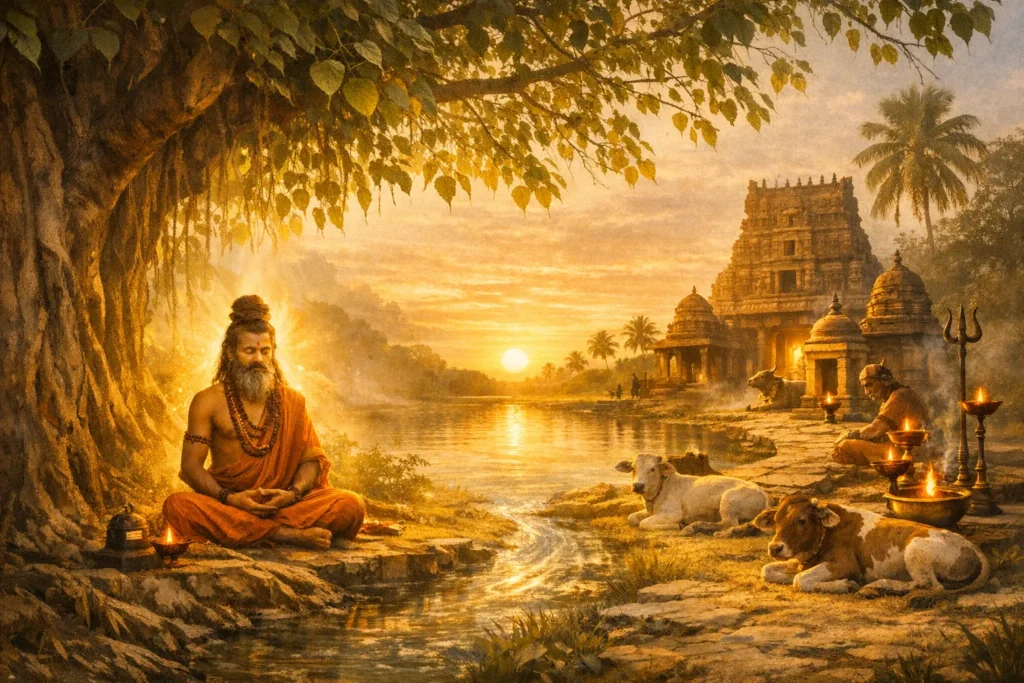
Thirumular was a Shaiva siddha — one of the great perfected masters of the Tamil tradition, a yogi who had achieved a state of consciousness beyond ordinary human experience. He came, the tradition says, from the north — from Kailash, the abode of Shiva — and was travelling through the Tamil country when he witnessed something that stopped him entirely.
A herdsman named Mulan had died on the roadside, his cattle milling around the body in distress. Thirumular looked at the scene — at the grief of the animals, at the abandoned body, at the small human tragedy of it — and made a decision that would alter his destiny. He used his yogic power to enter the dead herdsman’s body, leaving his own body concealed nearby, intending to stay only long enough to shepherd the cattle home.
When he returned to reclaim his own body, it was gone.
He was now Thirumular — living in the body of Mulan the herdsman, with the consciousness of a perfected Shaiva master, in the Tamil country, with nowhere to go and no body to return to.
He sat down under a peepal tree near a Shiva temple.
And he began, year by year, to compose verses. One verse per year, each emerging from his meditative experience of Shiva. Three thousand verses over three thousand years — as the tradition poetically holds, marking with poetic precision the depth and slowness of contemplation from which each verse arose.
The result was the Thirumanthiram — the Sacred Mantra, the Holy Incantation — the eighth book of the Thirumurai, and one of the most extraordinary texts in the Tamil literary and spiritual canon.
📜 What is the Thirumanthiram?
The Thirumanthiram is a text that defies easy categorisation. It is simultaneously:
— A Bhakti text: full of intense devotional poetry addressed to Shiva, in the tradition of the Nayanmars
— A Tantric text: containing detailed exposition of Kundalini yoga, chakras, pranayama, and the inner path of the siddha tradition
— A Siddhanta text: laying out the philosophical framework of Shaiva Siddhanta — the Three Substances (Pati, Pasu, Pasam), the nature of liberation, the relationship between the soul and Shiva — centuries before Meykandar gave it systematic form
— A social text: containing some of the most radical statements of human equality in medieval Tamil literature This range — from the heights of philosophical abstraction to the depths of devotional intimacy to the practicalities of yoga and the fire of social conscience — is what makes the Thirumanthiram unlike anything else in Indian sacred literature.
The most famous verse of the Thirumanthiram — perhaps the most quoted verse in all of Tamil spiritual literature — is this:
📜 From the Thirumanthiram
ஒன்றே குலம் ஒருவனே தேவன்
Ondre kulam oruvanae thevan
“One is the human race. One is God.”
Thirumanthiram — This single line, composed in the 7th century CE or earlier, contains a social and theological revolution in four Tamil words.
One human race — not divided by caste, by birth, by learning. One God — not fragmented into competing deities, not hierarchised by tradition or Brahminical authority. Thirumular was saying something that the social structures of his time had no framework to absorb. The Tamil Shaiva tradition has been quoting it, and gradually trying to live up to it, ever since.
Thirumular’s other great contribution was the concept of — Anbe Sivam — Love is Shiva, Shiva is Love. Not as a poetic sentiment but as a precise theological statement: the nature of Shiva is love itself, and the path to Shiva is through love itself. The elaborate ritual of the Agamas, the philosophical distinctions of the Siddhanta, the yogic practices of the Siddha tradition — all of these are ultimately in service of the one recognition: that love is the ground of reality, and reality is Shiva.
When the Tamil Shaiva tradition speaks of its philosophical foundations, it invariably traces them to two sources: the Shaiva Agamas (the ancient ritual and theological texts) and the Thirumanthiram.
Thirumular is the bridge between the Agamic tradition and the Tamil devotional tradition — the figure who took the esoteric wisdom of the Siddhas and wove it together with the devotional fire of the Nayanmars and the philosophical framework that Meykandar would later systematise.
He was the root from which the great tree grew.
III. The Twelve Thirumurais — The Sacred Voice of Tamil Shaivism
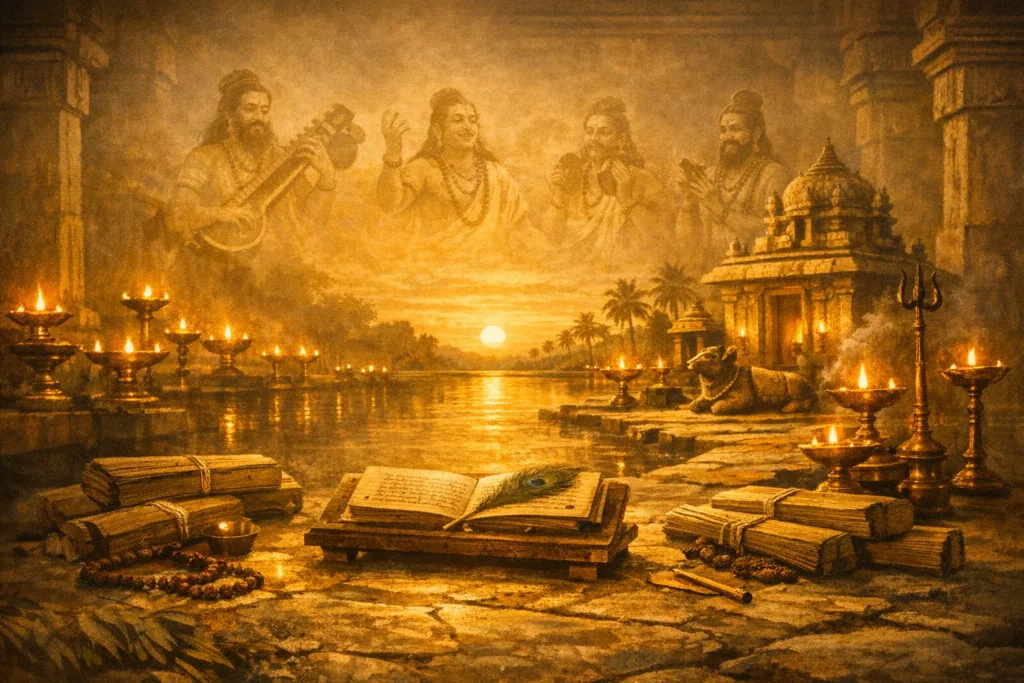
Before we meet Meykandar, we need to understand the canonical framework he was working within — because the Thirumurai is the scripture that gives the Shaiva Siddhanta tradition its devotional soul, even as Meykandar’s philosophy gives it its intellectual backbone.
The twelve Thirumurais are the collected sacred literature of Tamil Shaivism — twelve volumes, compiled and canonised by the great saint-scholar Nambiyandar Nambi in the 10th century CE under the patronage of the Chola king Raja Raja I (the same king who built the Brihadeeswara temple at Thanjavur). Together they form the most comprehensive body of devotional sacred literature in the Tamil language — and one of the greatest in any language.
💡 The Twelve Thirumurais — A Map
Books 1–3: The Tevaram of Thirugnanasambandhar — hymns by the child-saint of Sirkazhi
Books 4–6: The Tevaram of Thirunavukkarasar (Appar) — devotion as the reform of a life
Book 7: The Tevaram of Sundarar — the saint who argued with Shiva as a friend
Book 8: The Thiruvachagam and Thirukovaiyar of Manickavasagar — the hymns that can melt even a stone heart
Books 9: Works of various saints — Thiruvisaippa and Thirupallandu
Book 10: The Thirumanthiram of Thirumular — 3,000+ verses of yoga, philosophy, and mystical vision
Book 11: Works of various saints — Karaikkal Ammaiyar, Cheraman Perumal Nayanmar, Nakkirar, and others — the broader Shaiva devotional canon
Book 12: The Periyapuranam of Sekkizhar — the complete life stories of all 63 Nayanmars The Thirumurai is not merely an anthology. It is a complete spiritual curriculum — moving from the devotional fire of the Tevaram through the philosophical depths of the Thirumanthiram to the culminating hagiography of the Periyapuranam, which shows what the Shaiva life looks like when fully lived.
The relationship between the Thirumurai and the temples of Tamil Nadu is inseparable. The Tevaram hymns — the first seven books — are addressed to specific temples, specific deities, specific sacred sites. Every Padal Petra Sthalam — the 276 temples we are about to enter in this series — is a temple that appears in the Tevaram. These temples were literally sung into their sacred status. The hymn came first. The pilgrimage followed. The theology that explains why the hymn was sung — that is Shaiva Siddhanta.
Which brings us, finally, to Meykandar.
IV. Meykandar — Twelve Sentences That Changed Everything
Meykandar — Meykandadevar, the one who saw the truth — was born in Sirkazhi around 1200 CE. The same town as Thirugnanasambandhar. The tradition notes this with quiet satisfaction: the place that produced the greatest devotional voice of Tamil Shaivism also produced its greatest philosophical voice, six centuries later.
He was not a wandering ascetic or a mystical visionary in the mode of the Nayanmars. He was, by all accounts, a householder — a man who lived in the world, who had a family, who engaged with the great philosophical questions of his time from within ordinary life. This is itself a statement: the deepest philosophical truth does not require withdrawal from the world. It can be found — and it can be expressed — from within it.
He wrote one text. The Sivagnana Botham — The Awakening of the Knowledge of Shiva.
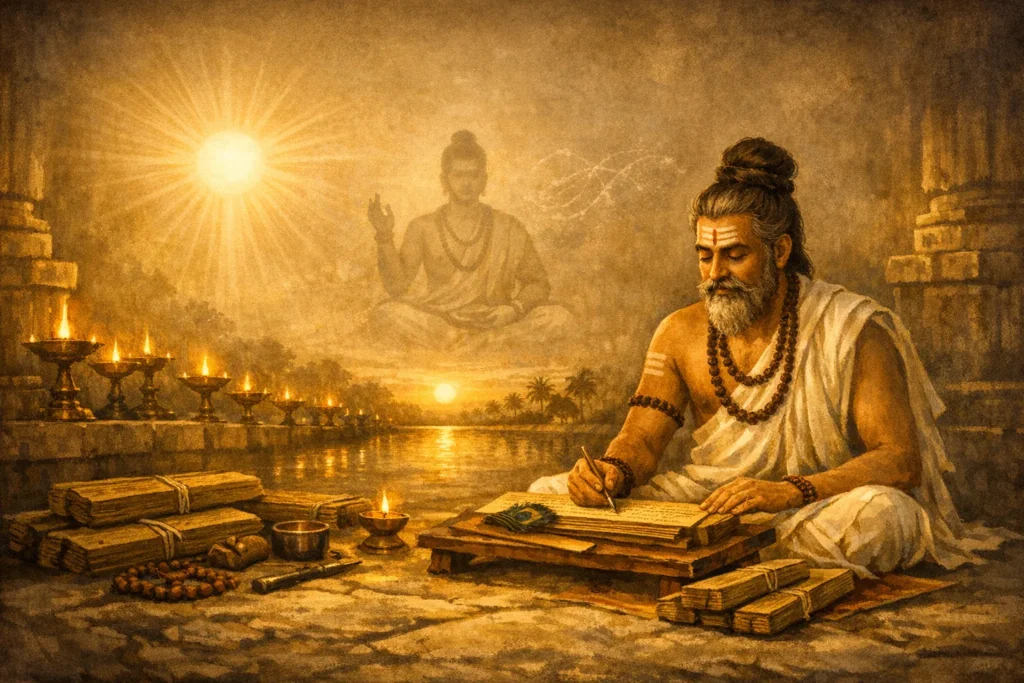
It contains twelve sutras. Twelve terse, dense, precisely constructed philosophical statements — the kind of philosophical writing where every word carries the weight of a paragraph, where removing a single syllable would change the meaning entirely. In the tradition of Indian sutra-writing, going back to Panini’s grammar and the Brahma Sutras, the sutra form is the most demanding: say everything in as few words as possible, and trust future commentators to unfold the meaning.
Meykandar’s twelve sutras unfold the entire metaphysical architecture of Shaiva Siddhanta.
The Three Substances — Mupporul
At the heart of Meykandar’s system are three eternal, irreducible, independently real substances:
Pati — God. Shiva.
The lord. The master. The source and ground of all existence. Not an impersonal absolute, not a philosophical concept, but a being — conscious, compassionate, personally involved in the liberation of every soul. Shiva in Meykandar’s system is not Brahman-without-attributes dreaming the world into existence. He is the Lord who knows each soul by name, who removes the bonds of each soul through his grace, who is present in the temple, in the guru, in the sacred syllable, in the silence after the prayer.
Pasu — The Soul.
The individual being. Not an illusion. Not a temporary appearance of the infinite playing at limitation. Real — genuinely, permanently, irreducibly real. The soul in Shaiva Siddhanta has its own existence, its own consciousness, its own journey. But its consciousness is occluded — covered, bound, unable to see itself clearly — by the three bonds.
Pasam — The Bonds.
The three fetters that bind the soul to the cycle of birth, suffering, and ignorance:
Aanavam — the primal ego-sense. Not ordinary selfishness, but the fundamental sense of being a separate, limited, isolated self — the deep contraction that separates the soul from its recognition of Shiva. This is the root fetter, the one from which all others grow.
Karma — the accumulated weight of past action. Every act generates consequence; the soul carries this weight across lifetimes, and it shapes the conditions of each birth.
Maya — matter, the world of physical existence. Not illusion in Shankaracharya’s sense — not a cosmic dream to be seen through and dissolved — but real substance, the medium through which the soul experiences the world and through which, ultimately, it encounters Shiva.
💡 The Key Difference — Meykandar vs. Shankaracharya
Shankaracharya: Atman (individual soul) = Brahman (ultimate reality). The apparent difference is Maya — illusion. Liberation is recognising this identity. At the moment of liberation, the separate self dissolves into the infinite. “Aham Brahmasmi” — I am Brahman.
Meykandar: The soul is real. Shiva is real. The world is real. None of them collapse into the other. Liberation is not the soul becoming Shiva — it is the soul’s bonds (Pasam) being dissolved by Shiva’s grace, so that the soul can rest in Shiva’s presence, knowing Shiva clearly, loved by Shiva — but always itself.
The liberated state in Shaiva Siddhanta is called Sayujya — intimate union with Shiva — but not identity with Shiva. The devotee remains a devotee. The love does not end. The relationship is not dissolved — it is perfected. This is not a minor theological quibble. It is a fundamental disagreement about what reality is and what salvation means.
The Role of Grace — Arul
The most beautiful element of Meykandar’s system — and the one that connects it most directly to the devotional tradition of the Nayanmars — is the role of grace.
The soul cannot liberate itself. This is the crucial point. No amount of ritual, no amount of philosophical study, no amount of yogic practice, no amount of ethical conduct can, by itself, dissolve the bonds. The bonds were beginningless — they have always been there, they have no traceable origin — and they cannot be removed by the soul’s own effort alone.
Liberation comes through Shiva’s grace — Arul. Shiva, moved by love for the bound soul, sends a teacher — a sat-guru, a perfected master — through whom he communicates the direct knowledge of liberation. The guru in Shaiva Siddhanta is not merely a teacher. The guru is Shiva’s grace in human form. The moment of liberation is the moment when the guru’s knowledge reaches the soul — and the soul recognises, for the first time, what it has always been: a being whose true nature is to know Shiva.
This is why the Nayanmars sang the way they sang. This is why Appar wept at the feet of Shiva in temple after temple. This is why Thirugnanasambandhar’s hymns have the quality of a child calling for its mother. They were not performing devotion. They were living the Shaiva Siddhanta truth: that the soul is utterly dependent on Shiva’s grace, that the only posture that makes sense before the Lord is the posture of complete surrender, and that in that surrender — and only in that surrender — is liberation found.
V. The Santana Kuravargal — The Four Teachers
The philosophy did not remain in twelve sentences. It became a living lineage. Meykandar did not write twelve sentences and disappear. He founded a lineage — the Santana Kuravargal, the four teachers of Shaiva Siddhanta — that carried his philosophy forward, elaborated it, defended it against rival schools, and enshrined it as the philosophical backbone of Tamil Shaivism for eight centuries.
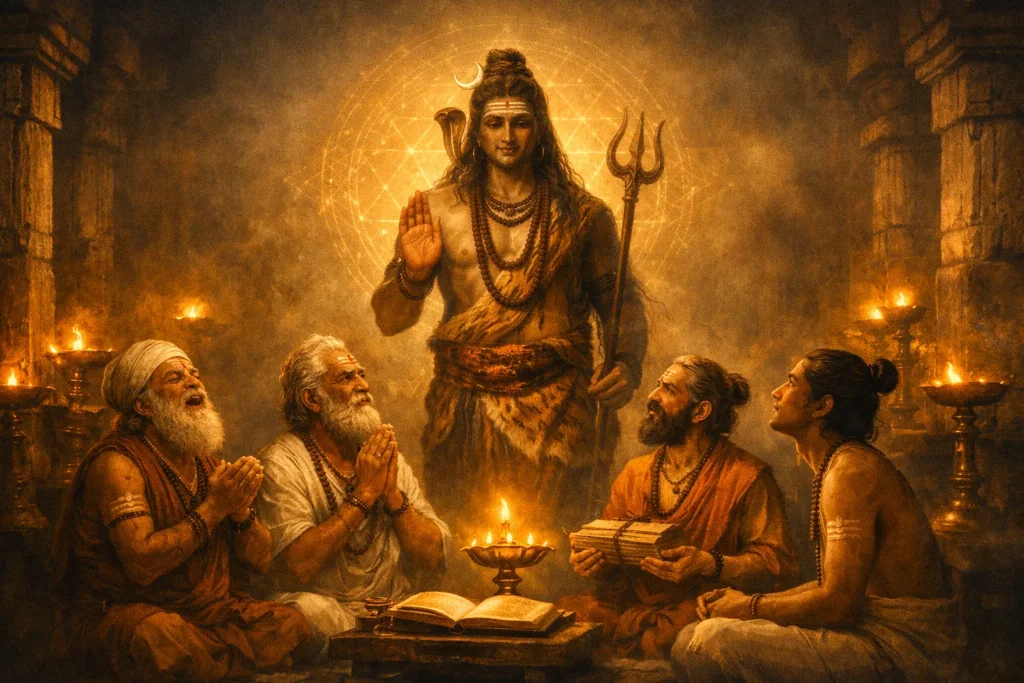
Arulnandi Shivacharya — The Great Defender
Arulnandi Shivachariar — known in Tamil sources as Arunandhi Shivachariar — was the direct disciple of Meykandar and the second of the four Santana Kuravargal. He wrote the Sivagnana Siddhiyar — a massive work in two parts, the first refuting fourteen rival philosophical schools (including Advaita Vedanta, Buddhism, Jainism, and others), the second providing an exhaustive elaboration and defence of Meykandar’s Sivagnana Botham.
The Sivagnana Siddhiyar is to Meykandar’s Sivagnana Botham what Shankaracharya’s Brahmasutra commentary is to the Brahmasutras — the work that turns a terse foundational text into an impregnable philosophical edifice.
Arulnandi Shivacharya was not merely a commentator. He was a fighter — a man who believed that the truth of Shaiva Siddhanta needed to be defended with the full rigour of philosophical argument, and who spent his life doing precisely that. The Sivagnana Siddhiyar remains the most comprehensive statement of the Shaiva Siddhanta position in the history of Tamil philosophy.
Maraijnana Sambandar — The Silent Philosopher
Maraijnana Sambandar — whose name means the one related to the knowledge of the Vedas, Marai being the Tamil word for Veda — is the most quietly present of the four Santana Kuravargal. He wrote Sivadharumotharam, focused on Shiva’s Dharma Sastra.
Maraijnana Sambandar taught entirely through direct transmission — through the living encounter between guru and disciple, through the spoken word, through the quality of understanding that passes from one consciousness to another in the intimacy of the teacher-student relationship.
He was born in the Samavedic tradition at Pennaagadam on the banks of the Vellar river, received initiation from Arulnandi Shivachariar at Kadandai, and eventually settled at Thirukkalanjeri — northeast of Chidambaram, in the heart of the Cauvery delta’s sacred landscape — where he taught the Meykanda Shastras to the students who came to him.
The tradition records that he worshipped at Chidambaram with a devotion that expressed, in ritual form, what his teacher Arulnandi had expressed in philosophy and what his own student Umapati would express in literature.
Umapati Shivacharya — The Canoniser
The grand-disciple of Meykandar, working in the early 14th century, Umapati Shivacharya is the figure who gave the Shaiva Siddhanta tradition its complete canonical form. He wrote eight foundational texts — collectively called the Umapati Nool — covering the full range of Siddhanta philosophy: the nature of Shiva, the nature of the soul, the path of initiation, the role of grace, the stages of liberation.
He also wrote the Thiruvarutpayan — a text that bridges the philosophical and the devotional in a way that only a master of both can achieve. And crucially, he compiled and systematised the entire Shaiva Siddhanta canon — the relationship between the Agamas, the Thirumurai, and the philosophical texts — giving the tradition the architectural coherence that allowed it to survive and thrive through the political upheavals of the following centuries.
It is largely due to Umapati Shivacharya that the Tamil Shaiva tradition arrived at the modern era as an intact, living, philosophically sophisticated system rather than a collection of beautiful fragments.
The Tradition Continues
The Shaiva Siddhanta tradition established by Meykandar and developed by his lineage did not remain confined to Tamil Nadu. It spread — to Sri Lanka, to Southeast Asia, to the diaspora Tamil communities of the modern world. The Shaiva Siddhanta Church, based in Hawaii, is one of the most active institutional expressions of the tradition in the contemporary West. Journals of Shaiva Siddhanta philosophy are published in Chennai to this day. The tradition that Meykandar compressed into twelve sentences in a small delta town eight centuries ago continues to think, to argue, to worship, and to wonder.
VI. Why You Cannot Understand the Temples Without This
We have spent five sections on philosophy and history. Now let’s make it concrete.
When you enter a Shaiva temple in Tamil Nadu — any of the 276 Padal Petra Sthalams we are about to visit in this series — you are entering a space designed, consecrated, and animated by the Shaiva Siddhanta worldview.
The Agamic rituals performed in the temple — the six daily worship sessions (Shad Kala Puja), the precise sequence of bathing, adorning, feeding, and fanning the deity, the recitation of the Tevaram hymns during worship — are not aesthetic performances. They are a philosophical statement enacted in action. They say: Shiva is a person. He is present here. He receives worship. He responds to love. The relationship between the devotee and the deity is real — not provisional, not a stepping stone to some higher truth where the deity dissolves and only the formless remains.
The Nayanmars — whose bronze images stand in the outer corridors of every Shaiva temple in Tamil Nadu, receiving their own worship — are not merely historical figures celebrated for their devotion. They are the embodiment of the Shaiva Siddhanta path: souls who received Shiva’s grace, who dissolved their bonds through surrender and love, who achieved liberation while remaining, in the tradition’s understanding, devotees. They did not become Shiva. They rested in Shiva.
The Tevaram hymns sung in the temple are addressed to the specific deity of that specific temple — not to an abstract absolute, not to a generic divine force, but to Shiva as he is present at that precise location, with that precise name, in that precise form. This is Shaiva Siddhanta embodied in sound: the God is real, the place is real, the relationship is real.
And the Sri Chakra and the Agamic geometry of the temple’s construction — the precise orientation, the nested enclosures, the hierarchy of shrines from the outermost wall to the innermost sanctum — are a map of the soul’s journey from the bonds of Pasam to the presence of Pati. The temple is not just a building. It is Meykandar’s philosophy in stone.
🗺️ A Note for the Traveller
When you enter a Tamil Shaiva temple and see the priest recite the Tevaram, you are hearing the voices of the Nayanmars — Thirugnanasambandhar, Appar, Sundarar — who sang these hymns a thousand years ago at these very temples.
When you see the bronze Nayanmar figures in the corridors, you are seeing the Shaiva Siddhanta understanding of liberation: souls who loved completely, surrendered completely, and now rest in Shiva’s presence — always themselves, always his.
When you feel the quality of presence in the inner sanctum — that specific feeling that is unlike any other feeling in any other kind of space — you are feeling what Meykandar spent twelve sentences trying to describe: the reality of Shiva’s presence, the reality of the relationship, the reality of the grace that flows from that relationship toward every soul that approaches.
VII. Now — We Enter the Temples
We began this series with the question that precedes all questions: what was there before the universe? We have walked through the Vedas and the Upanishads, the cosmic law of Rta, the six paths of Shanmatham, the poet-saints who sang temples into existence, the twelve Azhwars who walked the sacred rivers, the Divine Mother whose body became India, the god of the Tamil hills, the remover of obstacles, the solar path of the Sowras.
And now, in this unexpected blog — this philosophical clearing before the temple gates open — we have met the tradition that underlies it all: the Tamil Shaiva philosophical vision of three eternal realities, of bonds and grace and liberation, of a God who is not an impersonal absolute but the Lord who knows your name.
The foundation is complete.
Fourteen blogs of preparation. One tradition’s entire vision of what reality is, what the soul is, what temples are, and what it means to walk through their gates.
Now we enter.
In the next blog, we stand before the 276 Padal Petra Sthalams — the temples sung into sacred existence by the Nayanmars, the temples that Meykandar’s philosophy animates, the temples that The Sacred Trails will visit one by one, gopuram by gopuram, sacred tank by sacred tank, from the hills of the north to the shores of the south.
Next in the Sacred Foundations Series :
The Land Becomes a Map of Shiva. The most sacred Shaiva temples of Tamil Nadu, the Nayanmars who sang them, and the pilgrimage that connects them all.
Coming soon on thesacredtrails.com 🙏