There is a question so fundamental that it has occupied the greatest minds in human history for as long as human beings have been capable of asking it.
Not “why does anything exist?” — we explored that in Blog 1. Not “what is the order that holds existence together?” — that was Blog 2. Not “where did the knowledge of all this come from?” — Blog 3.
This question is more personal. More urgent. More immediately consequential for every human being who has ever lived.
The question is this: who are you?
Not your name. Not your nationality or profession or family history. Not the story you tell yourself about yourself when you lie awake at three in the morning. Who are you, at the most fundamental level — in your deepest nature, stripped of every attribute, every accident, every temporary condition that you mistake for your identity?
Three men read the same ancient texts — the Vedas, the Upanishads, the Brahma Sutras — and arrived at three completely different answers. Their names are Shankara, Ramanuja, and Madhva. Their debate — conducted not in the same room but across centuries, each building on and arguing against the others, through thousands of pages of Sanskrit philosophical prose — is one of the greatest intellectual dramas in human history.
And it matters for The Sacred Trails because the temples we are here to explore were built, consecrated, managed, and understood by communities defined by their allegiance to one or another of these three answers. To understand a temple is to understand the philosophy that built it. And to understand the philosophy is to understand these three extraordinary men.
What follows is not a dry summary of philosophical positions. It is the story of three human beings who took the most important question seriously — and the three different universes their answers created.
I. The Question They Were All Answering
Before we meet the men, we need to understand the question.
The Upanishads — the philosophical culmination of the Vedic tradition that we encountered in Blog 3 — made a claim so audacious, so philosophically explosive, that it has generated debate ever since it was first articulated.
The claim is this: Tat Tvam Asi. That thou art.
Three Sanskrit words. Three English words. The most compressed philosophical statement in the history of human thought.
What it means — or rather, what it might mean, which is exactly where the debate begins — is that the individual self (Atman) and the ultimate reality of the universe (Brahman) are not two separate things. They are, in some sense that the Upanishads gesture toward but do not fully specify, the same thing.
The river and the ocean. The wave and the water. The individual flame and the fire from which it was lit. But what exactly does “the same thing” mean? This is where three of the greatest philosophers India ever produced parted company — and where the debate that shaped an entire civilisation began.
📜 From the Chandogya Upanishad
तत्त्वमसि
Tat Tvam Asi
“That thou art.”
Chandogya Upanishad 6.8.7 — These three words, spoken by the sage Uddalaka Aruni to his son Shvetaketu, are the seed from which the entire Vedantic tradition grew. The father has been explaining the nature of Brahman — the ultimate reality — and now makes the most startling claim possible: that reality, that ultimate ground of being, is what you are. Not what you resemble. Not what you aspire to become. What you already, fundamentally, irreducibly are.
The philosophical tradition that grew from this seed is called Vedanta — literally “the end of the Vedas,” meaning both the final section of the Vedic literature (the Upanishads) and the ultimate conclusion toward which all Vedic inquiry points.
And the central question of Vedanta — the question that Shankara, Ramanuja, and Madhva each answered differently — is the precise relationship between Atman and Brahman, between the individual self and ultimate reality.
Is that relationship one of identity — that Atman and Brahman are literally, without qualification, the same? Or is it one of qualified identity — that they are the same in some respects but different in others? Or is it one of fundamental difference — that Atman and Brahman are irreducibly distinct, eternally separate, related not as wave and ocean but as lover and beloved?
Three answers. Three philosophical systems. Three ways of understanding what a human being is, what the universe is, and what the relationship between them ultimately looks like.
II. The First Man — Shankara and the Ocean
His name was Adi Shankaracharya. He lived in the 8th century CE and was born in a small village in Kerala, on the southwestern coast of India.
By the time he died — probably around 820 CE, at the age of approximately thirty-two — he had walked across the entire Indian subcontinent multiple times, debated and defeated the leading philosophers of every school, established four monastic centres (mathas) at the four geographic corners of India, written commentaries on the principal Upanishads, the Brahma Sutras, and the Bhagavad Gita, and single-handedly revitalized a tradition that had been fragmenting under the pressure of competing philosophical schools for centuries.
He did all of this in thirty-two years.
Shankara’s philosophical position is called Advaita Vedanta — non-dual Vedanta. Advaita means literally “not two.” And Shankara’s answer to the question of the relationship between Atman and Brahman is as radical as it is simple: there is no relationship. Because there are not two things to be related.
There is only Brahman. Only the infinite, undifferentiated, attributeless ground of pure consciousness. And the appearance of individual selves, of a multiplicity of beings, of a world of distinct objects and experiences — this appearance is Maya, the cosmic illusion, the superimposition of apparent diversity on the underlying unity of Brahman.
💡 Key Concept: Maya — Not Illusion But Misperception
Maya is one of the most misunderstood concepts in Hindu philosophy — particularly in Western interpretations that translate it simply as “illusion” and conclude that Shankara was saying the world doesn’t exist. This is incorrect.
Shankara’s point is more subtle: the world exists, but not in the way we think it does. We perceive it as a collection of independent, self-subsistent objects. In reality, it is a single, seamless expression of Brahman — like a rope mistaken for a snake in the dark. The snake isn’t real, but the rope is.
Maya is not the nonexistence of the world but our misperception of its nature — seeing many where there is one, seeing independence where there is only the infinite.
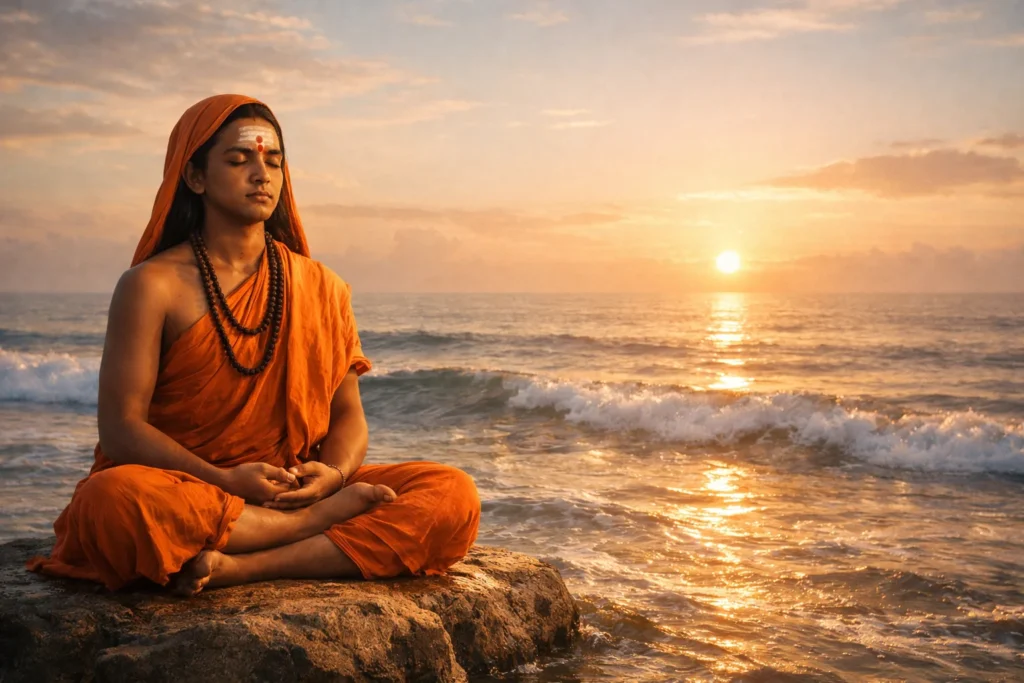
Shankara’s image for this is the ocean and its waves. A wave is real — it has shape, movement, force. But it has no substance of its own. Its substance is entirely the ocean. There is no wave-substance separate from ocean-substance. The wave is the ocean, temporarily appearing to have a distinct form.
So too with the individual self. You are real — you have thoughts, feelings, experiences, a distinct perspective on the world. But you have no substance of your own. Your substance is entirely Brahman. There is no Atman-substance separate from Brahman-substance. You are Brahman, temporarily appearing to have a distinct identity.
And liberation — Moksha — in Shankara’s system, is the direct, experiential recognition of this fact. Not a journey toward Brahman. Not a relationship with Brahman. Not even a merging with Brahman — because you were never separate from Brahman in the first place.
Liberation is simply the removal of the ignorance (avidya) that made you believe you were separate. Like waking from a dream: the dream ends not because you travel somewhere but because you recognise, suddenly and completely, that you were always awake.
In Shankara’s universe, the question “who are you?” has one answer, and only one: you are Brahman. The infinite consciousness that is the ground of all reality. You simply don’t know it yet.
III. The Second Man — Ramanuja and the Body of God
His name was Ramanujacharya. He lived in the 11th–12th centuries CE and was born in Sriperumbudur, Tamil Nadu — about forty kilometres from modern Chennai.
He lived to be approximately 120 years old. He walked to Kashmir and back. He was twice expelled from his home city of Srirangam by a king who disagreed with his philosophy. He established a tradition of temple worship, philosophical commentary, and devotional practice that still governs the great Vaishnava temples of South India — including the magnificent Ranganathaswamy Temple at Srirangam, one of the largest temple complexes in the world.
And he disagreed with Shankara. Profoundly. Systematically. In thousands of pages of Sanskrit philosophical prose.
Ramanuja’s philosophical position is called Vishishtadvaita Vedanta — qualified non-dual Vedanta. He accepted Shankara’s starting point — that Brahman is the ultimate reality, that the Upanishadic statement “That thou art” is literally true — but he rejected Shankara’s conclusion.
His objection was both philosophical and devotional, and understanding it requires understanding what was at stake for Ramanuja personally.
Shankara’s Advaita, for all its philosophical brilliance, has a problem. If Atman and Brahman are literally identical — if there is truly only one, undifferentiated consciousness — then devotion becomes impossible. You cannot love what you are. You cannot worship what you are.
The devotional relationship — the bhakti, the passionate, personal, heart-to-heart love between the individual soul and the divine — which Ramanuja considered not merely one path among many but the highest expression of the human-divine relationship, simply dissolves in the acid of pure non-dualism.
Ramanuja’s answer was to argue that the relationship between Atman and Brahman is real but of a specific kind: the relationship between a body and its soul.
💡 Key Concept: Vishishtadvaita — The Universe as God’s Body
In Ramanuja’s system, Brahman — whom he identifies with the personal God Vishnu/Narayana — is the ultimate reality. But Brahman is not the featureless, attributeless absolute of Shankara. Brahman has qualities — infinite knowledge, infinite bliss, infinite power, infinite love. And the universe — including all individual souls — is Brahman’s body. Just as your soul animates your body, Brahman animates the universe.
The universe is real. Individual souls are real. But they are real as modes of Brahman, parts of Brahman, the body through which Brahman acts and experiences. The relationship is one of inseparable unity — but unity that preserves real difference.
In Ramanuja’s universe, “That thou art” means not “you are identical to Brahman” but “you are a part of Brahman — a mode of Brahman’s being, as real and distinct as a limb of a body, but inseparable from and dependent on the whole.”
This preserves everything that Shankara’s system seemed to dissolve. The individual soul is real. God is real. The relationship between them — the devotional love, the prayer, the worship, the surrender — is real.
And liberation, in Ramanuja’s system, is not the dissolution of the individual into the infinite but the soul’s eternal, conscious, loving participation in the life of God.
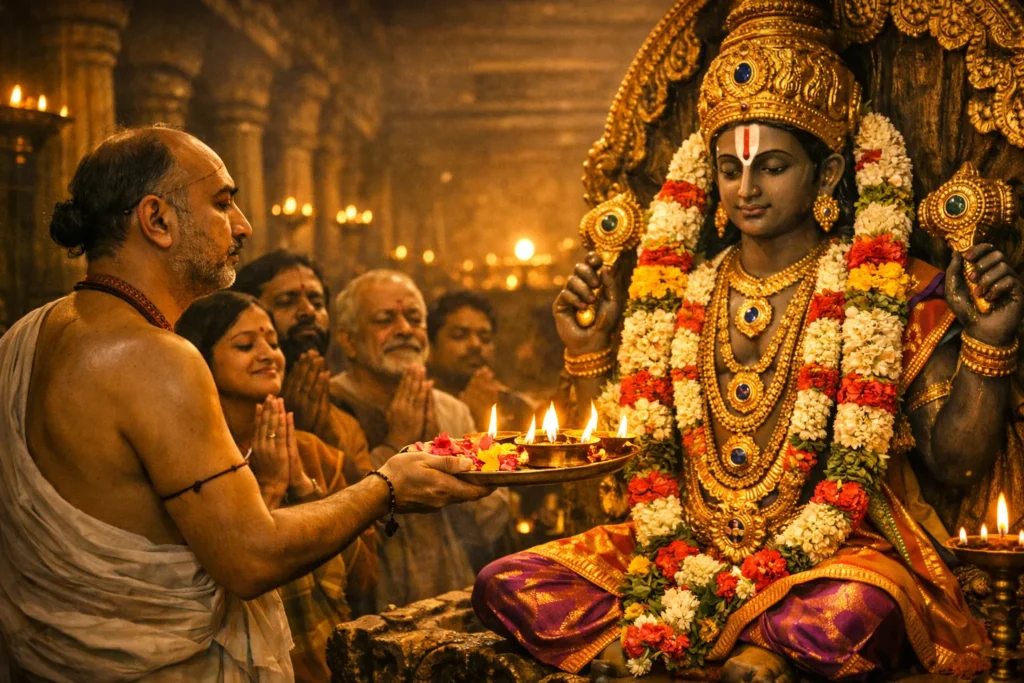
This is the philosophy that governs the great Vaishnava temples of South India — and it explains something that always strikes visitors to these temples: the extraordinary intimacy of the relationship between the deity and the devotee. The deity is bathed, fed, clothed, sung to, put to bed at night and woken in the morning. The priest serves the deity as one would serve a beloved lord — because in Ramanuja’s understanding, that is precisely what is happening.
The individual soul, in its proper nature, is a servant of God. And service, conscious and devoted and joyful, is liberation.
IV. The Third Man — Madhva and the Eternal Difference
His name was Madhvacharya. He lived in the 13th century CE and was born in Pajaka, near Udupi in coastal Karnataka.
He was, by all accounts, a man of extraordinary physical vitality — the tradition records that he could lift a temple chariot single-handed and swim the Malabar coast in conditions that defeated other swimmers. He established the Krishna temple at Udupi that still operates today under the system of worship he designed — eight mathas taking turns in a rotational management system that has functioned without interruption for nearly eight hundred years.
And he disagreed with both Shankara and Ramanuja.
Madhva’s philosophical position is called Dvaita Vedanta — dualist Vedanta. Dvaita means “two.” And Madhva’s answer to the question of the relationship between Atman and Brahman is the most straightforward of the three: they are different. Fundamentally, irreducibly, eternally different.
Madhva identified five eternal differences (pancha bheda) that he argued no philosophical sleight of hand could dissolve:
God and the individual soul — eternally different.God and matter — eternally different.Soul and matter — eternally different.One soul and another soul — eternally different.One piece of matter and another — eternally different.
This may sound like common sense — which is, in part, Madhva’s point. Shankara’s Advaita and Ramanuja’s Vishishtadvaita both require accepting that the apparent diversity of the world is in some sense unreal or subordinate to an underlying unity. Madhva refused this move.
The diversity is real. God is real. Souls are real. Matter is real. And the differences between them are not illusions to be dissolved or qualified differences to be understood — they are eternal facts about the nature of reality.
📜 From the Brahma Sutras commentary by Madhva
न च जीवस्य ब्रह्मैक्यं सम्भवति
Na cha jīvasya brahmaaikyam sambhavati
“The identity of the individual soul with Brahman is not possible.”
Madhva’s Brahma Sutra Bhashya — This single sentence is Madhva’s challenge to the entire Advaita tradition. His argument is not merely that identity is unproven but that it is impossible — that the very logic of consciousness, identity, and relationship requires distinction between the knower, the known, and the act of knowing.
A self that is identical to everything cannot know anything, because knowledge requires a distinction between the knower and the known.
For Madhva, liberation is not the dissolution of the self into Brahman, nor the self’s eternal participation in the body of God. It is the individual soul’s eternal, conscious enjoyment of the bliss of God — in the full awareness of being a separate being in the presence of an infinitely greater being. Like a musician in a great orchestra: fully themselves, fully distinct, and precisely because of that distinction, able to contribute something to the whole that only they can contribute.
V. Three Systems — Three Temples
Here is where philosophy becomes architecture.
The three philosophical systems of Shankara, Ramanuja, and Madhva did not remain abstractions in Sanskrit texts. They became institutions — monastic orders, temple networks, communities of practice, entire ways of organising religious and social life. And they shaped the temples of South India in ways that are still visible today, if you know what you are looking at.
The Shaiva temples — dedicated to Shiva, the great deity of the yogic tradition — tend to reflect the Advaitic sensibility. The Shiva lingam in the inner sanctum is not a personal deity to be served but a symbol of the formless absolute — Brahman itself, represented in its most elemental, attribute-free form. The ritual at a Shaiva temple has a quality of dissolution, of the worshipper’s self being absorbed into something vast and impersonal.
The great Chidambaram temple — where Shiva dances as Nataraja, the cosmic dancer whose movement is the universe itself — is a three-dimensional expression of Advaita philosophy. The dancing form is real. And behind it, in the most sacred inner sanctum, is the Chidambara Rahasyam — the secret of Chidambaram — which is a space of emptiness, a curtain of golden leaves, and nothing else. The formless absolute, present as pure space.
The Vaishnava temples — dedicated to Vishnu and his avatars, particularly Rama and Krishna — bear the unmistakable imprint of Ramanuja’s Vishishtadvaita. The deity in a Vaishnava temple is treated with an intimacy and a personal devotion that can feel startling to the uninitiated.
The temple at Srirangam, the greatest of all Vaishnava temples, is organised around the idea that the deity — Ranganatha, the reclining Vishnu — is literally present, living, receiving the care and attention of his devoted servants. The sixteen-step worship ritual (Shodashopachara puja) treats the deity as a living lord: he is woken in the morning, bathed, dressed, fed, entertained with music, put to rest at night. This is Ramanuja’s philosophy made ritual: the individual soul in its proper relationship with God — intimate, devoted, eternally joyful service.
The Madhva temples — concentrated particularly in the Udupi-Mangalore region of coastal Karnataka, centred on the Krishna Matha at Udupi — have their own distinctive character. The theology of radical difference expresses itself in a worship style of particular intentionality: God is wholly other, wholly greater, wholly beyond — and the soul’s proper response is not dissolution (as in Advaita) or loving participation (as in Vishishtadvaita) but reverent, joyful, absolute surrender to a being of infinite superiority.
VI. The Debate That Never Ended — And Why It Matters
Three men. One text. Three universes.
It would be tempting to treat this as a problem — a sign that the tradition failed to reach consensus, that one of the three must be right and the other two wrong, that the debate needs to be resolved before we can proceed.
But this would be to misunderstand what the debate is actually about — and to miss something important about the nature of the tradition that produced it.
The Vedantic debate between Shankara, Ramanuja, and Madhva is not a debate about facts that can be empirically verified or falsified. It is a debate about the nature of consciousness, selfhood, and ultimate reality — questions that, by their very nature, cannot be settled by external evidence. They can only be explored through the rigour of philosophical argument and the depth of direct experience.
And the tradition’s willingness to hold three incompatible answers to its most fundamental question — not by choosing one and suppressing the others, but by maintaining all three as living intellectual traditions, each with its own institutions, its own texts, its own practising communities — is itself a kind of answer.
An answer that says: reality is rich enough, deep enough, and complex enough that no single human formulation can fully capture it. That the diversity of philosophical perspectives is not a problem to be solved but a feature of genuine inquiry into genuine depth.
This is what the Rigveda said three thousand five hundred years ago: Ekam sat vipra bahudha vadanti. Truth is one. The wise call it by many names.
Shankara called it the ocean. Ramanuja called it the body. Madhva called it the beloved. Three names. One truth. A tradition capacious enough to hold all three.
VII. Walking Into the Debate
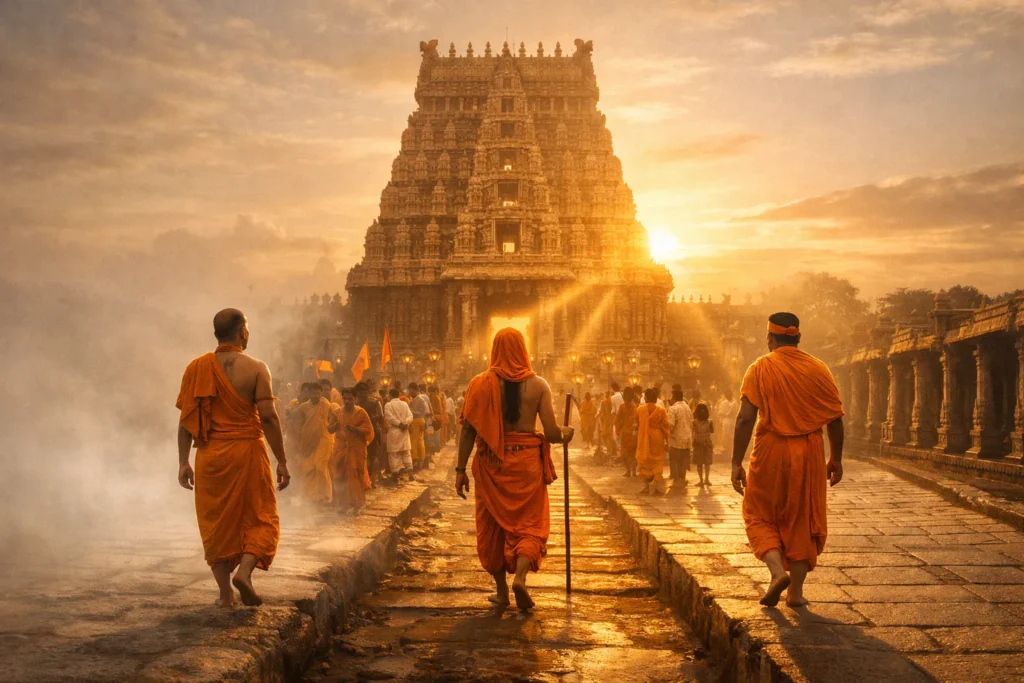
You are standing, once again, at the entrance of a South Indian temple.
But now you are standing with something you didn’t have before: a map of the philosophical territory that shaped what you are about to enter.
If the temple before you is a Shaiva temple — if the gopuram is crowned with the trident of Shiva, if the inner sanctum holds a lingam — you are entering Advaita territory. You are walking toward the formless absolute, represented in form. The ritual you are about to witness is an act of alignment with the infinite — a human being consciously dissolving the boundary between self and cosmos.
If the temple is a Vaishnava temple — if Vishnu reclines in splendour, if the priests sing the Divya Prabandham hymns of the Azhwars — you are entering Vishishtadvaita territory. You are walking toward the personal God, present and attentive and infinitely loving. The ritual you are about to witness is an act of devotion — a soul in its proper relationship with the divine ground of its being.
If the temple is a Madhva temple — if it is oriented toward Krishna in his absolute transcendence, if the worship has the character of total surrender to an infinitely greater reality — you are entering Dvaita territory. You are walking toward the wholly other, the God who is irreducibly different from you and precisely because of that difference, capable of being the object of your deepest love.
Three temples. Three philosophies. One tradition. One question.
Who are you?
VIII. Closing — The Bridge to What Comes Next
We have now established the complete philosophical foundation of The Sacred Trails.
What comes next is the human story — the story of how this philosophy became devotion, how devotion became poetry, and how poetry became temples.
In Blog 5, we meet the man who looked at a civilisation fragmenting into six competing religious traditions and saw not division but unity — and who built an institution that still governs how millions of Hindus organise their spiritual lives today. His name is Adi Shankaracharya — the same Shankara we met in this blog, now encountered not as a philosopher but as an institutional genius of the first order — and what he built is called the Shanmatham: the six-path tradition.
And then — through the saints, through the hymns, through the extraordinary devotional revolution that swept South India between the 6th and 10th centuries CE — we will arrive at last at the gates of the temples themselves. Ready to enter. Ready to truly see.
Next in the Sacred Foundations Series :
One Man Unified Six Warring Religions. How Adi Shankaracharya looked at a fragmented civilisation and built something that held it together — and why it still matters for every temple on The Sacred Trails.